


As healthcare systems worldwide grapple with rising administrative complexity, revenue cycle management (RCM) remains one of the most resource-intensive and fragmented functions. From eligibility verification and prior authorisations to claims processing and billing support, these workflows are often burdened by manual interventions, communication gaps, and inefficiencies that impact both financial outcomes and patient experience.
In response to these challenges, Cosentus has introduced Cosentus.ai, an AI-powered platform designed to automate high-volume, communication-driven RCM processes through voice-enabled, multilingual agents. By combining domain-specific intelligence with real-time contextual understanding, the platform aims to streamline interactions across patients, payers, and providers while ensuring accuracy, compliance, and scalability.
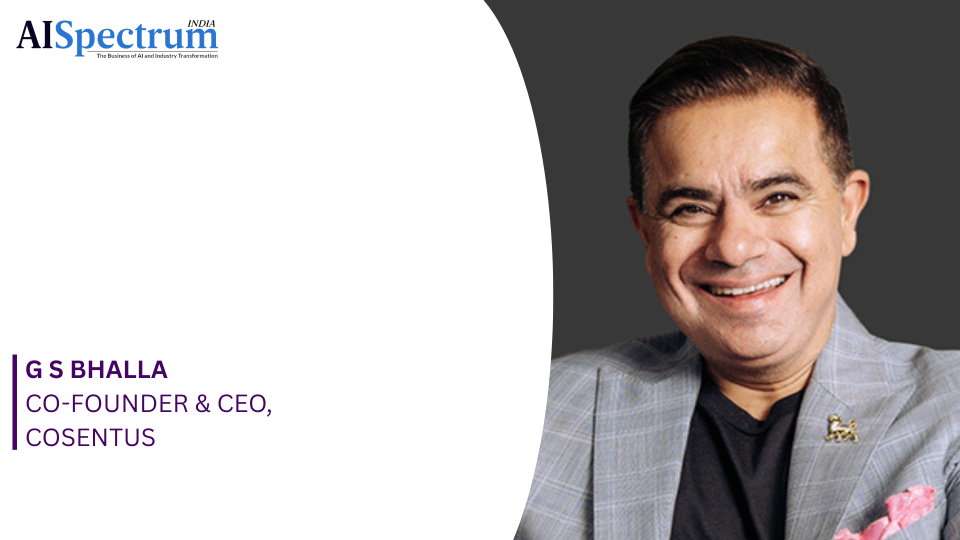
In this interview with AI Spectrum, GS Bhalla, Co-Founder & CEO of Cosentus, shares the vision behind Cosentus.ai and the operational gaps it seeks to address. He discusses the technological foundations enabling multilingual AI interactions, the importance of data security and regulatory compliance, and how the platform is scaling to handle thousands of daily interactions. Bhalla also offers insights into India’s growing role in shaping the future of AI-driven healthcare operations on a global stage.
With the launch of Cosentus.ai, what were the primary operational pain points in revenue cycle management that drove the development of this platform?
Revenue cycle management continues to be one of the most operationally intensive areas in healthcare, with a high volume of repetitive administrative interactions across patients, payers, and provider teams. Key challenges included fragmented communication workflows, delays in claim follow-ups, and the significant manual effort required for tasks such as eligibility verification, prior authorisations, and billing support. These inefficiencies not only impact financial performance but also affect the overall patient experience.
Cosentus.ai was developed to address these gaps by automating high-volume, communication-heavy workflows, enabling revenue cycle teams to operate more efficiently while allowing them to focus on more complex, judgment-based tasks.
Cosentus.ai leverages voice-enabled AI agents across multilingual workflows. What technical challenges did your team face in building AI that can seamlessly switch between over 30 languages in real time?
The 30 voices is available to us due to testing and choosing the best voice models to use. We’ve also trained our agents on the right queues to make sure they don’t keep switching back and forth. For example, there are some Spanish speakers who will use a small amount of English when they speak. In these cases, the agent will remain in Spanish mode to ensure a smooth conversation.
Had we not spent time choosing the right voice provider (for us it’s Elevenlabs, and specifically their premium models) then we wouldn’t have these capabilities.
How does Cosentus.ai ensure accuracy and contextual understanding when handling sensitive interactions such as insurance claims, billing queries, and prior authorisations?
Accuracy and context are built into how Cosentus.ai processes every interaction. The system is trained on domain-specific healthcare and RCM data, which helps it understand terminology, payer rules, and workflow nuances. It maintains context across the full interaction, not just individual queries. This ensures continuity when handling claims, billing questions, or prior authorisations.
There are also validation layers that cross-check inputs and outputs in real time. Structured workflows guide each step, reducing variability. Human-in-the-loop mechanisms are used for edge cases. This combination helps maintain high accuracy while keeping interactions reliable and compliant.
Given that the platform integrates with EMRs and practice management systems, how do you address data privacy, security, and compliance, especially across different geographies?
Data privacy and security are built into the core of Cosentus.ai. The platform follows a compliance-first approach, aligning with HIPAA and regional regulations. Data is encrypted in transit and at rest, with strict role-based access and audit trails to ensure control and traceability.
It also follows data minimisation principles, processing only what is necessary. For global deployments, the system adapts to local compliance requirements, with continuous monitoring and regular audits to maintain consistent standards across geographies.
Cosentus also maintains a strong ecosystem of technology partnerships, working with organisations including Microsoft, Cisco, Dell Technologies, and HP Inc. These collaborations support the development of enterprise-grade infrastructure and secure platforms that power the company’s AI-driven solutions.
Cosentus.ai is currently processing approximately 3,000 calls per day. What are the key factors enabling this scalability, and how do you maintain performance quality as volumes grow?
Scalability comes from an AI-first, modular architecture that can handle high volumes without linear increases in effort. Voice agents run in parallel, while workflows are standardised and automated across tasks like eligibility, follow-ups, and authorisations. This removes bottlenecks and keeps throughput consistent as volumes grow.
Performance quality is maintained through continuous monitoring and feedback loops. The system tracks outcomes in real time, with built-in validation layers to ensure accuracy. Models are regularly refined using interaction data, and edge cases are escalated through human oversight to maintain consistency and reliability.
As India strengthens its position in healthcare BPM and AI-driven services, how do you see the country contributing to the global evolution of AI-powered healthcare operations?
India is uniquely positioned to shape the next phase of AI-led healthcare operations. It combines deep experience in healthcare BPM with a strong talent base in AI, data, and engineering. This allows for building and scaling solutions that are both cost-efficient and operationally robust.
What stands out is the ability to operationalise AI at scale. India can move beyond services to creating globally relevant platforms, trained on diverse datasets and real-world workflows. This will play a key role in setting new benchmarks for efficiency, quality, and accessibility in healthcare operations worldwide.