

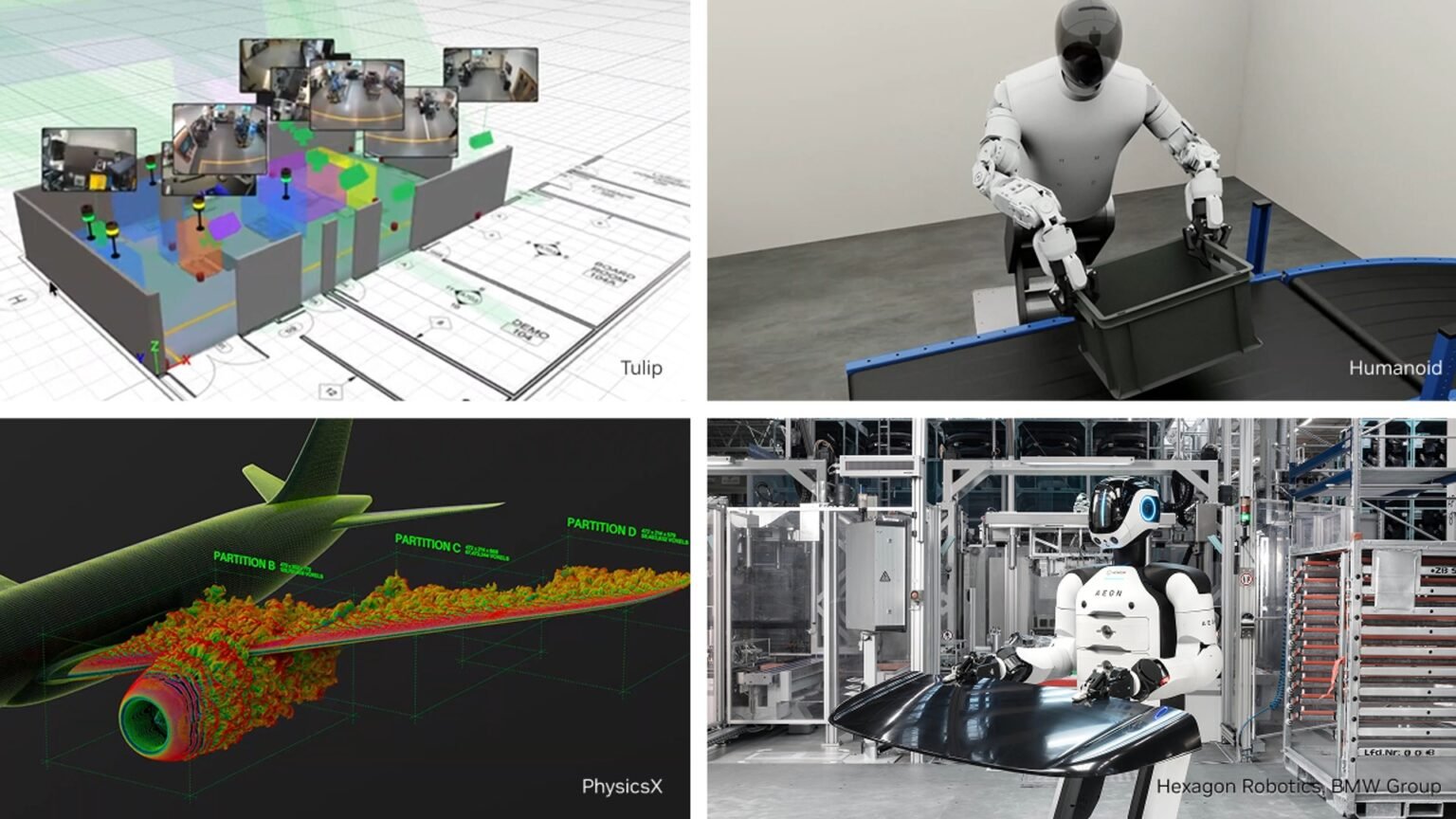
NVIDIA, along with its global ecosystem of partners, is highlighting the next phase of industrial transformation at Hannover Messe 2026, demonstrating how artificial intelligence is reshaping manufacturing across design, simulation, and production.
Held from April 20–24 in Hannover, the event is serving as a platform for showcasing AI-powered advancements ranging from real-time factory simulations and digital twins to robotics and agentic AI systems. The developments underscore a broader shift within the manufacturing sector, where AI adoption is rapidly becoming essential to meet demands for faster design cycles, leaner operations, and reduced reliance on skilled labour.
At the core of this transformation is the emergence of large-scale AI infrastructure. A key highlight is the Industrial AI Cloud, developed in Germany by Deutsche Telekom using NVIDIA’s AI stack. Positioned as one of Europe’s largest AI factories, the platform offers a secure and scalable foundation for deploying AI and robotics across industrial operations.
Several industry players, including Siemens, SAP, Agile Robots, Wandelbots and PhysicsX, are leveraging this infrastructure to run AI-driven workloads such as real-time simulation, factory-scale digital twins, and software-defined robotics. Engineering services provider EDAG has also announced the deployment of its industrial metaverse platform on the cloud, extending AI capabilities to automotive and industrial engineering.
To meet growing infrastructure demands, companies including Dell Technologies, IBM, Lenovo and PNY are showcasing NVIDIA-accelerated systems designed to support AI applications from edge computing to large-scale data centres.
AI is also redefining engineering workflows. Software leaders such as Cadence Design Systems, Dassault Systèmes and Synopsys are integrating NVIDIA technologies—including CUDA-X, AI physics models, and Omniverse libraries—into their platforms. These integrations enable real-time, physics-based simulations and AI-assisted design processes, allowing engineers to explore and validate complex systems more efficiently.
Digital twin technology is another major focus area at the event. Companies such as ABB, Kongsberg Digital and Siemens are demonstrating how virtual replicas of factories and infrastructure can be used to simulate operations, optimise performance, and predict potential issues before implementation in the physical world.
Meanwhile, Microsoft is showcasing integrations between NVIDIA Omniverse and its cloud platforms, including Azure and Fabric, enabling real-time, physically accurate simulations and accelerating the deployment of autonomous systems and robotics.
The demonstrations at Hannover Messe highlight how AI is moving beyond experimentation to large-scale industrial deployment. From intelligent design and simulation to autonomous operations, NVIDIA and its partners are illustrating how the “factory of the future” is rapidly becoming a present-day reality.