


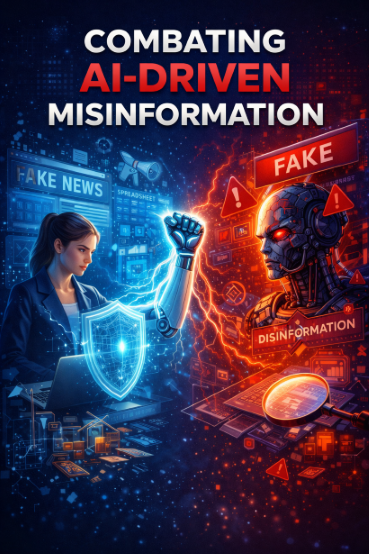
Combating AI-Driven Misinformation: Global Strategies and B2B Implications
The World Economic Forum’s Global Risks Report 2026 ranks misinformation and disinformation—amplified by artificial intelligence—as the second-highest global risk over the next two years, just behind geoeconomic confrontation.
AI technologies now enable the rapid creation and spread of deepfakes, synthetic media, automated bots, and hyper-targeted propaganda, threatening public trust, business stability, and even democratic processes. Here’s how leading nations and organizations are responding, and what B2B stakeholders need to know.
Regulatory Frameworks & Platform Accountability
Governments are enacting new laws to hold tech platforms, AI developers, and content creators accountable for AI-generated content. Key measures include mandatory labelling, transparency requirements, and significant penalties for non-compliance.
European Union (EU): The EU leads with the AI Act (effective 2024, major provisions in 2026), classifying high-risk AI systems and mandating transparency and risk assessments. The Digital Services Act (DSA) requires platforms to mitigate disinformation, with fines up to 6% of global turnover. The EU is also establishing a Centre for Democratic Resilience to coordinate against foreign AI-driven interference and strengthening supply chain security through NIS2 and the Cyber Resilience Act.
United States: The U.S. approach is more fragmented but enforcement-driven. Federal agencies have disrupted foreign AI-powered bot farms, while states like California, Colorado, and Illinois are enacting their own AI transparency and risk laws. Federal efforts include new cyber incident reporting regulations and ongoing debates over national AI policy and export controls.
China: China’s AI Safety Governance Framework (2024) mandates watermarking and metadata for AI-generated content, with a focus on centralized state oversight. The amended Cybersecurity Law (2026) further addresses AI risks.
United Kingdom: The Online Safety Act (2024, with 2026 enforcement) places responsibility on platforms to mitigate AI harms, including deepfakes, and updates criminal laws to address impersonation.
Other Regions: Australia, Taiwan, Malaysia, Chile, and Mexico are also advancing AI-specific regulations, particularly targeting deepfakes and election-related disinformation.
Technological Safeguards & Detection Tools
Nations are investing in AI-powered tools to detect and counteract AI-driven threats in real time.
-
- U.S. & Allies: The U.S. Department of Justice and partners like Canada and the Netherlands use AI to disrupt foreign bot farms. Social media platforms are encouraged to deploy AI for automated anomaly detection, supported by human review. NATO’s updated AI strategy promotes allied technology sharing.
- EU & Global: The EU’s draft Code of Practice on AI-generated content calls for real-time monitoring centres. UN initiatives, such as DPI Safeguards, use AI to map harmful narratives, with pilots in Kenya and Costa Rica.
- China: China enforces mandatory watermarking and VR-based labeling for AI-generated content.
- Education & Resilience-Building
Building societal resilience is crucial to countering the psychological impact of AI-driven disinformation.
- United States: Programs like WISE (Wellness and Independence in the Social Media Era) teach cognitive security skills. There are calls for broader public education on AI fraud and manipulation.
- European Union: The EU emphasizes critical thinking and epistemic skills in its disinformation strategies, with proposals for national institutions to foster long-term resilience.
- Global: International IDEA and Africa’s THRAETS project are enhancing investigative capacity and information resilience worldwide.
- International Cooperation
Multilateral efforts are accelerating, though geopolitical tensions remain a challenge.
- UN & G20: The UN’s Global Risk Report and India’s 2026 AI Impact Summit highlight the need for inclusive, youth-led AI monitoring and global safety standards.
- NATO & Bilateral Initiatives: Focus on AI threats in information operations and increased global cyber-crime cooperation.
Who’s Leading?
- EU: The EU stands out for regulatory depth and enforcement, with the AI Act influencing global standards.
- U.S.: The U.S. leads in enforcement and innovation but faces challenges from fragmented federal policy.
- China: China excels in rapid, state-controlled implementation, prioritizing censorship over transparency.
- UK & Australia: These countries bridge EU-style regulation with U.S. flexibility.
- Emerging Leaders: India and African nations are advancing context-specific resilience for developing regions.
Key Takeaways For Our Reader from AISpectrum:
- Compliance is critical: Stay ahead of evolving regulations in your operating regions.
- Invest in detection: Leverage AI-powered tools to monitor and authenticate content.
- Build resilience: Foster media literacy and critical thinking within your organization.
- Engage globally: Participate in international forums and adopt best practices from leading markets.
The fight against AI-driven misinformation is ongoing. Success will depend on balancing innovation with robust safeguards—without stifling free speech or business growth.