


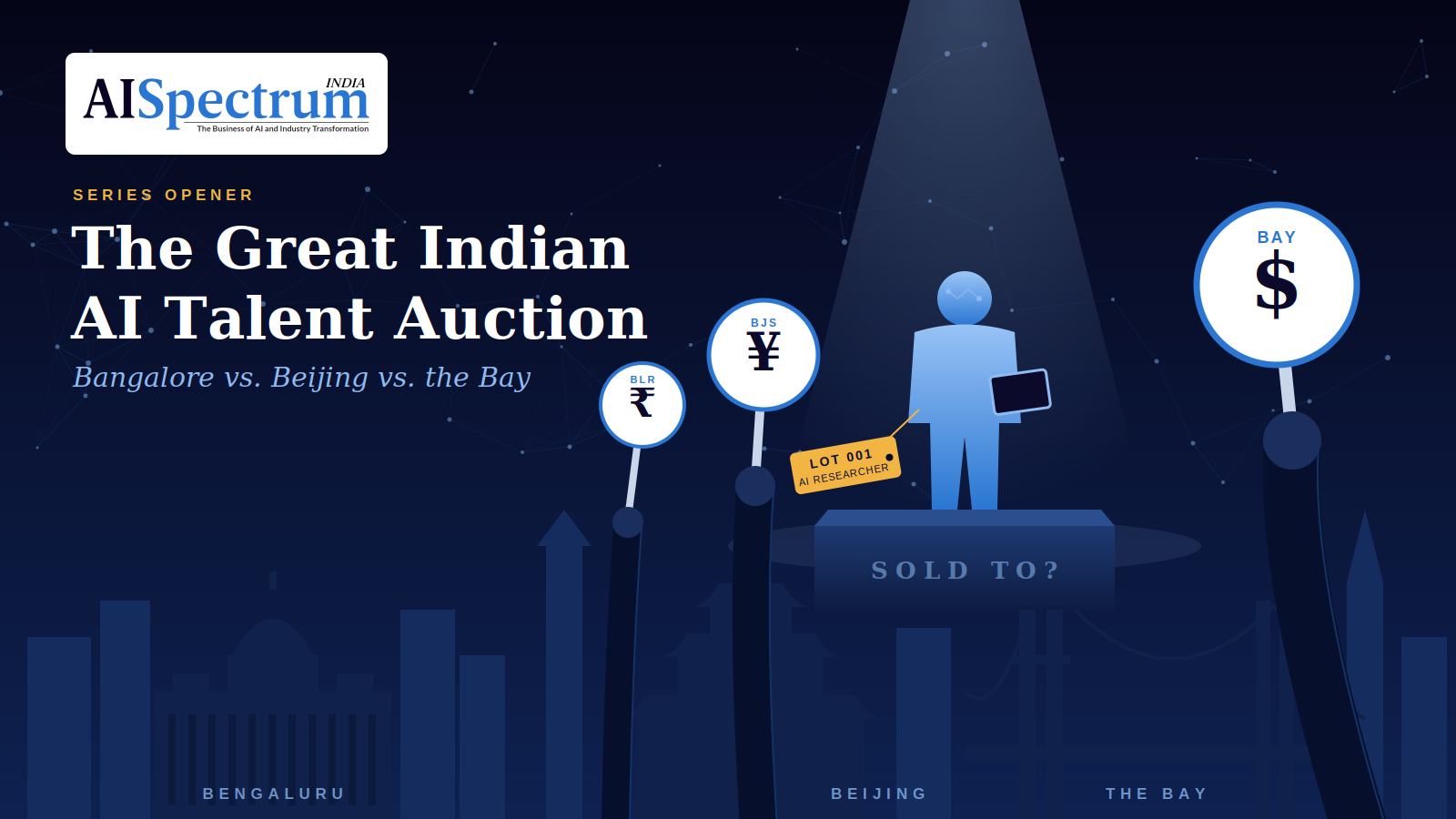
India produces more AI-capable engineers than any country on earth and keeps a shrinking fraction of the best of them. AI Spectrum India prices the auction, audits the homecoming story, and asks the question policy keeps stepping around: restrict, tax, or celebrate?
Two numbers arrived in the same report in April, and they have been arguing with each other ever since.
The first came from Stanford University's AI Index 2026. Using talent data from the analytics firm Zeki, it ranked India second in the world for top AI authors and inventors in 2025, with 50,460 people, behind only the United States at 220,520 and just ahead of Germany at 48,520. On LinkedIn's measure of relative AI skill penetration, India led the world outright, with AI skills showing up on Indian profiles at three times the global average.
The second number came from the same report. In 2025 India recorded a net AI talent migration score of minus 16.9, the largest outflow of any country in the dataset and more than double Canada's minus 7.1. The country with the second deepest bench of AI researchers on the planet was also the one losing them fastest.
Then, in June, the Ministry of Education added a third number. The Prime Minister Research Chair (PMRC) Scheme opened applications for Indian-origin researchers abroad, with packages reported at up to ₹4 crore for Young Research Fellows, ₹6.5 crore for Senior Research Fellows and ₹14 crore for Research Chairs, covering fellowship pay, a research grant, relocation and allowances for up to five years. It is the most generous repatriation offer the Indian state has ever made.
At roughly ₹96 to the US dollar, the rate on 28 September 2026, that top-tier ₹14 crore works out to about US$1.46 million, spread across as many as five years and including the cost of the research itself. Levels.fyi-based compensation analyses put the median total pay of a research scientist at OpenAI at around US$1 million a year. The best offer the Republic of India can make, for half a decade of a senior scientist's working life, buys roughly eighteen months of what the market pays for the same person.
That gap is the auction. This series is about who is bidding, what the lots actually sell for, and whether India should keep standing at the back of the room with a paddle it cannot afford to raise.
The conflict at the heart of it is not a simple one. On one side sits human-capital nationalism: the argument that a country which subsidises the education of its best engineers has a claim on their output. On the other sits the open market for what is now the most valuable labour in the world, and the equally serious argument that talent is not a natural resource to be fenced in. Both positions have a case. Neither has the data it needs. Over five parts, AI Spectrum India intends to supply some of it.
The auction, priced
Start with the top of the market, because it sets the reference price for everyone below it.
Frontier-lab compensation now runs in a band of its own. Recruiter analyses published this year put total pay at OpenAI and Anthropic at roughly US$250,000 at entry, rising to well over US$1.2 million at the top of the engineering ladder, with research scientists a tier above that. One Levels.fyi-based breakdown puts OpenAI research scientists between US$771,000 and US$1.47 million in total compensation. Equity makes up the majority of those packages, which is worth remembering before anyone treats the headline as cash.
Above the band sit the named hires. Meta's 2025 campaign to staff its Superintelligence Labs reset what the industry believes a single researcher can be worth, with reported offers running into nine figures for a handful of individuals, including a package the Wall Street Journal reported at roughly US$1.5 billion over six years for Thinking Machines Lab co-founder Andrew Tulloch. The research group Epoch AI has estimated that a superstar frontier researcher may be worth more than US$30 million a year to a lab chasing a prize of that scale. Whatever one thinks of the arithmetic, the labs are acting on it.
Now come down to Bengaluru. Mid-2026 benchmarks for global capability centres (GCCs) in the city put AI engineers at ₹48 lakh to ₹72 lakh at senior level and ₹78 lakh to ₹1.2 crore at lead and principal level. The top of that range, converted, is about US$125,000. A senior engineer at OpenAI on the standard L5 band, reported at around US$1.15 million, earns roughly nine times as much. Frontier Indian model builders sit below the GCC line in cash: one hiring platform's 2026 survey puts freshers at companies such as Sarvam and Krutrim at ₹18 lakh to ₹32 lakh, with ESOPs making up the difference on paper.
The state's best offer, for five years of a senior scientist's working life, buys roughly eighteen months of what the market pays.
Which brings us to the phrase that titles the first instalment of this series: the US$1 million fresher. It is a provocation, and it deserves an honest correction up front. The fresher who commands that kind of money is almost never a B.Tech graduate at a campus placement table. The highest verified offers of the 2025 to 2026 IIT placement season were ₹2.5 crore from Optiver to a computer science student at IIT Hyderabad, for a role in the Netherlands, and ₹2.44 crore at IIT Kharagpur, where the ₹1 crore-plus band was dominated by quant trading houses and data-infrastructure companies such as Da Vinci, NK Securities, IMC Trading, Databricks and Glean. Those are extraordinary numbers. They are also roughly a quarter of a million dollars, and they come mostly from trading desks, not frontier labs.
The real US$1 million fresher is a freshly minted PhD, or a researcher two or three years out with a strong publication record at venues such as NeurIPS. That is a pool of a few thousand people, not the millions India's skilling statistics describe. It is also the pool that matters most, because it is the one from which foundation-model teams, research labs and deep-technology founders are drawn.
For a sense of scale on the domestic side, one advisory's 2025 compilation puts a typical Indian Series A at US$8 million to US$15 million, and Tracxn's data shows fewer companies raising Series A rounds each year as capital concentrates in larger cheques. A four-year frontier-lab package for a senior researcher at around US$1 million a year already rivals the smaller end of that range. For the named hires, a single employment contract can exceed the entire round of the Indian start-up that hoped to hire the same person.
The PhD pipeline leak
If the top of the market is where the money is, the doctoral pipeline is where the supply problem starts.
NITI Aayog, as reported by University World News this month, estimates that India produces fewer than 500 AI-related PhDs a year and that nearly 44 per cent of the country's top AI researchers work abroad. It also names the reason plainly: government pay scales in fields such as AI cannot compete with private-sector offers, so many PhD graduates head for industry, at home or overseas.
The shortfall compounds at the faculty level. Pankaj Mittal, secretary general of the Association of Indian Universities, has said the number of academics with deep, specialised expertise in advanced AI is still limited. Former IIT Delhi professor V Ramgopal Rao has pointed to the difficulty premier institutes face in recruiting and retaining skilled faculty. Rahul Choudaha of DrEducation Research put the diagnosis in a sentence: India is a source country for AI talent, but not yet a strong retention destination for its own talent. Fewer faculty means fewer supervisors, which means fewer PhDs, which means fewer faculty a decade on. The loop is slow and it is self-reinforcing.
Underneath it all sits the national research budget. The Economic Survey 2025 to 26 puts India's gross expenditure on research and development at 0.64 per cent of GDP, against 3.48 per cent for the United States, 2.43 per cent for China and 4.91 per cent for South Korea. Compute is the sharper edge of that gap. Advanced AI research needs large GPU clusters and high-quality datasets, and while those are routine inside well-funded companies, most Indian universities still lack them. A doctoral student who wants to train a model at meaningful scale often has to leave the university to do it.
What nobody has is the one dataset that would settle the argument: a five-year retention record for AI doctoral graduates from India's top institutions. We know roughly how many graduate. We do not know, cohort by cohort, where they are now. Part 2 of this series sets out to build that record with the cooperation of IISc and IIT departments, tracking recent AI and machine-learning PhD cohorts into six destinations: Indian academia, Indian industry research labs, GCCs, Indian start-ups, academia abroad and industry abroad. If the leak is as large as the anecdote suggests, the numbers will show it. If it is not, that will be a story too.
Reverse brain drain, audited
Every few months, a homecoming story travels across Indian technology media. This year's most prominent was Shyamal Anadkat, who spent nearly four years at OpenAI leading its Applied Evals team before leaving Silicon Valley for India. Stories like his are real, and they matter, because returnees carry networks, standards and ambition that are hard to import any other way. The question is whether they describe a trend or a highlight reel.
Stanford's own report cuts both ways. It describes India as being in the process of shifting from a net exporter of AI talent towards a net absorber. Yet it also records India's minus 16.9 for 2025, the worst outflow in its dataset. The two statements can both be true only if the shift is early and driven by something other than India's own pull. The report points to that something: the number of AI researchers and developers moving to the United States has fallen 89 per cent since 2017, with an 80 per cent drop in the last year alone. As ThePrint's reading of the report put it, Indian talent may be starting to stay home not because India has fixed its structural weaknesses, but because America has become harder to reach.
Washington has spent the year making it harder still. The US$100,000 payment on certain new H-1B petitions, introduced in September 2025, was struck down by a federal court on 8 June 2026, and an appeals court declined in July to revive it while the case proceeds. On 18 September, a new presidential proclamation extended the requirement to 21 September 2027 while the litigation continues. Indian nationals accounted for close to 70 per cent of approved H-1B petitions in fiscal 2025.
A US$100,000 fee is a rounding error on a US$1 million researcher. It filters the middle of the market, not the top.
Here is the part of the debate that tends to get lost. A US$100,000 fee is a rounding error on a US$1 million researcher. A frontier lab that wants a particular scientist will pay it without a second meeting. What the fee does filter is the middle of the market: the mid-career engineer whose value to a US employer is real but not unique. So if returns rise, the returnees may skew towards exactly the tier India already retains reasonably well, while the frontier tier keeps leaving on terms the fee barely touches. Push is not the same as pull, and a homecoming produced by a closed door abroad is more fragile than one produced by an open door at home.
The United States is also no longer the only destination. A 2026 analysis by the European think tank interface, tracking more than 1.6 million technical AI professionals, found Indian-trained talent growing as a share of the AI workforce in every major destination it studied, a trend it expects the January 2026 India and EU free trade agreement and its mobility framework to accelerate. Gulf states are bidding too. When the United States closes one door, the auction does not end. It changes venue.
Part 3 will test the returnee narrative against three kinds of evidence: visa and immigration flows, LinkedIn cohort analysis of Indian-origin researchers at leading labs, and interviews with founders who came back. It will also apply a stricter definition than the anecdotes do. A researcher who moves to Bengaluru but remains on a US employer's payroll, a founder who returns with a Delaware parent company, and a scientist who relocates to lead a lab at an Indian institution are three very different outcomes. Only one of them is unambiguously a return.
The GCC vacuum
The most counterintuitive part of this story is that the biggest bidder for Indian AI talent may not be abroad at all.
The Nasscom and Zinnov GCC Landscape Report 2026 counts 2,117 global capability centres in India, employing 2.36 million people and generating about US$98.4 billion in revenue in FY2026. It names India the world's number one AI hiring market. More than 1,200 of those centres have embedded AI and machine-learning capability, supported by over 250 dedicated centres of excellence and a talent base of around 250,000 AI professionals. Nearly half of all GCCs established since FY2021 were set up with AI as a core focus from the start. One advisory's research across more than 200 GCC engagements projects GCC salary increments of about 11.5 per cent in 2026, against an India Inc average of 9.1 per cent.
A claim now common in founder circles holds that GCCs outbid Indian start-ups for the same talent by three to four times. On the published benchmarks, that claim does not hold as an average. Across the market, funded AI start-ups and GCCs pay within shouting distance of each other in cash at senior levels. One 2026 survey puts senior engineers at frontier Indian AI start-ups at ₹45 lakh to ₹70 lakh plus ESOPs, against ₹35 lakh to ₹55 lakh for a GCC machine-learning engineer with four years of experience.
The multiple opens up somewhere more specific. It appears at seed and early Series A, where a founder's cash budget for a senior hire is thin and the offer is mostly illiquid equity. And it appears for scarce senior specialists, where a GCC can pay in liquid stock of a listed global parent while a start-up can only offer paper. That narrower version of the claim is the one this series will test, using real offer letters gathered through executive-search firms rather than published salary ranges.
Even if the cash gap turns out to be narrower than the brief assumed, the structural point survives. GCCs retain talent in India's geography while exporting its output. The engineer stays in Hyderabad; the intellectual property, the product roadmap and most of the upside accrue to a parent company elsewhere. That is not a criticism of GCCs, which are among the best things to happen to Indian technology employment in a decade. It is a description of a ceiling. A country can run everyone else's AI beautifully and still own very little of the AI that matters most.
There is an early signal worth watching, too. The same Nasscom and Zinnov data, as summarised by one GCC index, records a 28 per cent fall in GCC hiring volumes between the first and second halves of FY2026, as centres redeployed staff and leaned on AI-supported delivery. If the largest domestic buyer of AI talent starts buying less, the pressure on the top tier to look abroad could rise again, not fall.
Bangalore vs. Beijing vs. the Bay
The strapline of this series names three cities, and the comparison with Beijing is the most uncomfortable of the three.
China produces elite AI talent at a scale India does not yet match, but the more important difference is what happens next. An analysis of NeurIPS authors by researchers Ma and Yang found that 57 per cent of elite AI researchers in 2025 held undergraduate degrees from China, against 13 per cent from the United States. A Carnegie China study reported this month that 41 per cent of the world's top AI researchers were hired by Chinese companies in 2025, up from 27 per cent three years earlier, with firms such as DeepSeek and Moonshot AI offering pay on par with Silicon Valley.
The lesson is not that China found a better recall programme, though it ran the most aggressive one of the past two decades. It is that China built domestic companies doing frontier work, and those companies became bidders in the auction. Indian talent, by contrast, overwhelmingly works for foreign firms whether it leaves the country or not. The Bay bids from California. It also bids from Bengaluru, through its GCCs and research labs. Beijing bids mostly from Beijing. Bangalore, as a buyer of frontier research talent rather than a supplier of it, has barely entered the room.
Restrict, tax, or celebrate?
Which brings us to the policy question, one the historical record answers more clearly than the current debate admits.
Restriction has the weakest record. Service bonds and exit conditions exist in parts of Indian medical education, but for globally mobile researchers, restriction mostly relocates the problem. Talent that cannot leave as an employee tends to leave as a founder, incorporating abroad and hiring Indians remotely. The frontier researcher, the one person restriction would actually target, is also the person best equipped to route around it.
Taxation has a more interesting intellectual history. In the 1970s, the economist Jagdish Bhagwati proposed that countries be allowed to tax the foreign income of their skilled emigrants, returning a share of the gains to the society that trained them. The idea has never been implemented at scale, largely because it requires tax co-operation from destination countries and runs into obvious enforcement limits. A softer variant, asking graduates of heavily subsidised public institutions to repay part of that subsidy if they emigrate within a set period, surfaces periodically in Indian debate. It would raise little money, and critics argue it would mostly signal that India views its graduates as a liability to be recovered rather than a network to be cultivated.
Recall is where the comparators are richest. China's Thousand Talents Plan, launched in 2008, is estimated in a 2019 US Senate report to have recruited around 7,000 high-tech researchers, supported by housing, grants and prestige, before being folded into lower-profile successors such as the Qiming programme, which Reuters reported in 2023 was offering signing bonuses of three to five million yuan. South Korea, which pioneered returnee recruitment in the 1960s, is still fighting the same battle: it recorded a net loss of 0.36 AI experts per 10,000 people in 2024, and its science ministry earmarked about KRW 115 billion in 2026 to bring roughly 130 overseas postdoctoral researchers home, alongside a new programme in July 2026 to repatriate 20 teams of AI and deep-technology specialists. India's PMRC, by comparison, targets 120 fellows over five years across 13 priority sectors, with a reported overall budget of about ₹200 crore. AI is one of those thirteen. The scale mismatch with China's effort is two orders of magnitude.
Then there is celebration, the option most often dismissed as doing nothing. Israel is the case that complicates that dismissal. Its government seeded a domestic venture capital industry through the Yozma programme in 1993, and it spends a larger share of GDP on research and development than almost any other country. The result is an ecosystem in which frontier technical work happens locally, multinational research centres compete for the same people as domestic start-ups, and emigrants remain tied to a home market they can return to without a career penalty. Israel did not stop its talent from travelling. It made staying and returning competitive.
The price India has to match is not only the salary. It is the problem worth working on.
Set side by side, the comparators suggest the policy question may be slightly mis-posed. Restrict, tax and celebrate are all ways of acting on the seller. The countries that changed their position in the auction did it by adding a credible domestic buyer: a lab, a company or an institution doing work hard enough and well funded enough that the best people want to do it at home. China's frontier firms, Israel's research-dense ecosystem and, belatedly, Korea's lab-funding push all point the same way. The price India has to match is not only the salary. It is the problem worth working on, and the compute, colleagues and capital needed to work on it.
India has begun to assemble some of those pieces, from national compute capacity under the IndiaAI Mission to the new generation of domestic model builders. Whether those efforts add up to a real bidder, or remain a well-intentioned reserve price nobody meets, is the question this series will keep asking.
What the series will do
Over the coming instalments, AI Spectrum India will publish the data spine this debate has lacked: compensation benchmarks from GCC offer letters to frontier-lab packages; doctoral-output and five-year retention records built with department cooperation; LinkedIn cohort tracking of Indian-origin researchers; GCC hiring data; and a comparative record of national talent policy. We will speak to AI faculty and deans at IISc and the IITs, lab leadership at Google DeepMind India and Microsoft Research India, start-up founders, executive-search firms, returnee researchers and NITI Aayog.
Every figure we publish will carry its source and its date. Where two datasets disagree, we will publish both and explain why, rather than averaging them into false precision. Every organisation we assess will be offered the right of reply before publication. And we will not pretend the answer is obvious. India is simultaneously the world's largest exporter of AI talent and one of its fastest-growing employers of it. The auction is already under way. The only open question is whether India intends to keep selling, or learn how to bid.
|
THE AUCTION IN NUMBERS |
|
|
50,460 |
Top AI authors and inventors in India, 2025; second only to the US (Stanford AI Index 2026, Zeki data) |
|
-16.9 |
India's net AI talent migration score, 2025; the largest outflow of any country (Stanford AI Index 2026) |
|
< 500 |
AI-related PhDs India produces a year (NITI Aayog, via University World News, Sept 2026) |
|
44% |
Share of India's top AI researchers working abroad (NITI Aayog, same source) |
|
~US$1M |
Median total pay, OpenAI research scientist (Levels.fyi-based analysis, 2026) |
|
₹78L to ₹1.2 cr |
AI engineer pay at lead/principal level, Bengaluru GCCs (mid-2026 benchmark) |
|
₹14 cr |
Top PMRC Research Chair package, up to five years, including research grant (reported) |
|
2,117 |
GCCs in India, employing 2.36 million people (Nasscom and Zinnov, FY2026) |
|
0.64% |
India's R&D spend as a share of GDP (Economic Survey 2025 to 26) |
Currency converted at ₹96 to US$1, the approximate rate on 28 September 2026. Frontier-lab figures are total compensation including equity at paper value.
|
THE SERIES |
||
|
1 |
The $1M Fresher |
Global compensation data for Indian AI researchers, from GCC packages to frontier-lab offers. The auction, priced. |
|
2 |
The PhD Pipeline Leak |
IISc and IIT AI doctoral output against five-year retention, from an original tracking dataset built with department cooperation. |
|
3 |
Reverse Brain Drain, Audited |
The returnee narrative tested against visa data, LinkedIn cohort analysis and founder interviews. How much is real. |
|
4 |
The GCC Vacuum |
Where GCCs outbid Indian start-ups for the same talent, by how much, and what that does to the domestic ecosystem's ceiling. |
|
5 |
Restrict, Tax, or Celebrate? |
Policy options set against China's Thousand Talents, Israel's ecosystem lock-in and Korea's returnee programmes. Whitepaper anchor. |