

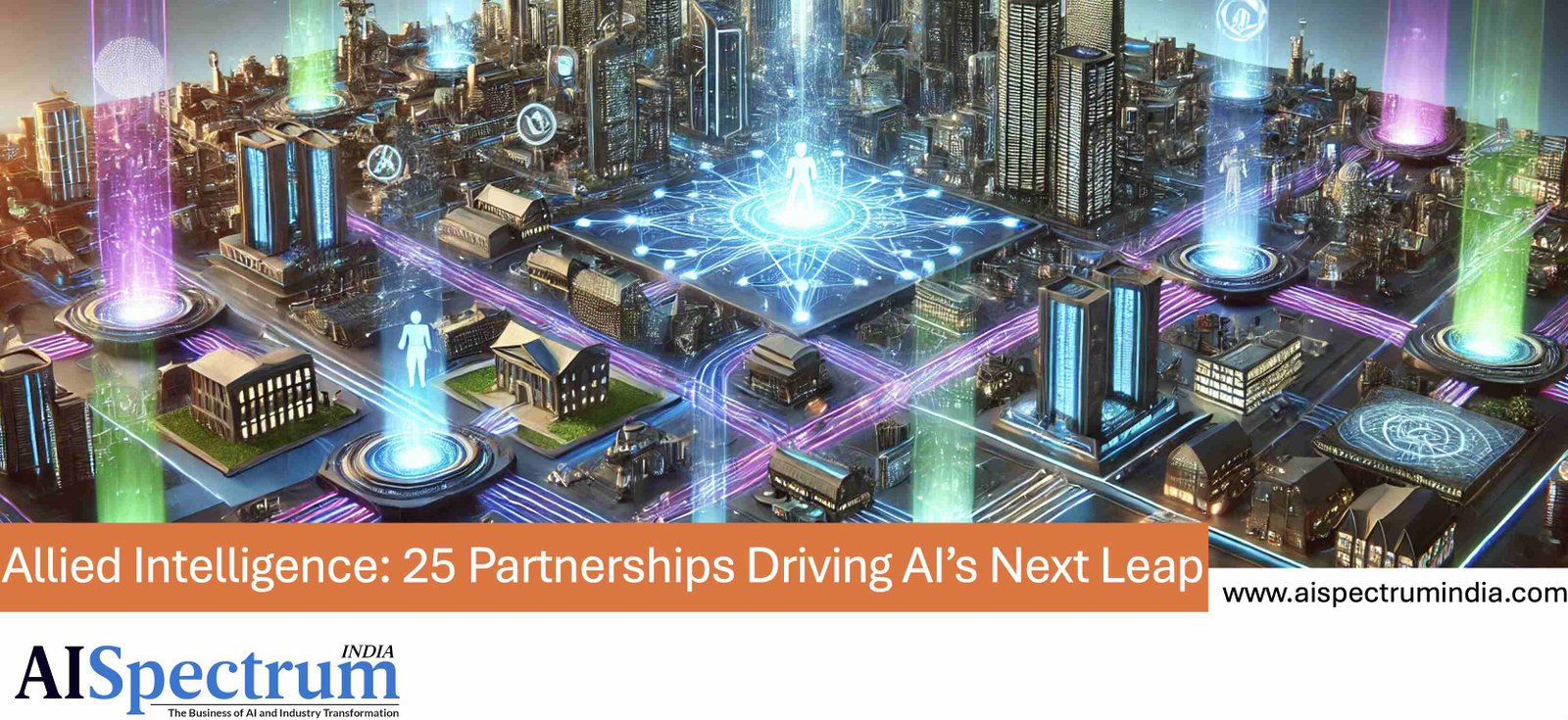
From tech giants partnering with nimble AI startups to industry incumbents teaming up with academia and government, collaborative ventures are reshaping competitive advantages across sectors. This report profiles 25 of the most significant AI collaborations active or announced in 2025. Each partnership demonstrates how combining strengths – be it data, technology, or industry expertise – is unlocking new revenue streams and transforming operating models in B2B domains like finance, healthcare, logistics, manufacturing, energy, and professional services.
Introduction: The Power of AI Partnerships
No single company can master the full AI stack or address every use-case alone. Thus, 2025 has seen a surge in strategic alliances where organizations pool resources to accelerate AI breakthroughs. These collaborations take many forms, including:
- Tech Titans + AI Startups: Large firms secure cutting-edge models and talent, while startups gain scale and validation. For example, Amazon, Google, and Microsoft have all invested billions in AI innovators to integrate their models into cloud platforms and products.
- Enterprise + Cloud Providers: Industry leaders in finance, healthcare, or manufacturing partner with cloud/AI providers to develop domain-specific solutions, combining deep industry data with AI prowess.
- Consortia and Public-Private Efforts: Governments, academia, and companies co-create AI infrastructure (e.g. massive AI supercomputers or open standards) to benefit entire ecosystems.
The following collaboration profiles are grouped by industry and impact area. A summary table is provided at the end for quick reference. All collaborations highlight strategic value, whether improving productivity with generative AI, speeding up R&D, or enabling entirely new AI-driven services.
Tech Titans and AI Startups: Generative AI Alliances
Microsoft & OpenAI – Generative AI at Enterprise Scale
Collaborators: Microsoft (Azure) and OpenAI
Scope: Long-term partnership (since 2019, expanded in 2023) to co-develop and deploy generative AI at scale. Microsoft invested billions and integrated OpenAI’s GPT-4 and DALL·E models into Azure cloud and products like Office 365 Copilot.
Technologies: Large Language Models (GPT-4), generative image AI, Codex (for code).
Industries Impacted: Cross-industry – from software development (GitHub Copilot) to professional services (e.g. PwC using Azure OpenAI) and knowledge work productivity.
Strategic Value: Microsoft gains a cutting-edge AI arsenal and Azure cloud demand, while OpenAI gains funding and enterprise-grade deployment. The alliance has “transformed the way [Microsoft and its clients] work by harnessing generative AI” – e.g. enabling code generation, chatbot assistants, and content creation tools that boost productivity across finance, consulting, and creative fields. Realised outcomes include over 5 million paid business users of ChatGPT and the widespread roll-out of AI copilots in 2025.
Google & Anthropic – Open Cloud Ecosystem for Safer AI
Collaborators: Google Cloud and Anthropic (AI startup)
Scope: Multi-faceted partnership in which Google took a minority stake by investing billions in Anthropic. Anthropic uses Google Cloud as a key provider for training its Claude large language models on Google’s TPU and GPU infrastructure. In return, Google offers Claude via its Vertex AI platform as an option alongside its own models.
Technologies: Generative AI (Claude 2 LLM), AI safety research.
Industries Impacted: Cross-industry via Google Cloud’s enterprise clients (e.g. finance, retail) now able to deploy Anthropic’s models. Emphasis on safety-critical uses (Anthropic is known for AI alignment), appealing to sectors like healthcare or finance that require trustworthy AI.
Strategic Value: This alliance counters Microsoft–OpenAI’s dominance by positioning Google Cloud as an open ecosystem with multiple top-tier models. It provides Google a seat at the table in Anthropic’s advancements, while Anthropic gains capital and cloud muscle. “Anthropic’s Claude is now natively integrated into Google’s Vertex AI”, giving enterprises a secure, managed way to use it. Ultimately, Google and Anthropic together can attract customers needing flexibility in model choice and high safety standards.
Amazon (AWS) & Anthropic – Bedrocking Enterprise AI with Claude
Collaborators: Amazon Web Services and Anthropic
Scope: In late 2023, AWS announced a $4 billion investment in Anthropic and a strategic collaboration to make Anthropic’s Claude models available on AWS’s AI platforms. Anthropic has designated AWS as its “primary cloud provider” and will build future models on AWS’s Trainium/Inferentia AI chips.
Technologies: Generative AI (Claude 2 LLM with 100k token context), custom silicon (Trainium accelerators).
Industries Impacted: Cross-industry – through Amazon Bedrock (fully-managed foundation model service) Anthropic’s models can be accessed by enterprises in finance, legal, healthcare, retail, etc.. Also, integration with Amazon’s own businesses (e.g. potential Alexa improvements).
Strategic Value: This partnership solidifies AWS’s position in enterprise AI. Customers get diverse model choices (beyond OpenAI) on AWS, benefiting from Claude’s strengths (e.g. very large context, noted “reliability and steerability”). Amazon in turn ensures heavy AI workloads run on its cloud and silicon, driving demand for AWS. As Amazon’s CEO put it, this “deeper collaboration should help customers get even more value” by combining Anthropic’s safe AI systems with AWS’s leading cloud tech – offering a competitive edge in AI adoption to sectors like manufacturing, aerospace, finance and healthcare already experimenting with Claude.
AWS & Hugging Face – Democratizing AI Development
Collaborators: Amazon Web Services and Hugging Face (open-source AI hub)
Scope: A collaboration to make open-source AI models and tools easily accessible on AWS cloud. Since 2023, the two have worked closely (not exclusively) to integrate Hugging Face’s repository of models (e.g. BLOOM, Stable Diffusion) with AWS services. Hugging Face also chose AWS as its preferred cloud and will use AWS’s proprietary chips (Trainium) to train next-gen models.
Technologies: Open-source LLMs and Diffusion models, AWS Trainium accelerators, Hugging Face APIs.
Industries Impacted: Software & IT services across all industries – developers at startups, banks, or research labs can quickly fine-tune models on AWS. Also government and academia seeking open AI solutions.
Strategic Value: By partnering, AWS positions itself as the go-to cloud for the open AI ecosystem (complementing closed models like OpenAI’s). Businesses benefit through lower-cost, customizable AI: AWS touts up to 50% cost savings and 4x higher throughput for training HuggingFace models on its chips. In practice, this means faster development of AI features (from chatbots to vision systems) for enterprises. As Reuters reported, “the startup [Hugging Face] is working closely with AWS to make it easy for developers to take code from the site and run it on AWS”. This lowers barriers for companies to weave AI into their products, fueling innovation in domains from e-commerce to logistics.
Oracle & OpenAI – Building AI’s Mega-Cloud (Project Stargate)
Collaborators: Oracle and OpenAI (plus input from Microsoft and others)
Scope: A record-breaking cloud infrastructure deal announced in 2025: Oracle will provide up to $300 billion in cloud capacity to OpenAI over 2027–2031. Dubbed “Stargate”, the partnership entails building 4.5 gigawatts of new data center capacity (with plans for 10 GW) across multiple regions. It effectively makes Oracle a key secondary cloud for OpenAI, complementing Microsoft Azure.
Technologies: AI superclusters (up to 130k NVIDIA GPU scale), advanced power and cooling (liquid cooling, on-site generation), multi-cloud orchestration with Azure and Google Cloud.
Industries Impacted: Cloud computing & AI services – indirectly impacts all industries that will use OpenAI’s future models (by ensuring capacity for training GPT-5, etc.). Also significant for energy and real estate sectors (data center construction, renewable power usage).
Strategic Value: This collaboration addresses the compute bottleneck in training frontier AI. OpenAI secures guaranteed capacity to innovate (de-risking GPU shortages), and Oracle vaults into the top tier of AI cloud providers with a single deal. It’s “one of the largest tech contracts on record” and transforms Oracle from a database vendor into an AI infrastructure leader. The project aligns with U.S. national interests too – positioning AI farms as critical infrastructure and creating jobs. For OpenAI, the multi-cloud strategy (Azure + OCI + Google) provides resilience and geopolitical flexibility. The scale of Stargate signals how vital partnerships have become to power AI’s next chapter.
Meta & Microsoft – Open-Source Llama for Enterprise
Collaborators: Meta (Facebook) and Microsoft
Scope: An AI partnership expanding in 2023 with the release of Llama 2, Meta’s open-source large language model. Microsoft became Meta’s “preferred partner” to distribute Llama 2 to commercial users via Azure and Windows. The two had prior collaborations (ONNX for AI runtimes), but Llama 2 marked a new level of cooperation: Azure offers Llama 2 models (7B, 13B, 70B) as part of its AI Model Catalog, and Windows optimizes Llama for local use.
Technologies: Llama 2 (open LLM), ONNX Runtime, Azure AI platform, Windows AI integration.
Industries Impacted: Cross-industry, especially developers and enterprises seeking cost-effective, custom AI. Any business with Azure can fine-tune Llama 2 for their domain (finance, legal, etc.) while keeping data private – a draw for regulated sectors. Windows developers can also build AI apps that run locally (e.g. on a laptop for field work).
Strategic Value: This collaboration champions open innovation in AI. By supporting an open-source model, Microsoft offers customers more choice beyond OpenAI’s proprietary models, potentially reducing vendor lock-in. “Meta is taking an open approach with Llama 2…and we are thrilled to be their preferred partner for its commercial release,” Microsoft wrote. For Meta, partnering with Microsoft (instead of solely cloud competitors) accelerated Llama’s adoption in enterprise settings, thus enlarging its community and feedback loop. The outcome is a win-win: businesses get democratized AI access, Microsoft enriches its AI ecosystem, and Meta positions Llama as a credible alternative for AI workloads – influencing how AI platforms evolve and compete.
Enterprise Software and Cloud: AI-Embedded Solutions
SAP & Microsoft – Copilots for HR and ERP
Collaborators: SAP and Microsoft
Scope: A deepening collaboration (announced at SAP Sapphire 2023) to embed generative AI into SAP’s enterprise software suite, especially in HR (SuccessFactors). Microsoft 365 Copilot and Azure OpenAI Service are being integrated into SAP’s systems to generate natural language outputs within business workflows. For example, AI can draft job descriptions or analyze workforce data in conversational form. SAP also plans to leverage OpenAI’s ChatGPT in its other products.
Technologies: Azure OpenAI (GPT models), Microsoft 365 Copilot, SAP SuccessFactors and ERP software.
Industries Impacted: Enterprise across industries – any company using SAP for HR, finance, supply chain will benefit. Particularly recruiting and talent management sees efficiency gains in writing postings, scanning CVs, and answering employee queries.
Strategic Value: SAP gains cutting-edge AI features without building models from scratch, potentially closing the “talent gap” for its customers. Microsoft gains a massive distribution channel for its AI via SAP’s user base. The partnership “unfolds generative AI opportunities for [SAP’s] industry and customers”, said SAP’s CEO, by automating routine tasks in HR and beyond. Early value is seen in faster hiring processes (AI-assisted candidate screening, Q&A) and more intuitive enterprise software (users can ask SAP systems questions in plain English). This collaboration exemplifies how operating models in professional services and corporate functions are evolving: human experts are now supported by AI copilots embedded in their daily tools.
Salesforce & OpenAI – Einstein GPT for CRM
Collaborators: Salesforce and OpenAI
Scope: Salesforce launched Einstein GPT in 2023 as “the world’s first generative AI for CRM,” powered initially by OpenAI’s models. The partnership allows Salesforce to infuse its proprietary AI (Einstein) with OpenAI’s GPT-3.5/4 via a trusted layer. Use cases range from AI-generated sales emails and customer service answers to marketing content and code for Slack apps. Salesforce also invested in OpenAI and Anthropic, signaling multi-model support.
Technologies: GPT-3.5/GPT-4 via Azure OpenAI, Salesforce Einstein AI platform, Trust Layer for data privacy.
Industries Impacted: Sales, marketing, customer service functions across all industries – e.g. financial advisors drafting personalised outreach, or retail customer support auto-answering queries. Any business using Salesforce (from banks to telecoms) can leverage these generative features.
Strategic Value: The collaboration transforms how customer relationship management (CRM) tasks are done. Reps spend less time on manual writing and data entry, focusing more on strategy and relationships. Salesforce benefits by significantly enhancing its platform with minimal R&D delay – it “turned to OpenAI as the first model to power its Einstein platform” to help customers be more productive. Early adopters report faster sales cycles and improved service resolution. For OpenAI, it’s another revenue stream and learning avenue in enterprise contexts. This alliance illustrates AI’s role in unlocking new revenue: companies that deploy Einstein GPT can handle more leads or cases with the same staff, directly impacting sales growth and customer satisfaction.
ServiceNow & NVIDIA – Generative AI for Workflow Automation
Collaborators: ServiceNow (workflow software leader) and NVIDIA
Scope: Announced in May 2023, this partnership focuses on developing enterprise-grade generative AI capabilities to transform business processes. They integrate NVIDIA’s AI software and hardware (like NVIDIA AI Enterprise, DGX systems) with ServiceNow’s platform. Initial projects include AI virtual service agents that can handle IT helpdesk or HR inquiries, using large language models to power conversation and resolve issues automatically. The alliance also brought in Accenture to help deploy these solutions for clients (the AI Lighthouse program).
Technologies: Large Language Models (custom-tailored for ServiceNow domains), NVIDIA AI Enterprise suite, ServiceNow’s cloud platform, Avatar Cloud Engine for speech avatars.
Industries Impacted: Cross-industry enterprise IT – any organisation that uses ServiceNow for IT service management, customer support, HR, etc. (e.g. financial services for IT ops, government for citizen services, manufacturing for IT support).
Strategic Value: By embedding generative AI into workflow automation, routine tasks (password resets, ticket routing, knowledge base queries) can be handled by AI agents 24/7, greatly improving efficiency and user experience. ServiceNow aims to *“transform business processes with faster, more intelligent workflow automation”, addressing labour shortages and freeing staff for higher-value work. NVIDIA gains a flagship enterprise software partner showcasing its edge-to-cloud AI capabilities. For clients, this translates to lower support costs, faster issue resolution, and the ability to scale operations without linear headcount growth – a clear competitive advantage in cost and service quality.
Snowflake & NVIDIA – Custom AI on Your Data Cloud
Collaborators: Snowflake (cloud data platform) and NVIDIA
Scope: A partnership (launched at Snowflake Summit 2023) to let enterprises build generative AI and ML models directly where their data lives. NVIDIA is embedding its NeMo framework and GPU acceleration into Snowflake’s Data Cloud, enabling customers to fine-tune LLMs on their proprietary data without moving data out. Essentially, the data warehouse becomes an AI development studio. Initial focus is on chatbots, search, and summarisation use-cases for internal data.
Technologies: NVIDIA NeMo LLM platform, GPUs in Snowflake clusters, Snowpark Container Services (to run GPU workloads in Snowflake).
Industries Impacted: Financial services, healthcare, retail, and others – Snowflake cited customers ranging from banks to retailers to hospitals looking to leverage their data for AI. For example, a bank can train a chatbot on its policy documents; a retailer can build an AI to analyse supply chain logs – all within Snowflake’s secure environment.
Strategic Value: Data is a competitive moat, and this collaboration lets companies use their proprietary data to create AI “crown jewels” without exposing it. “When you have giant amounts of proprietary data…you move the compute to the data,” noted NVIDIA’s CEO. This in-database ML approach cuts latency and avoids costly data transfers. The partnership gives Snowflake an edge against other data platforms, and for NVIDIA it drives more GPU usage. Critically, it empowers enterprises to gain AI-driven insights and automation tailored to their business – e.g. a manufacturer can build AI to predict equipment failures using its sensor data. As Snowflake’s CEO put it, companies can “train new AI models to gain advantage… without losing control of their data”, highlighting the balance of innovation and governance this alliance strikes.
Dell & Cohere – On-Premises Generative AI for Enterprises
Collaborators: Dell Technologies and Cohere (AI startup)
Scope: In 2025, Dell and Cohere partnered to deliver “Agentic AI” solutions on-premise for enterprises. Dell will be the first provider to offer Cohere’s “North” platform, a secure generative AI workspace, on Dell infrastructure. This allows organizations to deploy conversational AI and other gen AI apps behind their firewall, addressing data privacy and regulatory needs. The collaboration was unveiled at Dell Technologies World and targets industries that require strict data control (e.g. banking, defense, healthcare).
Technologies: Cohere’s large language models (e.g. Command, Embed), Dell’s AI-optimized hardware (PowerEdge servers with GPUs), and Dell AI Factory software stack.
Industries Impacted: Enterprises in regulated or sensitive sectors – e.g. finance (banks can run AI assistants on customer data internally), government agencies (AI on classified networks), healthcare (patient data stays in-house). Also any large company that prefers not to send data to public clouds.
Strategic Value: This collaboration fills an important gap: offering ChatGPT-like capabilities “within” a company’s own data center. Many firms want the productivity of generative AI but balk at sending data off-site or sharing it with third-party AI providers. Dell and Cohere provide a solution – a turnkey package of hardware and models that empowers enterprises to “unlock the future of AI on their terms”. For Dell, it differentiates its servers in the AI era and opens new services revenue (installation, support). For Cohere, it massively expands reach into conservative industries. Strategically, it helps businesses transform operating models securely – e.g. an insurance company can internally automate claims Q&A or report generation with AI, speeding up work while meeting compliance. Early adopters cite reduced latency, full data residency, and the confidence to scale AI knowing their IP stays protected.
Finance and Professional Services: AI for Insight and Efficiency
Morgan Stanley & OpenAI – AI Assistant for Wealth Management
Collaborators: Morgan Stanley Wealth Management and OpenAI
Scope: Morgan Stanley was an early adopter, partnering with OpenAI in 2023 to develop an internal GPT-4 powered assistant for its 16,000+ financial advisors. The AI (often called “AI @ Morgan Stanley Assistant”) is trained on the firm’s vast research library and is used to answer advisors’ complex client questions, retrieve documents, and even draft follow-up emails – all with domain-specific accuracy. By 2025, the collaboration expanded to include an AI tool (“Debrief”) that automatically summarises client meetings using OpenAI’s models (GPT-4 and Whisper for speech).
Technologies: GPT-4 fine-tuned on Morgan Stanley’s data, secure retrieval augmented generation (ensuring responses cite internal content), Whisper (speech-to-text).
Industries Impacted: Financial services (wealth management) – a highly competitive sector where client service quality and advisor productivity are key. Also indicative for broader banking (research, trading) where tailored AI assistants can be deployed.
Strategic Value: This collaboration gave Morgan Stanley a first-mover advantage in augmenting its workforce with AI. Advisors report significant time saved in research and report prep – the AI can scan 100,000+ documents to answer queries in seconds. According to the firm, over 98% of advisor teams actively use the AI Assistant, underscoring strong adoption. Clients benefit through quicker, well-informed advice, and advisors can handle more relationships. OpenAI gains insights into real-world enterprise use (which informs improvements). The partnership showcases how knowledge-intensive professional services can be transformed: “This tech makes you as smart as the smartest person in the organization,” said Morgan Stanley’s AI lead, highlighting how AI leveled up every advisor’s capabilities – a true competitive differentiator in wealth management.
Global Financial & Tech Coalition – Agentic Payments Protocol (AP2)
Collaborators: Google Cloud and 60+ organisations including Mastercard, PayPal, American Express, major Asian e-commerce firms (Lazada, Shopee), Coinbase, and others.
Scope: A broad industry collaboration launched in 2025 to establish AP2 (Agent Payments Protocol) – an open standard for secure payments initiated by AI agents. As autonomous AI agents (like shopping bots) become capable of making purchases, this coalition is proactively developing the rules and infrastructure to handle authorisation, authentication, and auditability of AI-driven transactions. AP2 uses cryptographic “mandates” (digitally signed instructions from a human) to ensure accountability for an AI’s spending.
Technologies: Open protocol with contributions from Google (tech lead), financial networks (for integration with cards and bank transfers), blockchain elements for tamper-proof records, and compatibility with existing agent communication protocols. A real-world pilot includes agent-bots auto-purchasing out-of-stock items once available, within user-set limits.
Industries Impacted: Payments and e-commerce globally – this affects online retailers, payment processors, banks, and consumers as AI shopping and financial planning agents rise. Also relevant for supply chain automation (agents ordering inventory) and potentially IoT (devices ordering services).
Strategic Value: By collaborating early, these players aim to shape the future of money movement in the AI era rather than react to it. The protocol prevents fragmentation – a “common language for secure, compliant transactions between AI agents and merchants”. For participants like Mastercard and PayPal, it’s an opportunity to stay at the forefront of innovation (maintaining relevance as payment flows evolve). It also mitigates risks: AP2’s mandates and audit trails address who is liable if an AI buys something, building trust in agentic commerce. In B2B contexts, this could streamline automated procurement; in consumer world, it might enable services like intelligent bill payment agents. Strategically, AP2 could unlock new revenue (more transactions driven by 24/7 AI shoppers) while safeguarding against fraud in a future where bots carry wallets.
Thomson Reuters & Microsoft – AI-Infused Legal and Tax Research
Collaborators: Thomson Reuters (TR) and Microsoft
Scope: A partnership to integrate TR’s vast legal and tax content (Westlaw, Practical Law, etc.) into Microsoft 365’s generative AI Copilot platform. Announced in 2023, it enables lawyers and other professionals to query TR’s databases via natural language in Word or Outlook. For example, an attorney drafting a contract in Word can ask Copilot (powered by OpenAI) to suggest a clause from TR’s Practical Law library or to verify a point of law via Westlaw. Microsoft’s Azure OpenAI service will also power new TR products (TR is investing $100M+ annually in AI).
Technologies: GPT-4 via Azure, Microsoft 365 Copilot, TR’s proprietary content and NLP. Custom plugins connect Copilot to TR’s tools with secure access controls.
Industries Impacted: Legal services, corporate law departments, tax & accounting – any professional who uses TR’s information can now do so more efficiently. This spans law firms (contract drafting, legal research), in-house legal (compliance checks), and accountants (AI help in tax code navigation).
Strategic Value: For Thomson Reuters, embedding in Microsoft’s ecosystem secures its role in the AI age of professional work. Rather than risk users relying on generic AI (which may hallucinate law), TR ensures authoritative content is in the loop – “Users of Microsoft 365 Copilot will be able to access Thomson Reuters legal tools like Westlaw” directly. This adds value to TR’s subscriptions and likely attracts new customers. For Microsoft, it enriches Copilot’s domain expertise, making it far more useful to legal and financial verticals. The collaboration exemplifies augmenting human expertise: lawyers can draft and validate documents in minutes instead of hours, with AI handling drudge work but citing real sources. Early tests show time saved in contract review and fewer errors. Strategically, such alliances signal a new operating model in consulting and law – routine document and research tasks offloaded to AI, while humans focus on strategy and judgment. This improves throughput (firms can handle more cases) and possibly even lowers costs for clients, a competitive edge in professional services.
PwC & Microsoft/OpenAI – AI-Powered Professional Services
Collaborators: PwC (PricewaterhouseCoopers) and Microsoft/OpenAI
Scope: PwC in 2023 committed $1 billion to AI, anchored by an “industry-leading” partnership with Microsoft to harness OpenAI’s GPT-4 across its tax, audit, and consulting services. The deal involves PwC using Azure OpenAI Service and ChatGPT to build internal tools (for example, an audit document review assistant, or a tax research chatbot) and client-facing solutions. PwC is also upskilling its 65,000 US employees in AI and has jointly developed use-cases with Microsoft for clients in insurance, aviation, healthcare and more.
Technologies: Azure OpenAI (GPT-4), Microsoft 365 Copilot for internal productivity, specialized fine-tunes of GPT for domains (e.g. auditing standards). All under a responsible AI framework (both firms prioritise AI ethics and governance).
Industries Impacted: Professional services and B2B consulting – and by extension, all industries PwC serves. For instance, finance (AI in risk modeling), healthcare (AI-assisted compliance audits), legal (contract analysis). PwC’s clients in sectors like insurance have already seen AI prototypes saving time and costs.
Strategic Value: This collaboration illustrates the multiplier effect of AI in services. PwC expects augmented productivity (e.g. faster data analysis in audits, automated code generation in software consulting) to drive new revenue and improve client outcomes. “Generative AI will revolutionize how we work, live and interact at scale,” said PwC’s Vice Chair, and the partnership “will help our people and clients realize augmented productivity and new growth opportunities”. By jointly developing offerings with Microsoft/OpenAI, PwC can reinvent offerings (like continuous auditing via AI) and differentiate in the market. Microsoft gains a huge deployment of its AI tech in a domain it wouldn’t reach alone, plus feedback to refine tools for enterprise use. The move is also defensive: as audit/tax tasks automate, firms that lead in AI will win market share. Already, PwC reports use-cases where Azure OpenAI helped clients save time and costs while accelerating revenue. Long-term, expect new services (AI strategy consulting, AI model validation services) to emerge from this alliance, further monetising the AI wave.
Healthcare and Life Sciences: AI for Discovery and Care
Google & Mayo Clinic – Generative AI in Healthcare Operations
Collaborators: Google and Mayo Clinic (US hospital system)
Scope: A strategic R&D partnership exploring generative AI applications in hospital settings. In 2023, Mayo Clinic began piloting Google Cloud’s Gen App Builder to create chatbots and search tools that can answer clinicians’ complex queries and summarize information from massive medical records. This builds on an earlier multi-year cloud partnership (inked in 2019) where Google and Mayo co-developed AI for radiotherapy planning and other clinical decision support. Current projects focus on using Med-PaLM 2, Google’s medically-tuned LLM, to help with things like treatment planning and data retrieval within Mayo’s secure environment.
Technologies: Google Cloud’s Generative AI App Builder, Med-PaLM 2 large language model, various Google Cloud services integrated with Mayo’s data. Also prior use of computer vision AI for radiology (DeepMind tech).
Industries Impacted: Healthcare (hospitals, research) – especially improving provider workflow efficiency. Also, by extension, patient care quality (e.g. quicker answers could lead to faster diagnoses). This collaboration is being watched by other health systems and could be replicated.
Strategic Value: Healthcare is information-dense and time-constrained; this collaboration addresses that by turning mountains of unstructured data into quick answers. Google benefits by validating its health AI in a real world, high-stakes setting (gaining credibility and refinement for its products). Mayo gains early access to cutting-edge tools to maintain its innovation leadership. Mayo hopes to “improve efficiency of clinical workflows and make it easier for clinicians and researchers to find information,” via Google’s gen AI. A concrete outcome: an internal chatbot that can instantly sift Mayo’s medical literature or patient databases to assist in case discussions – something that used to take hours of manual search. By 2025, Mayo reports smoother hospital operations (administrative queries auto-answered) and more time for doctors to spend with patients, thus transforming the operating model of care delivery. For Google, success here could open up healthcare as a vertical for its AI cloud offerings globally.
IBM & NASA – AI for Climate and Geospatial Discovery
Collaborators: IBM and NASA
Scope: A collaboration to apply AI to Earth science on a planetary scale. In 2023, IBM built a geospatial foundation model (as part of its watsonx initiative) trained on NASA’s satellite data – a first-ever AI model of its kind developed jointly under a NASA Space Act Agreement. In 2025, this partnership has expanded to open-source more models on Hugging Face and tackle weather prediction and climate change challenges. IBM and NASA scientists are working together on use cases like flood mapping, crop yield prediction, and tracking greenhouse gases using AI.
Technologies: Foundation models (based on transformer AI) for geospatial tasks, trained on Harmonized Landsat and Sentinel-2 satellite imagery. These models leverage IBM’s AI hardware and cloud, and NASA’s petabyte-scale Earth observation data. The resulting models are made available openly (the largest geospatial model on Hugging Face) and also fine-tuned into IBM’s commercial Environmental Intelligence Suite for enterprise use.
Industries Impacted: Climate science, agriculture, government and energy – any domain needing insights from satellite data. For example, insurance firms (disaster modelling), utilities (identifying risks to infrastructure), agritech (monitoring crop health), and environmental agencies worldwide can benefit from these AI models to inform decisions.
Strategic Value: This collaboration demonstrates the multiplier effect of open science and public-private partnership. NASA gains AI expertise to extract more value from its vast data (which was under-utilised), advancing its mission by accelerating discoveries – IBM’s model showed 15% improvement over state of the art in some mapping tasks using half the labeled data. IBM gains differentiation in AI offerings and goodwill by solving big societal problems (and potentially new government contracts). As IBM’s research VP said, combining IBM’s AI systems with NASA’s data “leverages the power of collaboration for faster, more impactful solutions…to improve our planet”. The open-source aspect also means academics, startups and other companies can build on the work – driving further innovation. In sum, IBM and NASA are catalysing an ecosystem where AI tackles climate challenges, turning what used to be sporadic research projects into robust, deployable solutions (e.g. an AI that any city can use to plan flood defences). The competitive advantage here is more societal – whoever masters climate AI will lead in sustainability solutions – and this team is ensuring the U.S. and partners do so in a collaborative way.
Moderna & IBM – Generative AI for mRNA Therapeutics
Collaborators: Moderna (biotech) and IBM
Scope: A collaboration formed in 2023 to explore how generative AI and quantum computing can accelerate the design of mRNA vaccines and therapies. Moderna is using IBM’s MoLFormer (a generative AI model for molecular structures) to optimize mRNA sequence design, and IBM’s Quantum computing expertise to potentially simulate mRNA-protein interactions. The aim is to shorten R&D timelines for new vaccines (e.g. for emerging variants or other diseases) by letting AI suggest candidates and dosages that scientists can then validate.
Technologies: MoLFormer-XL (IBM’s AI for molecule generation), IBM Quantum systems, Moderna’s mRNA platform and proprietary datasets on mRNA performance.
Industries Impacted: Pharmaceutical R&D, Biotechnology – especially vaccine development and personalised medicine. Faster design of mRNA treatments could impact how quickly we respond to pandemics or create cancer vaccines.
Strategic Value: The COVID-19 vaccine race showed the value of speed. This partnership aims to make drug discovery more of a compute-driven problem than a trial-and-error lab problem. Moderna benefits by adding cutting-edge tools to maintain its edge in mRNA (a field now with many entrants). IBM gets to prove its AI and quantum tech in a high-profile domain with life-saving potential. If successful, they could cut development times dramatically – Moderna’s CEO said generative AI could “help design mRNA medicines with optimal efficacy and safety profiles”, potentially finding better candidates in silico before ever entering a lab. In business terms, that means more shots on goal in less time, a critical competitive factor. The collab also signals a convergence of tech and biotech expertise: IBM’s knowledge of AI algorithms pairs with Moderna’s data and biological know-how to achieve results neither could alone. Long term, it might establish a new model for drug discovery partnerships (similar to how large pharma partner with AI startups) – here a pharma leader teams with a tech giant directly. The payoff could be not just faster drugs, but new IP (AI-designed molecules that can be patented) and robust pipelines for Moderna, and a successful case study for IBM to attract other pharma clients.
AstraZeneca & BenevolentAI – AI-Driven Drug Target Discovery
Collaborators: AstraZeneca (pharma) and BenevolentAI (UK AI drug discovery firm)
Scope: A multi-year collaboration (since 2019, extended in 2022) to use BenevolentAI’s platform to identify novel drug targets for diseases. The partnership initially focused on chronic kidney disease and idiopathic pulmonary fibrosis, later expanding to heart failure and systemic lupus erythematosus (SLE). BenevolentAI’s AI mines biomedical data to propose new biological targets that AstraZeneca’s scientists then validate. This approach has borne fruit: by 2024 the team announced successful identification of two novel targets (one for heart failure, one for lupus) that AstraZeneca added to its drug development portfolio.
Technologies: BenevolentAI’s proprietary platform combining knowledge graphs, machine learning models (for target prediction), and vast life sciences data. AstraZeneca contributes disease area expertise and lab testing for validation. Commercial terms include milestone payments and royalties for any resulting drugs.
Industries Impacted: Pharmaceuticals and biotech – this is about improving the product pipeline of a pharma giant. Successful targets could lead to new medicines for lupus or heart failure, areas of high unmet need (and large markets). It also exemplifies how AI startups and pharma increasingly collaborate industry-wide, possibly inspiring similar deals.
Strategic Value: Drug discovery is costly and failure-prone; an AI that can propose better targets or predict failures earlier is game-changing. For AstraZeneca, this alliance is a way to boost R&D productivity and fill its pipeline with novel mechanisms discovered by AI – giving it an edge over competitors relying solely on traditional methods. Already, “AstraZeneca has added a novel target for SLE…discovered using BenevolentAI’s platform and validated by AZ” – demonstrating tangible progress. BenevolentAI gains a strong validation partner (and revenue through milestones), plus real-world data to improve its models. The “innovative structure combining AstraZeneca’s disease expertise with BenevolentAI’s platform” is credited for the success. Strategically, if even one of these AI-identified targets leads to a blockbuster drug, it changes the ROI calculus in pharma. The partnership also exemplifies shared risk/reward: AZ pays milestones and will owe royalties, aligning both parties towards successful drugs. In summary, this collaboration is shortening the path to innovation in medicine – potentially bringing new treatments to patients faster and at lower cost, which for AstraZeneca means competitive advantage and for BenevolentAI, proof that its AI-first approach can deliver what matters.
Sanofi & Exscientia – AI-Enhanced Drug Design at Scale
Collaborators: Sanofi (global pharma) and Exscientia (AI drug design startup)
Scope: A strategic research collaboration and license deal established in 2022 wherein Exscientia will deploy its end-to-end AI platform to design up to 15 new small-molecule drug candidates for Sanofi across oncology and immunology. Sanofi committed up to $5.2 billion in payments (milestones + upfront $100M) – one of the largest AI-pharma deals to date. Exscientia’s AI systems work from target identification to generating novel molecular structures, which are then experimentally tested. The partnership builds on a prior relationship (Sanofi had licensed an AI-designed drug from Exscientia in 2019).
Technologies: Exscientia’s precision drug design AI (which integrates generative models, active learning, and actual patient tissue data in the loop). Sanofi provides domain knowledge, assays, and will handle clinical development and commercialisation of any successful compounds.
Industries Impacted: Pharmaceutical R&D – particularly for cancer and immune disorders. If successful, it yields multiple clinical candidates, potentially accelerating new treatments in oncology. More broadly, it influences the pharma industry’s adoption of AI-driven discovery (already many are partnering with AI firms, and this deal’s scale validated that trend).
Strategic Value: For Sanofi, leveraging Exscientia’s AI could shorten discovery timelines and improve success odds – AI can search a vastly larger chemical space and optimize compounds faster than humans. As Sanofi’s R&D chief noted, “applying sophisticated AI will not only shorten timelines, but design higher-quality, better-targeted medicines”. This means potential first-in-class drugs and cost savings in R&D, crucial for Sanofi’s growth. Exscientia secures a major revenue opportunity and a proving ground for its AI on multiple projects. The alliance also exemplifies capacity increase: 15 projects in parallel would be hard with traditional methods, but with AI assistance Sanofi can tackle more shots on goal simultaneously. From a competitive standpoint, whichever pharma best harnesses AI will lead in innovation output. The milestone payments show Sanofi’s confidence – essentially betting that AI will deliver at least a few winners. In sum, this collaboration may unlock new revenue streams by feeding Sanofi’s pipeline with novel drugs, while showcasing a new operational model where “AI and human scientists co-create medicines”. The first AI-designed Sanofi molecule could enter trials within a couple of years, potentially making headlines as an AI invention reaching patients.
Medtronic & NVIDIA – AI-Enabled Medical Devices
Collaborators: Medtronic (world’s largest medical device company) and NVIDIA
Scope: Partnership announced in 2023 to create an AI platform for medical devices, starting with enhancing Medtronic’s GI Genius endoscopy system. GI Genius (used to detect polyps during colonoscopies) will integrate NVIDIA’s healthcare AI hardware/software to improve real-time image analysis. More broadly, Medtronic will adopt NVIDIA’s Holoscan platform to develop AI across its product line – e.g. surgical robots that can see anatomy or patient monitoring systems that predict emergencies.
Technologies: NVIDIA IGX edge GPU hardware, NVIDIA Holoscan (real-time streaming AI computing software), and Metropolis/CLARA AI models for medical imaging. Medtronic contributes clinical data and device integration. Cosmo Medical (Medtronic’s partner) and others are also involved in content.
Industries Impacted: Healthcare (medical devices, diagnostics) – initially gastroenterology (colonoscopy), but extensible to cardiology (smart pacemakers), neurosurgery (AI-guided navigation), etc. Essentially, any medical procedure involving image or signal analysis can be enhanced by AI onboard the device. Regulatory approval processes will also be impacted as AI becomes part of device software.
Strategic Value: This partnership helps Medtronic differentiate its devices with AI capabilities, improving patient outcomes and provider efficiency. For example, a smarter endoscopy means higher polyp detection rates (reducing cancer risk) – a clear clinical and marketing benefit. NVIDIA gains a huge vertical use-case for its edge AI solutions, showcasing that its chips aren’t just for data centers but can run reliably in operating rooms. “The companies will integrate NVIDIA healthcare and edge AI into Medtronic’s systems,” enabling faster innovation in new devices. In practice, this reduces Medtronic’s development cycle for AI features – rather than building AI infrastructure from scratch, they leverage NVIDIA’s. Strategically, it’s defensive too: tech entrants are eyeing digital health, so Medtronic partnering with NVIDIA keeps it ahead. The collaboration also paves the way for AI-as-a-service in medtech – imagine Medtronic offering hospitals AI upgrades or analytics subscriptions for devices, creating new revenue streams. For healthcare systems, the impact is devices that deliver more value (e.g. procedures with AI assistance may be quicker or more accurate). Overall, this alliance signifies that medicine’s future is devices+AI, and the players who form the right partnerships will lead that future.
Strategic Takeaways and Industry Insights
Across these 25 collaborations, several common themes emerge:
- Accelerating Innovation Cycles: By combining strengths, partnerships are slashing the time to develop AI solutions. Pharma companies with AI partners are finding drug targets in months rather than years, while enterprise software firms with AI cloud support rolled out generative features in a fraction of the usual development time. This speed is critical to stay competitive as technology evolves so rapidly.
- New Revenue Streams & Business Models: Many collaborations unlock fresh sources of value. Cloud providers are selling access to partner models (e.g. Anthropic’s Claude on AWS and Google Cloud). Consulting firms are productizing AI insights (PwC offering AI-enhanced audits). Device makers plan AI-driven services. These ventures often use shared risk-reward models – e.g. milestone payments in pharma or revenue share for model usage – aligning both parties to the success of the outcome.
- Competitive Moats via Data and Distribution: Partnerships often marry one party’s unique data or market access with the other’s AI tech. Thomson Reuters’ content with Microsoft’s AI yields a defensible legal AI solution. Mastercard’s payment network with Google’s AI forms a barrier to purely-tech entrants for agent payments. Companies are keenly aware that the right alliance can create a moat competitors can’t easily replicate.
- Industry Specialisation of AI: 2025’s collaborations show AI rapidly tailoring to industries. We see physician-facing AIs (Google-Mayo), banker-facing AIs (Morgan Stanley-OpenAI), factory-floor AIs (Siemens-Microsoft), and lawyer-facing AIs (TR-Microsoft), among others. These solutions are not one-size-fits-all but deeply integrated into sector workflows, often requiring the domain partner’s deep expertise to get right. The result is AI that truly augments human professionals rather than generic AI struggling with context.
- Infrastructure Scale and Sovereignty: Several partnerships address the sheer scale of AI compute and the geopolitical desire for tech sovereignty. OpenAI’s multi-cloud strategy with Oracle (and previously Azure) ensures capacity and resilience. G42’s tie-up with Cerebras gives the UAE its own AI supercomputing capability, reducing reliance on US chip giants. Meta-Qualcomm’s on-device AI means less dependence on cloud. These moves aim for control over key resources – power, chips, data locality – which is strategically vital for nations and big firms. In competitive terms, those who secure ample AI infrastructure (computing power, proprietary models) through alliances will outpace those who don’t.
- Transformed Operating Models: Ultimately, these collaborations are transforming how businesses operate. In manufacturing, we see the emergence of “AI copilots” for engineers on the factory floor, heralding a new era of human-machine collaboration and higher productivity. In finance and law, what was once done via manual research is now accelerated by AI assistants working alongside staff. Healthcare operations are shifting to proactive and personalised care with AI insights at every decision point. Companies that embrace these changes – often via partnerships to get the necessary AI capability – are achieving “major efficiency boosts” and competitive advantage. Those that do not risk falling behind in cost, quality, and innovation.
In summary, 2025’s top AI collaborations demonstrate that partnership is a competitive strategy in its own right. By leveraging complementary assets through alliances, organisations can do more than they ever could alone – from building national-scale AI infrastructure to cracking medical mysteries. These 25 collaborations are not just driving innovation; they are defining new business landscapes and setting the pace for everyone else. The table below summarises each collaboration,
Organisations
|
Industry/Domain |
Key AI Technologies |
Strategic Impact |
|
|
Microsoft & OpenAI |
Cross-industry (Tech) |
Generative AI (GPT-4, DALL·E) |
Powering MS products (Office, Azure) with AI copilots; driving Azure cloud adoption and enterprise productivity |
|
Google & Anthropic |
Cross-industry (Tech) |
Generative AI (Claude LLM) |
Anthropic’s Claude integrated into Google Cloud Vertex; Google gains safe AI model offering to counter MS |
|
Amazon (AWS) & Anthropic |
Cross-industry (Cloud) |
Generative AI (Claude), AWS Trainium |
Claude available on AWS Bedrock; Anthropic using AWS chips – attracting enterprise AI workloads to AWS |
|
AWS & Hugging Face |
Cross-industry (Cloud) |
Open-source models (BLOOM, etc.), APIs |
Easier deployment of open-source AI on AWS; 50%+ cost reduction for AI development on cloud |
|
Oracle & OpenAI (Stargate) |
Cloud Infrastructure |
AI superclusters (GPU farms), multi-cloud |
$300B deal for 4.5 GW AI data centers; Oracle becomes a top AI cloud provider, OpenAI secures massive compute capacity |
|
Meta (Facebook) & Microsoft |
Tech (Open-source AI) |
Llama 2 LLM, ONNX, Azure AI |
Open-source LLM distributed via Azure & Windows; businesses get flexible on-prem/ cloud AI, MS expands AI ecosystem |
|
Siemens & Microsoft |
Manufacturing, Industrial |
Generative AI (Industrial Copilot) |
AI copilots for factory automation (120k engineers using it); boosting efficiency, reducing downtime in manufacturing. |
|
Snowflake & NVIDIA |
Data Cloud, Enterprise |
NVIDIA GPUs, NeMo LLM framework |
Enterprises fine-tune AI on their data within Snowflake; unlocking proprietary data value with custom AI while keeping data in-place |
|
ServiceNow & NVIDIA |
Enterprise IT, Workflow |
Generative AI (LLMs), NVIDIA AI software |
Generative AI agents in workplace (IT helpdesk bots, etc.) accelerating workflows and automation across industries |
|
PwC & Microsoft/OpenAI |
Professional Services |
GPT-4 via Azure OpenAI, Copilots |
$1B investment to embed GPT in audit/tax/consulting; increased productivity and new AI-driven client services for PwC |
|
Morgan Stanley & OpenAI |
Wealth Management (Finance) |
GPT-4 (custom), Whisper |
Internal AI assistant for financial advisors (98% adoption); faster research and client service, first-mover advantage in finance |
|
Google & Mayo Clinic |
Healthcare (Hospitals) |
Generative AI (Med-PaLM 2), Cloud Gen App Builder |
AI chat/search tools for clinicians and admins; improved clinical workflows and data access in hospital operations |
|
IBM & NASA |
Government, Climate Sci |
Foundation Models (geospatial), Hugging Face |
Open-source AI trained on NASA Earth data; accelerating climate research and enabling new environmental insights globally |
|
Mercedes-Benz & NVIDIA |
Automotive (Manufacturing & AV) |
NVIDIA Drive Orin (auto AI chip), Omniverse |
Developing software-defined vehicles with AI cockpit and autonomous driving features; faster design via metaverse simulation and upgradable car AI |
|
AstraZeneca & BenevolentAI |
Pharma R&D |
AI drug discovery platform, biomedical ML |
AI-generated novel drug targets (for CKD, IPF, HF, SLE); enriching AstraZeneca’s pipeline and cutting discovery time |
|
Sanofi & Exscientia |
Pharma R&D |
Generative drug design AI, Active learning |
AI-designed small molecules for up to 15 targets (oncology, immunology); potentially shorter path to clinical candidates, $5.2B milestone deal |
|
Dell & Cohere |
Enterprise (On-prem AI) |
Cohere LLMs (Command etc.), Dell AI hardware |
Private AI cloud in-a-box for enterprises; organisations run generative AI securely on-premises, solving data privacy/regulatory issues |
|
Google, Mastercard, PayPal, etc. (AP2) |
Finance (Payments) |
Agent Payment Protocol, cryptographic mandates |
Open standard for AI-driven transactions with 60+ partners; enabling secure “bot commerce” and new e-commerce models while preventing fraud |
|
G42 (UAE) & Cerebras |
AI Infrastructure (Energy) |
Wafer-scale AI supercomputers (Condor Galaxy) |
Building 9 AI supercomputers (36 exaFLOPs) for cloud AI services; UAE gains sovereign AI capacity, Cerebras secures ~$100M+ deal – an alternative to Nvidia clouds |
|
Moderna & IBM |
Biotech (mRNA Vaccines) |
Generative AI (MolFormer), Quantum computing |
AI/quantum-assisted design of mRNA medicines; aiming to accelerate vaccine/drug development and improve candidate efficacy in silico |
|
Medtronic & NVIDIA |
Medtech (Medical Devices) |
Edge AI (Holoscan), Computer Vision models |
Integrating AI into devices (e.g. smarter endoscopy for polyp detection); improving outcomes and creating AI-powered medical platforms across Medtronic’s portfolio |
|
SAP & Microsoft |
Enterprise Software (HR) |
Azure OpenAI, Microsoft 365 Copilot |
Generative AI in SAP’s HR and ERP (SuccessFactors + Copilot); automating recruiting and HR queries, enhancing user experience in enterprise apps |
|
Salesforce & OpenAI |
Enterprise Software (CRM) |
GPT-3.5/4 via Einstein GPT, CRM platform |
AI-generated content and answers in sales, service, marketing; boosting CRM user productivity and opening new Salesforce AI offerings |
|
Thomson Reuters & Microsoft |
Legal/Tax Services |
GPT-4 via Copilot, Proprietary data plugin |
Lawyers can query TR’s legal databases through MS Copilot; significant efficiency gain in legal research and drafting, TR monetizes content via AI |
|
Meta & Qualcomm |
Technology (Mobile AI) |
On-device LLM optimisation, Snapdragon AI chips |
Optimising Llama 2 (and 3) to run on smartphones/PCs; enabling private, offline AI applications with improved speed and user privacy, expanding AI to the edge |