

In an AI landscape crowded with generative models promising transformation, xAI's Grok platform has emerged as a distinctive force—one that combines frontier-level reasoning with real-time information processing and an architectural philosophy built for enterprise scale. As businesses navigate the complexities of AI adoption in 2025, Grok represents not just another language model, but a strategic tool designed to handle the high-stakes, context-heavy workloads that define modern enterprise operations.
The Grok Difference: Intelligence That Thinks Through Problems
Grok 4, launched in July 2025, marks a significant evolution in AI capability. Unlike traditional language models that simply recall and regurgitate information, Grok employs first-principles reasoning—actively working through logic internally before delivering responses. This fundamental shift has profound implications for enterprise use cases requiring accuracy, auditability, and deep analytical thinking.
The architecture is powered by xAI's Colossus supercomputer, representing what the company claims is a 10x leap in training scale compared to previous generations. The result is a model that doesn't just answer questions—it reasons through complex problems with step-by-step clarity, making it particularly valuable for research analysis, compliance review, and strategic decision-making.
Performance That Speaks for Itself
Grok 4 has demonstrated exceptional performance across rigorous benchmarks. On Humanity's Last Exam—a challenging test measuring AI's ability to tackle thousands of crowdsourced questions spanning mathematics, humanities, and natural sciences—Grok 4 scored 25.4% without tools, outperforming both Google's Gemini 2.5 Pro (21.6%) and OpenAI's o3 model (21%). With tools enabled, Grok 4 Heavy achieved an impressive 44.4% score.
Perhaps most notably, Grok achieved a state-of-the-art score of 16.2% on the ARC-AGI-2 test, a visual pattern recognition benchmark—nearly twice the score of the next best commercial model.
Enterprise Use Cases: Where Grok Excels
1. Document Analysis and Legal Review
With a 128,000-token context window, Grok 4 can process massive documents in a single pass—hundreds of pages of contracts, regulatory filings, or research papers—without truncating or losing context. For legal teams conducting due diligence or compliance officers reviewing policy documents, this capability eliminates the information loss that plagues shorter-context models.
A major telecommunications provider implementing Grok through Oracle Cloud Infrastructure noted the potential for integrating language comprehension and reasoning to propose meaningful actions across their operations—from network optimization to customer service protocols.
2. Financial Services and Risk Assessment
Grok's real-time information processing capabilities, combined with its deep domain expertise in finance, make it particularly valuable for market analysis, risk modeling, and fraud detection. Financial institutions can leverage Grok to automate reporting, compliance monitoring, and transaction reviews—empowering teams to move faster while maintaining accuracy.
The model's ability to access current information means financial analysts can query market conditions, regulatory changes, or emerging risks with confidence that responses reflect the latest available data.
3. Healthcare and Scientific Research
Grok 3 and 4 were specifically trained on comprehensive datasets across healthcare, legal, and scientific disciplines. This deep domain expertise enables healthcare organizations to process medical literature, analyze patient data patterns (within HIPAA-compliant frameworks), and support clinical decision-making with evidence-based insights.
Researchers can load entire academic journal issues or lengthy historical texts, asking questions that require connecting information across multiple sources—a capability enabled by Grok's extended context handling.
4. Software Development and Code Analysis
The recent introduction of grok-code-fast-1, a specialized reasoning model optimized for agentic coding, demonstrates xAI's commitment to developer workflows. Engineering teams can leverage Grok for code review, debugging, vulnerability analysis, and architectural planning—all with the benefit of a model trained to think through problems methodically.
The model's ability to ingest large codebases and reason about them holistically makes it valuable for technical debt assessment, refactoring recommendations, and cross-module dependency analysis.
5. Business Process Automation
Global BPO firms are deploying Grok AI agents to automate claims handling, workforce scheduling, and document review at scale. The combination of natural language understanding, logical reasoning, and tool integration enables sophisticated workflow automation that goes beyond simple template-based responses.
Pricing: Flexible Tiers for Every Enterprise Need
xAI has structured Grok's pricing to accommodate organizations at different scales and usage levels:
Consumer and Power User Tiers
- Free Access: Basic Grok capabilities available to all X users with usage limitations (approximately 10 prompts every two hours)
- X Premium+: $40/month for full consumer access to Grok 4, including higher usage limits and priority access
- SuperGrok: $300/year ($30/month equivalent) for increased access, 128K context tokens, and Projects workspace features
- SuperGrok Heavy: $300/month ($3,600/year) for dedicated support, early beta access, priority GPU allocation during peak times, and exclusive access to Grok 4 Heavy
Enterprise API Pricing
For businesses integrating Grok via API:
- Input tokens: $3.00 per million tokens
- Output tokens: $15.00 per million tokens
- Volume discounts available for enterprise contracts
Cloud Platform Access
Grok is available through major cloud providers with enterprise-grade security:
- Microsoft Azure AI Foundry: Full enterprise security, compliance, and integration
- Oracle Cloud Infrastructure (OCI): Zero data retention endpoints, SOC 2 compliance, native Oracle ecosystem integration
- Enterprise features include: GDPR and CCPA compliance, data encryption at rest and in transit, no training on customer data, and connectors to Google Drive, SharePoint, GitHub, and Dropbox
The Cost-Efficiency Breakthrough: Grok 4 Fast
In September 2025, xAI introduced Grok 4 Fast, a streamlined version delivering near-frontier performance at dramatically lower cost. The model matches Grok 4 on most benchmarks while using approximately 40% fewer "thinking tokens"—the computational resources consumed during reasoning.
For enterprises running high-volume operations like contract analysis, data enrichment, or code review, Grok 4 Fast represents one of the most compelling cost-efficiency options available. The model includes a "skip reasoning" mode for ultra-low latency applications where speed trumps depth of analysis.
Implementation and Integration
Getting started with Grok is straightforward across multiple deployment models:
Direct Access
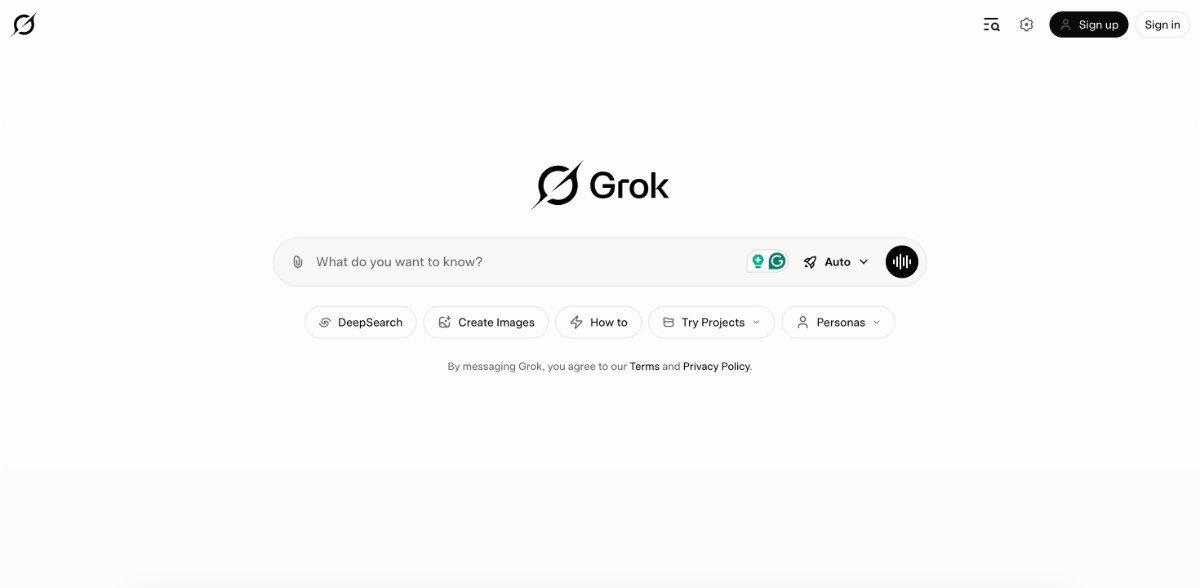
- Web interface at grok.com
- iOS app with Android coming soon
- Integration within the X platform for social listening and engagement
API Integration
- OpenAI-compatible endpoints for seamless integration
- Available through Azure AI Foundry and Oracle Cloud Infrastructure
- Support for popular development tools including Cline, Roo Code, and Open WebUI
Enterprise Deployment
- Dedicated account management for large organizations
- Custom solutions and specialized support
- Integration with existing enterprise data infrastructure
Security and Compliance: Built for Business
Enterprise adoption hinges on trust, and Grok delivers comprehensive security features:
- SOC 2 Compliance: Verified security controls and processes
- Zero Data Retention: Options for queries that aren't stored or used for training
- Encryption: Data encrypted both at rest and in transit
- Regulatory Compliance: GDPR and CCPA adherent
- Azure AI Content Safety: Default protection for enterprise deployments through Microsoft Azure
The Competitive Landscape
Grok positions itself distinctively against established players like OpenAI's ChatGPT, Google's Gemini, and Anthropic's Claude. Its key differentiators include:
- Real-time information access: Superior ability to incorporate current data into responses
- Extended context handling: 128K tokens enable processing of extensive documents
- First-principles reasoning: Methodical problem-solving rather than pattern matching
- Transparent safety approach: Publicly documented benchmarks for abuse potential, bias, and dual-use knowledge
- Enterprise flexibility: Multiple deployment options across major cloud platforms
Looking Ahead: The Grok Roadmap
xAI has signaled several expansions on the horizon:
- Multimodal expansion: Video generation capabilities (Grok Imagine with "Spicy Mode" already in beta for SuperGrok subscribers)
- Voice mode: Conversational AI with speech-to-text and text-to-speech integration
- Customization options: Mechanisms for organizations to fine-tune Grok with proprietary data
- Specialized versions: Industry-specific models optimized for vertical markets
- Enhanced tool integration: Expanded ability to connect with external systems
Making the Decision: Is Grok Right for Your Enterprise?
Grok is particularly well-suited for organizations that:
- Require current, real-time information in AI responses
- Handle large documents requiring extended context processing
- Need explainable reasoning and auditability in AI outputs
- Value a conversational, less restricted interaction style
- Already operate within the X ecosystem or Oracle/Azure cloud environments
- Prioritize cost efficiency in high-volume AI operations
For businesses where these factors align, Grok represents a compelling alternative to incumbent AI platforms—one that combines cutting-edge performance with practical enterprise considerations.
Get Started
Visit www.grok.com to learn more.
The enterprise AI landscape is evolving rapidly, and Grok's combination of reasoning capabilities, real-time knowledge, and flexible deployment options positions it as a strategic tool for forward-thinking organizations. As AI becomes increasingly central to business operations, the ability to think through problems—not just respond to them—may prove to be the defining competitive advantage.