


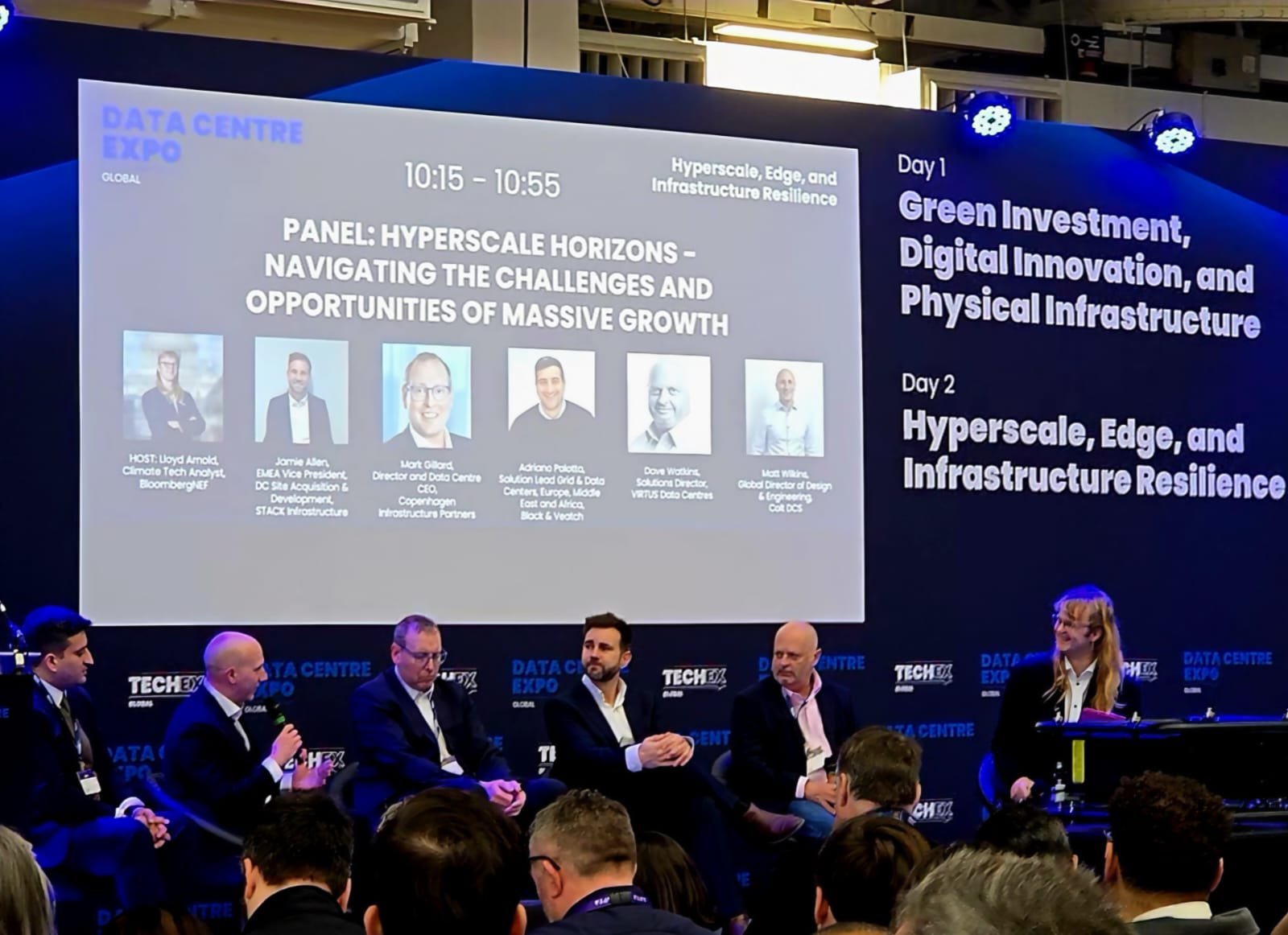
Artificial intelligence is reshaping the physical foundations of the digital economy. What was once described as cloud infrastructure is rapidly evolving into something far more complex: a form of industrial infrastructure that integrates energy systems, advanced cooling technologies, regional planning, and resilient network architectures.
Across hyperscale, edge, and distributed environments, resilience is no longer defined purely by uptime metrics. It now encompasses energy security, thermal management, geographic diversification, regulatory engagement, and cyber-physical integration. This transformation is redefining how AI-era data centres are planned, built, and operated.
1. Hyperscale Growth and the Emerging Power Constraint
The expansion of AI workloads — particularly model training — is driving unprecedented demand for high-density compute environments. Hyperscale operators continue to deploy capital at historic levels; however, financial investment is no longer the primary constraint. Electrical infrastructure is.
Grid interconnection timelines in major markets are extending to multiple years, making power availability the decisive factor in site selection. As a result:
- Traditional Tier-1 hubs face saturation due to grid capacity limits
- Secondary regions with electrical headroom are emerging as strategic AI infrastructure zones
- Early engagement with utilities and local authorities has become a core resilience strategy
Resilience at the hyperscale level increasingly begins with geographic and grid diversification, rather than purely technical redundancy.
2. Data Centres as Participants in Energy Systems
AI data centres are transitioning from passive power consumers to active components of energy ecosystems. Operators are adopting long-term strategies to secure reliable and sustainable power supply, including:
- Power purchase agreements linked to low-carbon generation
- Exploration of nuclear power, including small modular reactors
- On-site generation systems, often using natural gas as a transitional solution
- Load management capabilities that support grid stability during peak periods
Practices once associated with sustainability branding — such as waste heat recovery and advanced efficiency measures — are now operational requirements. In power-constrained environments, energy strategy functions as a prerequisite for expansion and regulatory approval.
3. Thermal Engineering as a Core Resilience Factor
AI infrastructure is fundamentally altering data centre thermal dynamics. High-density compute clusters significantly exceed the design thresholds of traditional air-cooled facilities. Consequently:
- Liquid cooling technologies are moving from pilot deployments to mainstream adoption
- Cooling systems are treated as mission-critical infrastructure, comparable to electrical redundancy
- Thermal design is increasingly central to uptime assurance and long-term facility viability
In AI environments, thermal resilience is directly linked to operational continuity.
4. The Evolution of Edge Architecture
While training workloads remain concentrated in hyperscale campuses, inference — the operational phase of AI — is driving a shift toward distributed compute. The most significant growth is occurring in “near-edge” regional facilities rather than far-edge micro-sites.
These facilities provide:
- Reduced latency for real-time AI applications
- High interconnection density
- Cloud-like orchestration and automation capabilities
Edge infrastructure is evolving into a distributed digital fabric, designed for consistent performance, automated recovery, and enterprise-grade resilience across multiple sites.
5. Execution Risk and Industrialised Deployment
A defining challenge in AI infrastructure development is the transition from planned capacity to operational capacity. Key constraints include:
- Extended grid connection timelines
- Supply chain bottlenecks for critical electrical components
- Shortages of specialised technical labour
- Complex permitting and regulatory processes
To address these issues, operators are adopting modular and prefabricated construction models, industrialising deployment in a manner similar to large-scale manufacturing sectors. Project execution capability has become a major determinant of infrastructure resilience.
6. Cyber-Physical and Hybrid Resilience
As infrastructure becomes more distributed, the attack surface expands. Security is therefore being embedded into infrastructure design through zero-trust frameworks, particularly across edge networks.
Simultaneously, organisations are embracing hybrid models that integrate hyperscale cloud, private facilities, and edge locations. Workload portability across environments is emerging as a critical resilience mechanism, enabling operational flexibility in response to technical, regulatory, or energy-related disruptions.
7. Strategic Implications for 2025–2026
AI infrastructure is increasingly characterised by attributes traditionally associated with utilities and heavy industry:
- High capital intensity
- Dependence on regional energy systems
- Physical and environmental constraints
- Strategic relevance to national and regional planning
Success in this environment will depend on capabilities beyond conventional IT operations, including:
- Accelerated permitting and regulatory coordination
- Long-term energy partnerships
- Expertise in advanced cooling and high-density power systems
- Modular, industrial-scale construction approaches
- Integration with grid and regional energy strategies
Conclusion
The AI era is redefining digital infrastructure at a structural level. Data centres are becoming multi-domain systems that combine computing, energy, and engineering disciplines. Resilience is now a multidimensional construct, encompassing not only technical redundancy but also energy security, thermal management, geographic strategy, and execution capability.
As AI adoption accelerates, infrastructure development is moving into the domain of national and industrial planning. The future of AI will therefore be shaped not only by advances in algorithms and software, but also by the evolution of energy systems, engineering practices, and regional infrastructure policy.