


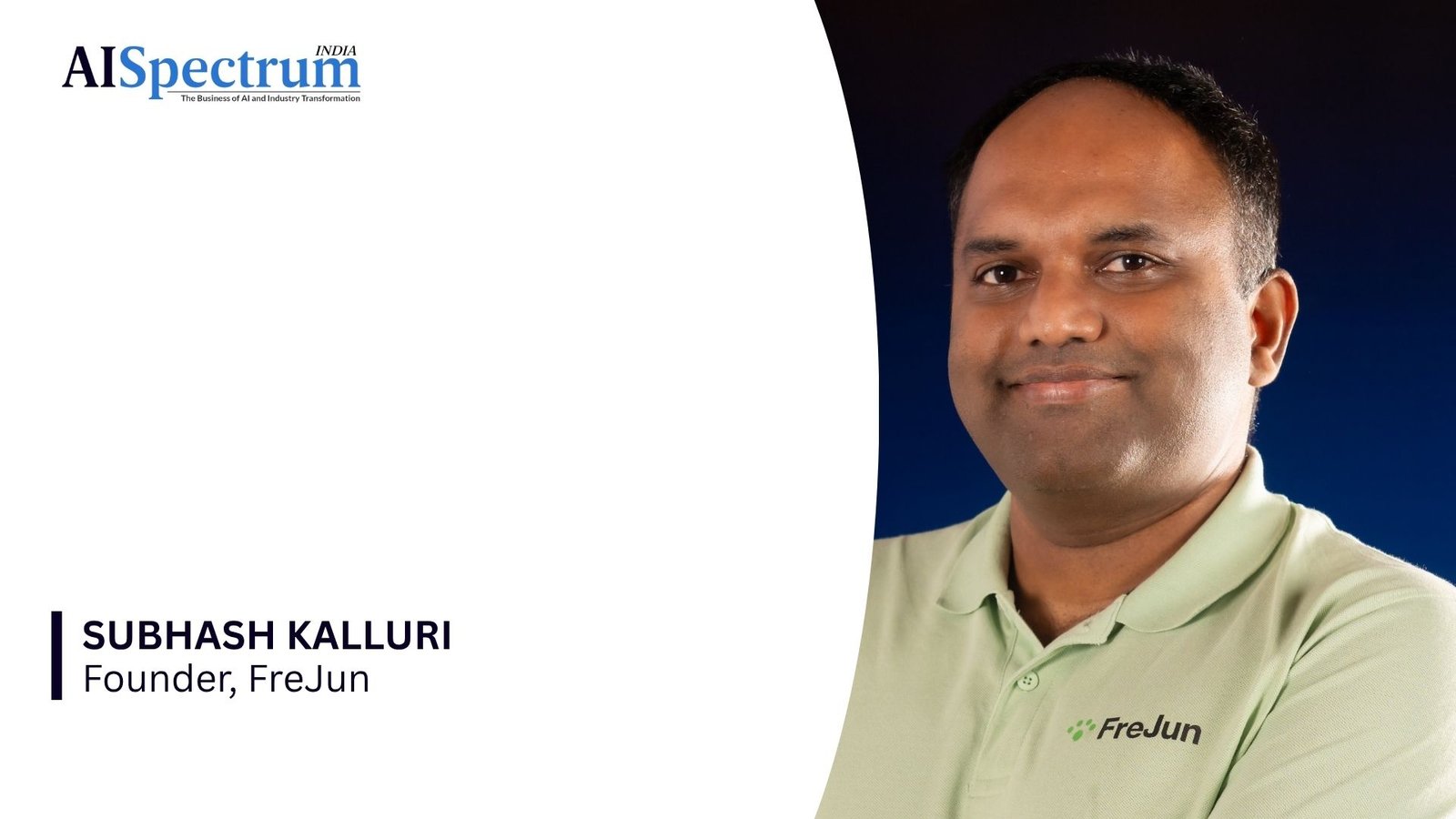
Enterprise software is entering a new era where conversations, rather than clicks, are becoming the primary interface for getting work done. Powered by advances in generative AI, large language models, and real-time speech intelligence, voice-first AI is enabling organisations to automate customer interactions, streamline enterprise workflows, and improve productivity across sales, recruitment, and customer support. As businesses move towards AI agents capable of understanding, acting, and collaborating in real time, the underlying communication infrastructure is becoming a critical enabler of this transformation. In this interview with AI Spectrum, Subhash Kalluri, Founder of FreJun, discusses why voice-first AI is poised to redefine enterprise operations, the challenges of deploying conversational AI at scale, and how advances in autonomous agents, multimodal AI, and speech intelligence are shaping the future of enterprise communication.
Enterprise software has traditionally been built around dashboards and graphical interfaces. What technological and behavioural shifts make voice-first AI a viable operating system for enterprise workflows today, and why do you believe this transition is happening now?
Enterprise software has mostly worked in one direction. The software decides how things should be done, and people adjust to it. You learn which screen to open, which field to fill, and which order to click in, and slowly you become fluent in someone else's design. It works, but there is a hidden cost. You are constantly converting what you actually want into the steps the software understands, and that translation is quiet, tiring, and always there. Voice takes it away. You say what you want, and the system handles the rest. On a single task, that just feels convenient. Across an entire workflow, it changes something more basic: who is adjusting to whom.
The real question is why now and not five years back. Two things had to come together, and they have only come together recently. One is the technology. Speech recognition and language models have finally become good enough to handle a real business conversation, with all its interruptions, accents, and jargon, and fast enough that it does not feel like you are waiting on a machine. That line was crossed only in the last two years or so. The second is people. A whole generation now talks to their phones without even thinking about it. The hesitation is gone. So the moment the technology was ready, the users were already there. These two things rarely line up at the same time, and that is exactly why this shift is happening now.
FreJun envisions conversations replacing clicks for everyday business operations. Could you share some real-world examples where voice AI has significantly improved productivity in functions such as sales, recruitment, or customer support? What measurable business outcomes have your customers experienced?
To answer this properly, I have to explain where we sit. FreJun is the telephony layer. We carry the voice connection between an AI agent and the person on the call, so the conversation runs cleanly, at low latency, and sounds like a real exchange and not a machine on delay. We are not the ones building the agent. The intelligence, the logic, and whatever decisions it takes, all of that belongs to our customers and the developers building on top of us. We carry the call. We do not decide what is said on it.
That is important for the data question. The numbers people usually want- conversion improvement, hours saved, resolution rates, all of that sit inside the agents our customers build. That data is theirs, not ours. It is under their confidentiality, and it is not mine to share. And honestly, even on our side, we do not hold agent-level performance numbers, because that is simply not the layer we work at. Specific figures cannot be shared, partly out of respect for our customers' confidentiality and partly because it would not be fair or appropriate to claim results that rightfully belong to another company's product. What I can talk about is the pattern and where the value keeps showing up. Voice AI is working best in the functions that are mostly conversation with a lot of repetition; sales outreach and first-level qualification; early recruitment screening where the number of calls is far more than any human team can manage well; and routine support where most questions are variations of the same few. In each of these, the win is the same. The machine takes the high-volume, repeatable calls, and people are left free for the ones that actually need judgement.
But all of this holds only if the layer underneath is solid. An agent is only as good as the line it speaks over. If the call drops, lags, or sounds robotic, even the smartest agent fails in the first ten seconds, because the person on the other side has already switched off. That reliability is the part we own, and it is quietly the part that decides whether these use cases scale or stay stuck in pilots. We chose to go deep on the layer everyone else takes for granted, because that is the one that makes or breaks everything on top.
Many organisations are experimenting with generative AI, but enterprise adoption often faces challenges around integration, security, and user trust. What are the biggest barriers to implementing voice AI at scale, and how should enterprises address them?
First is integration. Voice AI sitting on its own is just a toy. To be useful, it has to connect into the systems a company already runs on and work with them reliably. If it cannot, it creates more work than it saves. People underestimate how much of the real effort is here, in the plain plumbing, not the intelligence on top.
Second is security and compliance, and for voice, this matters double because you are handling live conversations and often personal or regulated data. Enterprises are right to be careful here. The honest answer is not to keep reassuring them; it is to build to the standard from day one, with proper certifications, clear data handling, and controls they can actually see for themselves. When you treat it as the foundation and not a feature, it often becomes the very thing that lets a serious conversation begin.
Third is trust, which is really a people problem dressed up as a technology problem. Nobody hands over work to a system they do not believe in, and no amount of technical brilliance shortcuts that. The way through is not to ask for a leap of faith. Let the system earn trust the way a new hire does: start it on small, low-risk tasks, keep it visible and correctable, and expand only as it proves itself. Companies that try to automate everything at once usually fail, not because the technology cannot do it, but because their people will not follow.
As AI agents become increasingly capable of autonomously updating CRMs, scheduling meetings, summarising calls, and triggering workflows, how do you see the balance between human oversight and AI-driven automation evolving over the next three to five years?
The direction is clear. AI will take over more of the mechanical work, updating records, scheduling, summarising, and triggering the next step, and it will do it well. That part is not in doubt. The real question is what people do with the time that opens up.
I do not see this going towards humans being removed. I see it going towards humans moving up. The machine does the doing; the person does the deciding. The model that will win over the next few years is supervised autonomy. The system acts on its own for anything routine and reversible, and it stops and asks a human on anything high-stakes or unclear. That judgement, deciding which is which, stays with people, and the line shifts slowly as trust builds, not in one jump. Anyone promising full autonomy from day one is either selling something or has not run it inside a real company. Five years out, the valuable skill will not be doing the tasks. It will be knowing which ones to hand off and how to keep a proper eye on them.
India has emerged as a major hub for AI innovation and SaaS development. How do you see Indian startups shaping the future of conversational AI globally, and what unique advantages does the Indian ecosystem offer in building voice-first enterprise solutions?
India has a real and underrated advantage here, and it comes straight from the conditions on the ground. This is a country with enormous language diversity, dozens of languages, countless accents, and people switching between English and a local language inside a single sentence. If you can build voice AI that works here, you have already solved a harder problem than most Western products ever have to face. And that toughness carries over. Building for India makes the product stronger everywhere else.
The second advantage is talent. We have engineers who have spent years building software for the rest of the world, so the instinct for global-quality product and enterprise reliability is already there in the ecosystem. The third is that Indian startups are used to building under constraint. Discipline about cost and efficiency is built in from the start, not added later. A tough home market, strong engineering, and lean habits- that is exactly the combination conversational AI rewards. I fully expect a good share of the serious voice infrastructure the world runs on tomorrow to be built from here.
Looking forward, what emerging technologies or trends, such as multimodal AI, autonomous AI agents, or real-time speech intelligence—do you believe will define the next generation of enterprise communication, and how is FreJun preparing for this future?
Three trends will shape the next generation. One is real-time speech intelligence, meaning systems that understand a conversation as it is happening, not after it is over. That turns a call from something you review later into something you can act on live. Second is autonomous agents that do not just talk but actually do, taking action across a company's systems on their own. And third is multimodal AI, where voice, text, and visuals stop being separate channels and become one continuous conversation.
Where all this leads is worth thinking about. The next wave of enterprise communication will not only be humans talking to machines. More and more it will be machines talking to machines on our behalf, one company's agent settling a query or a schedule directly with another company's agent, while people set the goals and check the outcomes. That is a real change in how business gets done.
Our preparation for it has been deliberate. We decided early that the lasting position is not the app that happens to be popular this year; it is the invisible layer everything else has to run on. Nobody thinks about the power plant when they switch on a light. So we do not chase every trend as it comes. We went deep on the telephony layer that all of these trends will depend on, because when voice becomes the way enterprises operate, the thing that carries the voice is what everything else stands on.