


As cyber threats grow more sophisticated and increasingly AI-driven, the gap between attacker speed and traditional defence mechanisms is widening rapidly. What once took weeks or months can now unfold in hours, as threat actors leverage artificial intelligence to scale and automate attacks. This shift is pushing organisations to rethink cybersecurity operations, moving away from rule-based automation toward intelligent, adaptive systems capable of operating at machine speed.
Against this backdrop, Accenture is advancing its Cyber.AI platform, integrating AI reasoning capabilities powered by Claude to enable real-time threat detection, contextual decision-making, and autonomous response. By orchestrating purpose-built AI agents across the security lifecycle from assessment and triage to remediation, the platform aims to help enterprises keep pace with rapidly evolving threats while maintaining governance and control.
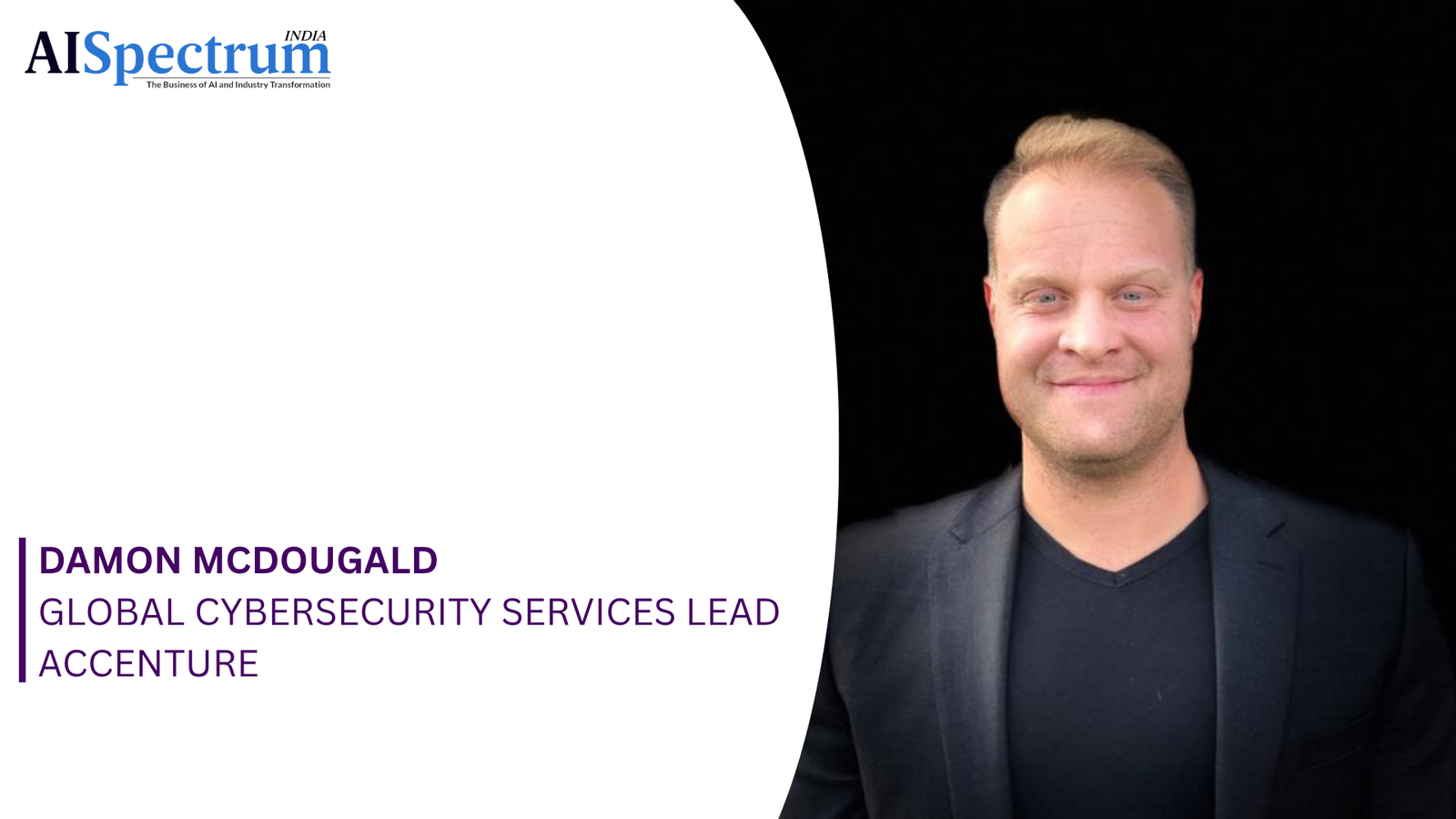
In this interview with AI Spectrum, Damon McDougald, Global Cybersecurity Services Lead at Accenture, explores how AI is transforming cybersecurity from static, human-led processes into dynamic, self-learning operations. He discusses the role of reasoning-driven AI in enhancing detection and response, the importance of agent governance through frameworks like Agent Shield, and how industry-specific AI agents are being designed to address complex regulatory and operational requirements. McDougald also shares his perspective on the future of self-defending enterprises and the critical balance between automation, trust, and responsible AI deployment.
Real-Time Detection: How does the integration of Claude enable real-time threat detection and response, and what differentiates it from traditional security automation tools?
Cybersecurity today is operating at a pace and level of complexity that traditional, human-driven approaches struggle to keep up with. As attackers increasingly use AI to accelerate and scale their techniques, organisations need security capabilities that can analyse threats in context and respond just as quickly. Cyber.AI addresses this by using Claude as a reasoning engine to synthesise large volumes of security data and provide contextual insights that support faster, more informed decision-making. Rather than relying solely on predefined rules or playbooks, Cyber.AI applies reasoning to determine how and when to deploy purpose-built agents across the security lifecycle, from detection through remediation.
This is a key differentiator from traditional security automation tools, which are typically limited to executing static workflows. Cyber.AI can adapt to evolving threats by combining AI-driven reasoning with Accenture’s cybersecurity expertise and dynamically orchestrated agents, enabling more responsive and effective detection and response. The result is a shift from rule-based automation to intelligent, AI-driven operations, helping organisations move closer to AI-speed detection and response while maintaining accuracy and control.
Agent Governance: Could you elaborate on how Agent Shield ensures visibility, control, and compliance in environments where multiple AI agents operate simultaneously?
Agent Shield within Cyber.AI is positioned as the layer that provides real-time protection, identification, monitoring and governance for autonomous agents operating in enterprise environments. It helps address an issue facing many organisations using AI agents: how can we know what they’re all doing and if they’re operating as intended? In practice, this means bringing visibility to what agents are running and how they are functioning, applying identity guidelines or “controls” to manage non-human identities, and adding threat detection and runtime protection so agent behaviour can be observed and constrained if needed. By making sure these agent controls are operating in line with organisational policies and risk tolerance, Agent Shield is intended to help organisations keep agents organised and secure even when they’re operating simultaneously across different security tasks and systems.
Evolving Threats: As adversaries increasingly leverage AI, how does Cyber.AI help organisations stay ahead of compressed attack timelines?
As adversaries increasingly use AI to compress attack timelines from weeks or months to hours, organisations are facing a growing mismatch with defences designed for human-speed threats. The barrier to launching sophisticated attacks has decreased significantly, allowing threat actors to move faster and at greater scale.
Cyber.AI is designed to close that gap by accelerating activities across the security lifecycle — from design and deployment to detection and response. By applying AI-driven reasoning and orchestrating purpose-built agents across tasks such as assessment, triage, remediation, and transformation, Cyber.AI enables organisations to prioritise and execute response actions more quickly and consistently. This allows security teams to operate at machine speed and scale without increasing manual effort, helping organisations keep pace with faster-moving, AI-enabled adversaries.
Proprietary Agents: How are Accenture’s proprietary agents designed to adapt to industry-specific security requirements?
This is where the collective expertise of Accenture’s over 30,000 cybersecurity professionals and more than 20 years of expertise comes into play. Accenture’s proprietary agents are designed to adapt to industry-specific requirements by being built from real client deployments across sectors and refined through ongoing use in complex, regulated environments. This ensures they reflect the practical needs, regulatory constraints, and threat profiles of different industries from the outset. Within Cyber.AI, these agents are organised into a curated library spanning key security domains such as identity security, cyber defence, secure digital core, and cyber resiliency. They can be selected and orchestrated based on the specific needs of an organisation and deployed across different stages of the security lifecycle, or “missions,” to address targeted use cases. Their adaptability also comes from how they integrate with existing technology environments. Cyber.AI agents are designed to work alongside leading ecosystem platforms, allowing organisations to extend and orchestrate their current investments while tailoring security capabilities to their industry and operating models.
Trust and Safety: How do Claude’s built-in safety guardrails combine with Accenture’s governance frameworks to ensure secure and responsible AI deployment?
Cyber.AI leverages Claude’s built-in safety guardrails as a foundation and then strengthens them with enterprise-grade governance and controls. Agent Shield, which is a part of Cyber.AI, enhances Claude with security controls over AI agents to help ensure alignment with organisational policies and risk tolerance. When agents are acting autonomously through complex workflows, this is critical for responsible AI deployment. In addition, Cyber.AI incorporates validation, testing, and assurance processes, including alignment with responsible AI practices and controls over how data and models are used, to support alignment with enterprise and regulatory requirements. Together, this approach helps ensure agents are secure and governed from initial deployment.
Future Outlook: How do you see AI reshaping the future of cybersecurity operations, and what role will platforms like Cyber.AI play in enabling self-defending enterprises?
Hackers and threat actors used to be sophisticated teams with extensive technical resumes. That has changed. Now, every day, people with a little bit of experience with technology like AI can mount attacks against organisations, sometimes through just a click of a button. It’s clear now that AI is shifting cybersecurity operations from human-paced, manual processes to continuous, AI-driven capabilities where reasoning, analysis and decision-making can be executed at machine speed. It’s within this context that Cyber.AI will shine. Cyber.AI can coordinate specialised agents across the security ecosystem, automate complex workflows end-to-end, and improve consistency and measurability without proportionally increasing staff effort. As non-human identities and autonomous agents proliferate and organisations use them to defend against AI threats, these organisations need to keep these agents organised and secure. Cyber.AI will do just that, all while setting the standard for the industry.