

The automotive industry is undergoing a profound transformation as vehicles evolve from hardware-centric machines into intelligent, software-defined platforms capable of continuous improvement throughout their lifecycle. As automakers adopt centralised electrical and electronic architectures, the focus is shifting toward embedding artificial intelligence directly at the edge, enabling vehicles to learn, adapt, and optimise performance in real time.
Against this backdrop, the collaboration between Sonatus and Schaeffler aims to bring AI-powered intelligence into critical vehicle systems, including steering, braking, and energy management. By integrating Sonatus's AI software stack with Schaeffler's cross-domain control units, the partnership seeks to enable over-the-air updates, predictive maintenance, targeted data collection, and continuous system optimisation, helping OEMs accelerate the development of next-generation software-defined vehicles (SDVs).
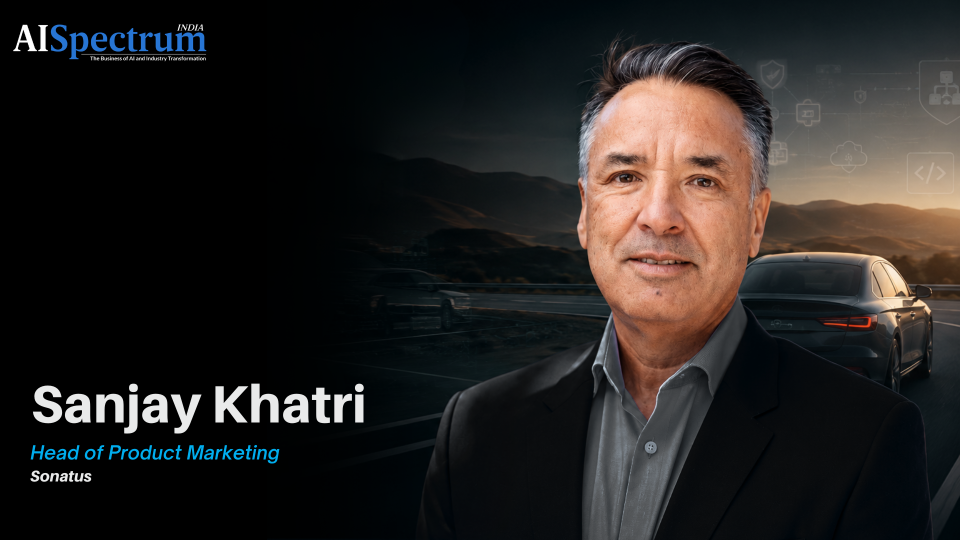
In this exclusive interaction with AI Spectrum, Sanjay Khatri, Head of Product Marketing at Sonatus, discusses the growing role of Edge AI in automotive innovation, the benefits of combining intelligent software with advanced motion control systems, and how embedded AI will shape the future of connected, adaptive, and autonomous vehicles over the coming years.
What specific industry challenges does the integration of Edge AI into motion control systems address, and why is now the right time for this collaboration?
The automotive industry is at a crossroads. As vehicles become more software-defined, OEMs need hardware that can evolve after it ships. But traditional motion control systems have been static by design. Once these physical systems are installed, they cannot be updated, optimised, or adapted based on real-world performance data. By integrating Sonatus’s AI software directly into Schaeffler’s cross-domain control units, the systems managing steering, braking, and energy management can be updated over the air, improved continuously, and programmed for real-time intelligence throughout the vehicle’s lifecycle. The timing reflects where the market is today: OEMs are centralising their electrical and electronic architectures, and they need production-ready, pre-integrated solutions.
How do Schaeffler's control units work with Sonatus Collector AI and AI Director to enable real-time intelligence and continuous learning?
Schaeffler’s cross-domain control units provide the hardware foundation — high-performance compute at the edge, spanning chassis, powertrain, and zonal backbone functions. Sonatus Collector AI runs within that environment to perform targeted, real-time data collection, capturing the specific signals that matter for performance monitoring and issue resolution rather than generating undifferentiated data streams. Sonatus AI Director manages the deployment and orchestration of AI models on the vehicle, enabling those models to be updated, swapped, or refined over the air as conditions and requirements evolve. Together, the integration creates a ready-to-use foundation for next-generation vehicle architectures, one that arrives pre-validated and production-grade rather than requiring OEMs to build and certify the stack themselves.
What are the most promising use cases for Edge AI in areas like predictive maintenance, energy management, and autonomous driving?
The most immediate use cases centre on the domains where Schaeffler’s hardware already operates: steering, braking, and energy management. Within those systems, Edge AI enables continuous performance optimisation — adjusting parameters based on real-world conditions, rather than fixed calibration — alongside targeted data collection for faster issue identification and resolution.
Predictive maintenance is a particularly compelling near-term application. The 2026 Omdia SDV Survey sponsored by Sonatus found it to be the No. 1 value-added feature OEMs are prioritising, cited by 44 per cent of respondents. With Sonatus Collector AI capturing the right signals in real time, it becomes possible to detect early indicators of component wear or anomalous behaviour before they become failures, reducing recall costs and improving the ownership experience.
How do you envision the evolution of SDVs over the next five years, and what role will embedded AI play?
Vehicles are increasingly defined by their software capabilities rather than only their hardware specifications when they roll off the factory floor. The centralised electrical and electronic architectures that OEMs are adopting now create the conditions for software to run across domains, not siloed by ECU. Embedded AI at the edge is the next layer. It’s what turns those centralised architectures into systems that learn, adapt, and improve over time. The Schaeffler-Sonatus partnership is designed to give OEMs a production-ready path to that future now.