


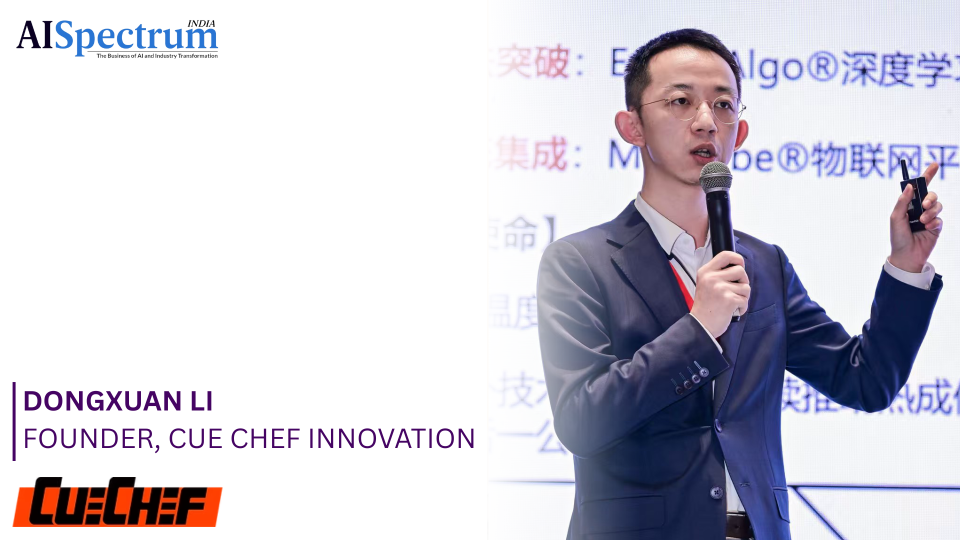
As artificial intelligence increasingly moves beyond screens and into the physical world, few settings present greater complexity or creative opportunity than the kitchen. For Dongxuan Li, founder of Cue Chef Innovation, this is precisely where AI can make one of its most meaningful contributions. His team’s latest creation, the Cube O1, is a compact cooking companion that quietly combines thermal vision, embedded neural networks and an ultra-minimal interface to guide home cooks through real-time decisions without relying on screens or voice commands.
Far from being yet another “smart” kitchen gadget that overwhelms users with data or prescriptive instructions, the Cube O1 is built on a genuinely human-centred philosophy: technology should support instinct rather than override it. By capturing what Li describes as a “cooking event stream”, a real-time record of actions, conditions and outcomes, the device preserves the spontaneity and emotion of cooking while offering the kind of dependable assistance many cooks, amateur and experienced alike, often wish they had.
In this exclusive interview with AI Spectrum India, Li discusses the insight that led to a screenless, voiceless AI assistant; how the Cube O1 makes repetition, creativity and even remote cooking both achievable and enjoyable; and why the future of assistive AI lies in helping people develop real-world skills without diminishing personal taste, cultural expression or the joy of experimentation.
The Cube O1 blends thermal vision, embedded neural networks, and a minimal interface. What was the core insight that led you to design an AI cooking companion that communicates through subtle cues rather than screens or voice commands?
While most AI today is limited to Q&A, it rarely helps in the real world. The kitchen is one of the most complex and chaotic environments, where help is needed the most, yet often unavailable. Too much information must be processed, and most electronics and interfaces aren’t designed for the kitchen. Screens get dirty, voice commands fail amid noise from range hoods and sizzling oil, and any wired device poses a safety risk. We wanted to challenge this scenario and create an AI that truly assists people in doing something tangible.
You describe Cube O1 as part of a “human-centric AI” approach. How does the device enhance a cook’s intuition without overshadowing their creativity or personal style?
At its core, AI is about algorithms—what data goes in and what comes out, with labelling being key. Under scaling laws, AI essentially fits labels. In the kitchen, existing data and experience are often vague descriptions, inaccurate measurements, or unclear instructions. Even a skilled cook may struggle to recreate their own successful dishes.
We started by helping the same cook consistently replicate their dishes. Then we realised—this wasn’t limited to one person. We accidentally enabled true remote cooking simply by keeping data collection, processing, and feedback local. Now, you just cook. Forget overthinking—just follow along like watching TikTok. If the dish turns out well, mark it, and you can make it again exactly the same. And trust us, there are many who share your taste.
The concept of a “cooking event stream” is fascinating. Can you explain how Cube O1 captures and interprets cooking data, and how this might transform recipe development or home-kitchen experimentation?
Simply put, our local device understands video and extracts actions and conditions in real time. It doesn’t comprehend “experience”—it only knows that under certain conditions, you took certain actions, and you were happy with the result. That becomes a reliable recipe worth saving. It acts as your kitchen assistant, never interfering with your creativity.
Many smart kitchen tools struggle to balance usability with complexity. What were the key design choices that ensured Cube O1 remains accessible to beginners while still being valuable for experienced cooks?
For beginners: straightforward guidance—no confusing numbers or text, just clear instructions like “do this now” or “next step in X minutes.”
For experienced cooks: no more juggling timers, cameras, or thermometers. Just confirm the taste was good, then later add photos and notes if you wish. You don’t need to be a photographer to appreciate beauty—just like you don’t need to code to write a beautiful poem on a postcard.
Cooking is deeply emotional and cultural. How did your team ensure that an AI-driven product like Cube O1 preserves the soul and storytelling of cooking, rather than making the experience feel overly technical?
Jeremy in our team is a stubborn yet deeply respected engineer. He doesn’t write code but is incredibly meticulous and focused. Making the device usable for someone like him pushed us through countless challenges. The journey never ends—a truly good product requires no learning. The soul and story belong to people; we just built a little box to record, store, and share them.
As Cube O1 enters the market, what does this launch signal about the future of assistive cooking technology and the broader role of AI in everyday human skill-building?
- Cooking is a wordless bridge between people.
b. Food promotes cross-cultural and cross-regional exchange, helping to resolve conflicts—after all, good food is universally appreciated.
c. AI only relieves repetitive and unreproducible labour; it cannot replace human taste and judgment. The same piece of meat tastes different to different people. Now you can truly find others who also prefer their steak medium-rare—without being told “medium-rare is the only right way.”
d. AI reduces information gaps in communication and collaboration. Some less-skilled cooks may struggle, but anyone can execute clear steps. Yet the explorers of flavor—those who push culinary boundaries—will never walk alone. We hope to spread the joy and resonance of food. Humanity is an ocean; each person is a wave, worthy of respect and remembrance.