
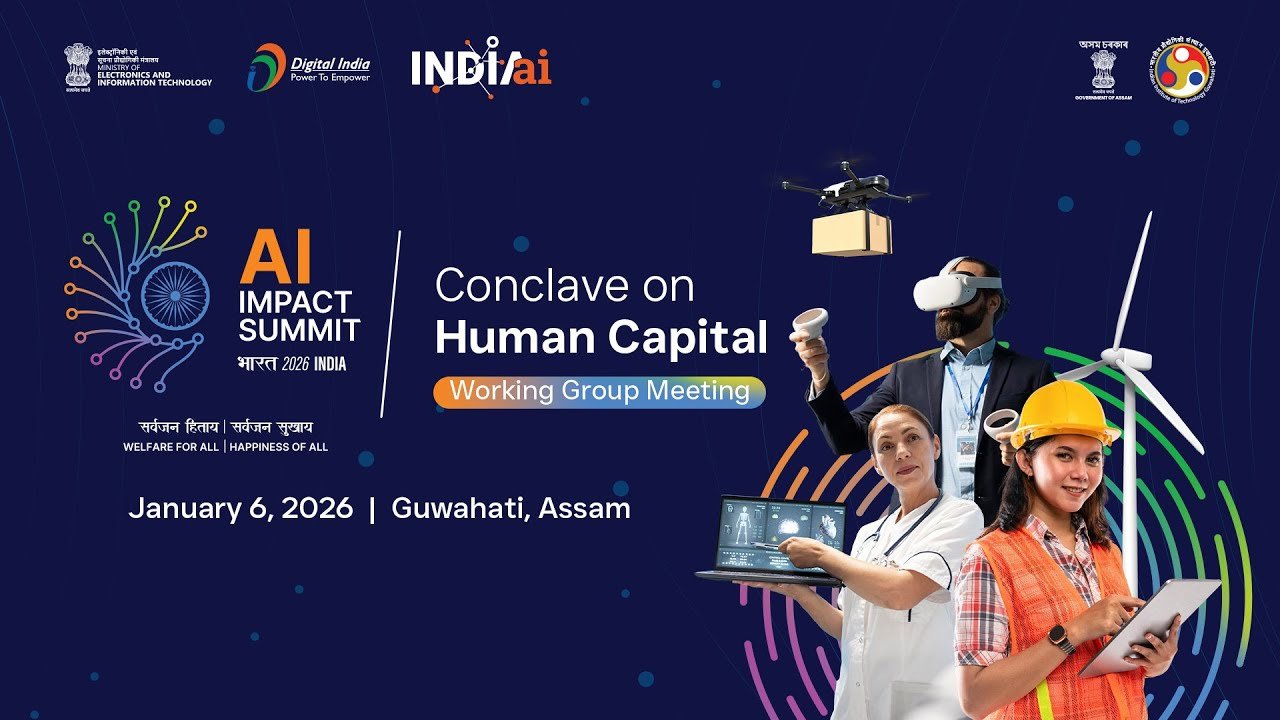
The National Language Translation Mission (NLTM) emerged as a central focus on Day 2 of the Human Capital Working Group Meeting held in Guwahati, as policymakers, academicians, and technologists deliberated on strengthening India’s language technology infrastructure and preparing future-ready AI talent. The meeting was organised by the Ministry of Electronics and Information Technology (MeitY) and the IndiaAI Mission, in collaboration with the Government of Assam and IIT Guwahati.
Opening the day’s proceedings, Prof. Mitesh Khapre, IIT Madras, Head of AI4Bharat, led a session on “The Architecture of the National Language Translation Mission (NLTM)”. He traced the evolution of the mission over the past four years and outlined its objective of building foundational AI and language technologies to support India’s linguistic diversity. Prof. Khapre noted that NLTM prioritises the 22 constitutionally recognised Indian languages, which together serve nearly 99 per cent of the population, balancing inclusivity with practical feasibility. He also highlighted the need to counter the global dominance of English-centric AI systems to ensure Indian languages are adequately represented in the global AI ecosystem.
Bringing a regional perspective to the discussion, Prof. Rohit Sinha from the Department of Electrical Engineering and the Centre for Linguistic Science and Technology, IIT Guwahati, spoke on “North East Language Technology Development and NLTM”. He highlighted the Northeast’s unique linguistic landscape, noting that the region is home to nearly 200 languages despite accounting for only 3–4 per cent of India’s population. He outlined how regionally grounded data collection, native-speaker annotation, and the development of machine translation, OCR, automatic speech recognition, and text-to-speech systems are enabling progress for low-resource and non-scheduled languages such as Assamese and Mizo, helping expand access to education, governance, and digital services.
Jyotismita Devi, Engagement Manager – Northeast India, Digital India BHASHINI Division, MeitY, presented an overview of the BHASHINI initiative, positioning it as a key implementation platform supporting NLTM’s goals. She explained that BHASHINI’s voice-first approach allows citizens to interact with digital systems in their native languages, regardless of literacy levels or technical proficiency. By offering open APIs, datasets, and quality standards through a centralised platform, BHASHINI supports low-resource languages while enabling real-world use cases such as multilingual service delivery and digitisation of legacy records.
The final session of the day focused on “The Reverse Engineering Approach to AI Education”, led by Prof. Amit Awekar, Department of Computer Science and Engineering, IIT Guwahati. Addressing students and early-career professionals, he discussed the importance of moving beyond surface-level AI tool usage towards a deeper understanding of system architecture, modular design, documentation, debugging, and ethical deployment. He highlighted reverse engineering as a pedagogical method to foster critical thinking, creativity, and real-world problem-solving skills.
The meeting concluded with remarks by Dr Sanasam Ranbir Singh, Professor and Head, Centre for Linguistic Science and Technology, IIT Guwahati, who thanked representatives from the Central and Assam Governments, academicians, and students for their active participation.
Across sessions, speakers stressed the need to align education and skilling frameworks with real-world AI deployment environments, ensuring that learners are equipped not only to use AI tools but also to design, evaluate, and govern them responsibly. Interdisciplinary foundations spanning data, algorithms, infrastructure, and ethics were identified as critical to achieving India’s AI ambitions.
The Human Capital Working Group Meeting in Guwahati marks an important regional milestone and serves as a precursor to the India AI Impact Summit 2026, scheduled to be held in New Delhi from 15 to 20 February 2026. Insights from the Working Group are expected to inform national and global discussions, reinforcing India’s commitment to building an inclusive, resilient, and future-ready AI ecosystem anchored in its linguistic diversity.