

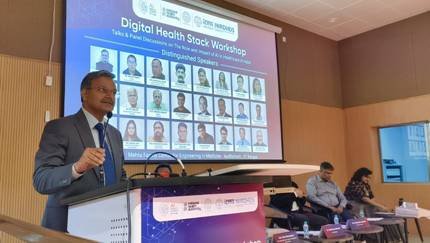
The National Health Authority (NHA), in collaboration with the ICMR–National Institute for Research in Digital Health and Data Science (NIRDHDS) and the Indian Institute of Technology (IIT) Kanpur, organised a national Federated Intelligence Hackathon to accelerate the development of Digital Public Goods (DPGs) for Health AI. Held from January 19 to 24, 2026 at IIT Kanpur, the event served as a prelude to the India AI Impact Summit 2026. It focused on building secure, scalable and privacy-preserving artificial intelligence solutions for healthcare.
A key outcome of the initiative was the launch of a benchmarking platform being jointly developed by IIT Kanpur and NHA to evaluate the performance and reliability of AI models while maintaining institutional control and data privacy. All models created during the hackathon were assessed on this federated platform, enabling innovation without centralising sensitive health data.
The hackathon drew 374 registrations, including 208 individual participants and 166 teams, with over half identifying as AI researchers or innovators. Participants also included health-tech startups, healthcare providers, graduate students and data scientists. Winners were announced across three clinical use-cases — bone age prediction, cataract detection and diabetic retinopathy screening — and received certificates and cash prizes totalling Rs. 12 lakh.
Delivering the keynote address, NHA CEO Dr. Sunil Kumar Barnwal highlighted the strategic shift from experimental AI to benchmarked and reliable models for healthcare deployment. He stressed that AI systems must be tested on diverse, population-scale datasets and that federated, consent-driven architectures enable innovation to scale while ensuring privacy and trust. Referring to AB PM-JAY and the Ayushman Bharat Digital Mission, he called for context-ready, inclusive AI solutions that reflect India’s demographic diversity.
The inaugural session featured senior leaders from IIT Kanpur, state health authorities and digital health missions. Dr R.S. Sharma underscored the role of Digital Public Infrastructure in citizen-centric health data management, while SarvamAI CEO Vivek Raghavan emphasised indigenous, open-source AI models and data sovereignty as foundations for responsible, large-scale healthcare transformation.
The initiative marks a significant step towards building a trusted federated AI ecosystem for India’s public health system.