


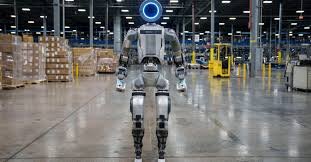
Boston Dynamics has reached a major milestone in industrial robotics as its next generation humanoid robot, Atlas, begins real world testing inside a live automotive manufacturing environment operated by Hyundai Motor Group in Georgia, United States.
The trials mark the first time Atlas has moved beyond controlled research settings to perform early stage production related tasks on a factory floor. At Hyundai Motor Group’s advanced manufacturing facility near Savannah, Atlas is being evaluated for component handling and logistics activities within a parts warehouse environment, working alongside human teams and existing automation systems.
Designed as a fully electric, AI driven humanoid, Atlas combines human scale mobility with advanced perception and manipulation capabilities. Unlike traditional fixed industrial robots, the humanoid platform can walk freely, adapt to changing layouts and handle objects in less structured environments, making it suitable for factories where flexibility and rapid reconfiguration are increasingly critical.
Atlas is trained using a combination of simulation, teleoperation and machine learning. Skills are first learned through human demonstration and virtual environments before being transferred to physical execution, allowing the system to safely and efficiently adapt to real industrial conditions. This approach enables continuous improvement as Atlas gains experience in live operational settings.
Hyundai Motor Group, which holds a controlling stake in Boston Dynamics, views humanoid robotics as a long term pillar of its smart manufacturing strategy. The company has outlined a vision in which humanoid robots support human workers by taking on repetitive, physically demanding or potentially hazardous tasks, improving workplace safety while enhancing productivity and operational resilience across global manufacturing sites.
“Moving Atlas into a real factory environment is a defining step for humanoid robotics,” said Robert Playter, Chief Executive Officer, Boston Dynamics. “These trials allow us to validate how humanoids can operate safely, reliably and usefully alongside people, while learning directly from real world industrial workflows.”
While Atlas remains in an evaluation phase, the Georgia factory trials demonstrate a significant shift in how humanoid robots are being positioned, not as experimental showcases but as practical tools for industrial operations. Boston Dynamics and Hyundai Motor Group will continue refining Atlas’s capabilities through progressive testing, with the aim of expanding use cases across manufacturing, logistics and industrial operations over time.
The collaboration reflects a broader industry movement towards intelligent, adaptive automation, where artificial intelligence and robotics converge to redefine the future of work on the factory floor