


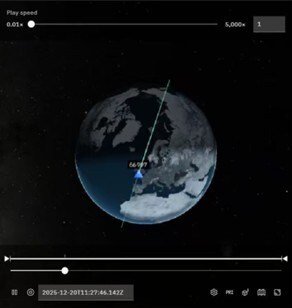
PowerBank Corporation, a leader in North American energy infrastructure development and asset ownership, today provides a milestone update on its collaboration with Smartlink AI (Orbit AI) following the successful December 10, 2025, launch of the DeStarlink Genesis-1 satellite, announced by PowerBank. The satellite has been recorded operating and producing solar power as it moves around the Earth.
Dr Richard Lu, CEO of PowerBank, commented: "The successful deployment of Genesis-1 validates a vision we announced just weeks ago—that solar-powered infrastructure can extend beyond Earth's surface to power the next generation of computing. This isn't just about launching a satellite; it's about proving that clean energy technology can enable entirely new categories of digital infrastructure. The Orbital Cloud represents the convergence of three megatrends: renewable energy, artificial intelligence, and decentralised computing. PowerBank's planned role in advancing solar and thermal control solutions for space-based data centres positions us uniquely at this intersection, opening exposure to markets projected to exceed $700 billion over the next decade."
On December 10, 2025, Orbit AI successfully deployed the DeStarlink Genesis-1 satellite into low-Earth orbit (LEO), marking the inaugural launch of the Orbital Cloud network. Genesis-1 represents the first satellite in a planned constellation designed to integrate three critical capabilities in space:
DeStarlink Connectivity: Decentralised communication infrastructure providing global, censorship-resistant connectivity
DeStarAI Computing: Solar-powered AI data centres naturally cooled in the vacuum of space, enabling continuous inference and processing
Blockchain Verification: Ethereum wallet and blockchain node capabilities for verified, tamper-proof transactions executed in orbit
The satellite's successful deployment validates the core technical architecture of the Orbital Cloud and establishes the foundation for expanded constellation deployment beginning in 2026. Genesis-1 carries initial AI inference payloads and blockchain verification capabilities, demonstrating the feasibility of autonomous, solar-powered computation beyond terrestrial infrastructure constraints.