

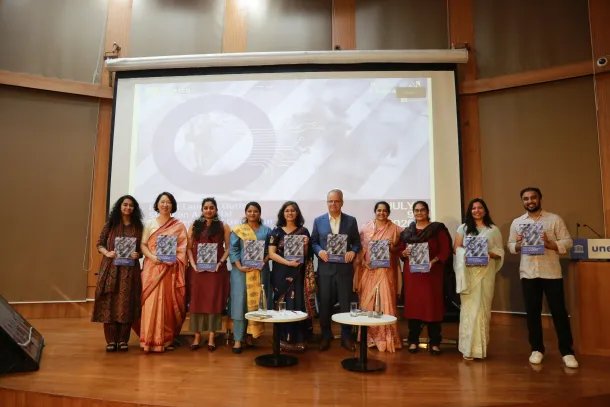
UNESCO's Regional Office for South Asia launched the Outlook Study on Artificial Intelligence and Gender in South Asia, the first regional assessment of women's participation in artificial intelligence (AI) across Bangladesh, Bhutan, India, Maldives, Nepal and Sri Lanka. Produced by the UNESCO Women for Ethical AI (W4EAI) South Asia Chapter, the report maps women's participation across the AI ecosystem — from education to entrepreneurship, revealing how barriers accumulate across the AI pipeline and limit access to leadership.
Across South Asia, women account for only about one-third of STEM students. Progress in women's access to higher education has not consistently translated into participation in AI-related disciplines. In the Maldives, women make up nearly 78 per cent of university students, yet only about 2 per cent enrol in science and technology programmes. In Nepal, women represent just 24 per cent of computing and IT enrolments, while in Bangladesh they account for only one in five STEM graduates. In India, women have reached near parity in science disciplines, but men continue to dominate engineering and technology enrolment.
A bibliometric analysis of AI publications between 2015 and 2025 shows that while 71.76 per cent of publications across the six countries include at least one woman author, women hold only 26 per cent of corresponding or primary authorship positions—roles that typically reflect research leadership and intellectual ownership. Country-level disparities are particularly pronounced: male corresponding authors produce 2.7 times more AI publications than women in India, eight times more in Bangladesh and nearly 14 times more in the Maldives. Sri Lanka records the narrowest gap.
Globally, women represent 41.2 per cent of the overall workforce but only 28.2 per cent of the STEM workforce. In AI, women are significantly less likely than men to report AI engineering skills on LinkedIn. The study finds that women are concentrated in upstream data preparation and downstream service functions, with limited representation in model development—the stage where technical authority, innovation, intellectual property and higher-value employment are concentrated. LinkedIn data from 2024 show that women account for only 29.92 per cent of LinkedIn users in India who report AI engineering skills, compared with 20.57 per cent in Nepal and 15.64 per cent in Bangladesh.
Women's participation in AI entrepreneurship remains constrained across the region, not by lack of ambition but by unequal access to technical expertise, finance and institutional support. In India, only about 10 per cent of AI start-ups have at least one woman founder. In Bangladesh, women account for just 7.2 per cent of entrepreneurs overall. Access to investment also remains limited: fewer than 1 per cent of India's estimated 10,000 angel investors are women.