


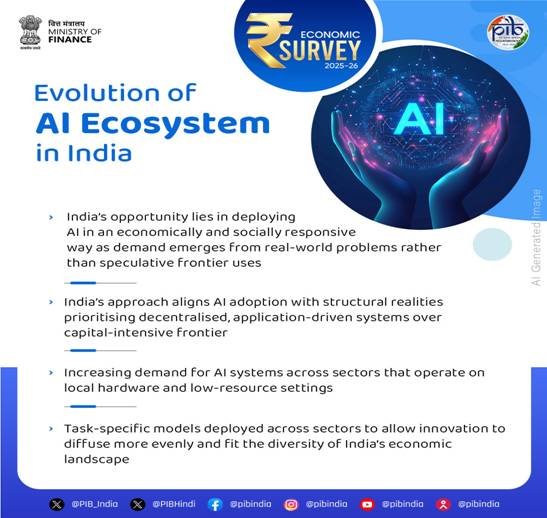
The Economic Survey 2025-26, tabled in Parliament on Friday by Union Minister of Finance and Corporate Affairs Nirmala Sitharaman, positions artificial intelligence (AI) as an economic strategy rather than a prestige technology race, advocating a pragmatic and development-oriented approach tailored to India’s structural realities.
In a dedicated chapter on AI, the Survey examines how the technology is reshaping the global economy and outlines a bottom-up, sector-specific roadmap for India. It argues that AI deployment should be economically grounded, socially responsive, and built on open and interoperable systems to encourage collaboration and shared innovation. This approach, the Survey notes, aligns with India’s strengths in human capital, data diversity, and institutional coordination.
Rather than focusing on frontier or speculative use cases, India’s demand for AI is emerging from real-world challenges across healthcare, agriculture, education, urban management, disaster preparedness, and public administration. The Survey highlights growing adoption of AI solutions that operate on local hardware and in low-resource environments, enabling applications such as early disease screening, precision water management, farmer market access, classroom analytics, and regional language interfaces. These trends signal a large, scalable market for cost-efficient, application-led AI solutions.
The Survey cautions against premature regulatory lock-in and over-centralisation, stressing that India’s AI strategy must account for capital availability, energy constraints, institutional capacity, and market depth. It favours decentralised, task-specific models over large centralised systems, arguing that smaller models lower entry barriers, diffuse innovation more evenly, and better suit India’s economic diversity.
On governance, the Survey calls for proportionate, risk-based regulation, emphasising accountability, transparency, and auditability over rigid data localisation. It also underscores the continued importance of human capital, urging a shift in education and training towards foundational skills such as reasoning, communication, judgment, and adaptability.
Overall, the Survey concludes that India can maximise economic and social returns from AI by sequencing policy carefully—building coordination first, capacity next, and binding regulation last—while remaining integrated with global innovation networks.