

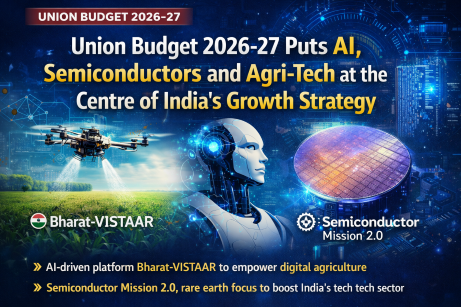
The Union Budget 2026–27 has underscored the government’s intent to accelerate India’s transformation through artificial intelligence, digital innovation, and advanced manufacturing, with key announcements spanning agriculture, semiconductors, and critical minerals. Experts across academia and the technology industry have welcomed the measures, calling them foundational for a future-ready economy.
Welcoming the Budget, Prashant Girbane, Director General, MCCIA, said its emphasis on data centres is critical to India’s AI ambitions. “AI depends heavily on data infrastructure. Data centres are a crucial layer in the digital ecosystem, and increasing domestic capacity will reduce dependence on the outside world while making other countries more dependent on India,” he said.
Girbane highlighted that tax exemptions for data centres till 2047 would provide a strong boost to investments in digital infrastructure, reinforcing India’s position as a global technology hub. “This aligns with the broader vision of making India an integral part of global value chains,” he noted.
However, he said India must now focus more on AI diffusion, ensuring that the benefits of artificial intelligence reach the bottom of the pyramid. “AI should not remain limited to elite enterprises. The real impact will come when small businesses, farmers, and grassroots users begin to benefit,” Girbane said.
He expressed hope that further details on AI diffusion will emerge either in the Budget’s fine print or through upcoming national-level AI discussions. “For India’s digital growth to be inclusive, AI adoption must be widespread and accessible,” he added.
Commenting on the agriculture-focused technology push, Dr Pushpendra P. Singh, Dean CAPS and Project Director, ANNAM.AI at IIT Ropar, said the Budget aligns closely with Prime Minister Narendra Modi’s vision of leveraging technology to transform Indian farming.
“The launch of Bharat Vistaar is a significant step towards empowering farmers with AI-driven, real-time, climate-smart support,” Dr Singh said. He noted that the platform would help farmers make informed decisions, reduce risks from unpredictable weather, optimise agricultural inputs, and ultimately improve yields and livelihoods.
According to Dr Singh, the continued emphasis on precision agri-tech practices supports efficient, sustainable, and climate-resilient farming. “This Budget rightly positions AI and digital innovation as key enablers of a future-ready farm sector while enhancing farmers’ incomes,” he added.
From the technology and manufacturing perspective, veteran IT expert Deepak Shikarpur described the Budget as a strong signal of India’s evolution into a digitally driven economy.
“I have been working in the IT industry for the last 41 years. When I joined IT in 1985, IT referred to Income Tax. Today, we live in an AI-driven world,” Shikarpur said, reflecting on the sector’s transformation.
He highlighted the announcement of Semiconductor Mission 2.0 and the focus on rare earth discoveries across four states as particularly encouraging. “This indicates that in the near future, a significant amount of hardware and electronics manufacturing will take place in India,” he said, adding that these measures strengthen India’s position in the global digital and electronics value chain.
Taken together, experts believe the Union Budget 2026–27 signals a decisive shift towards AI-led growth, combining digital agriculture, semiconductor self-reliance, and advanced manufacturing to build a resilient, innovation-driven economy aligned with the vision of Viksit Bharat.