

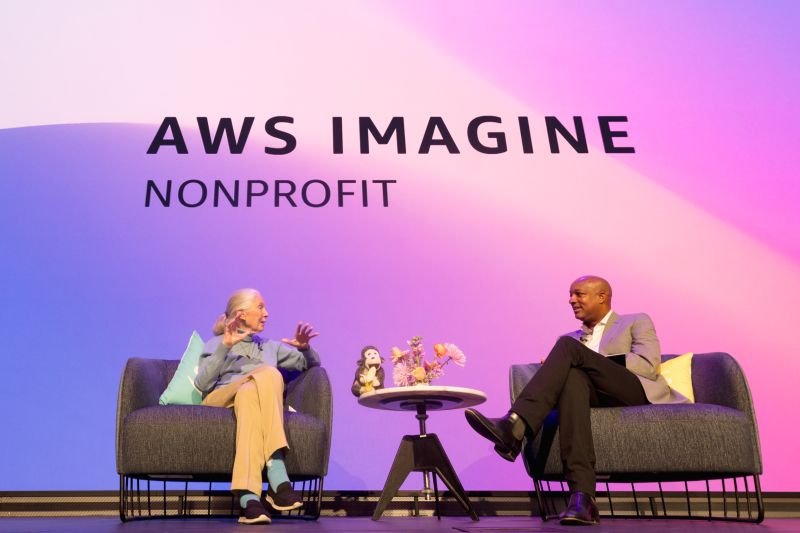
Amazon Web Services will commit a sum of $1 million to the digitization of primate research from the Jane Goodall Institute with the help of its Generative AI Innovation Fund. This means that the data produced by the research, which consists of handwritten notes and rare films, will be made available in form that cannot only be searched but also analyzed using AI.
The project is in a way a unlocking of 65 years of detailed research that itself is not much accessible to human readers. Some part of the conservation science studies may be replaced by new findings and connections.
An incredible collection
Dame Jane Goodall, the British anthropologist and primatologist who became the world's leading expert on chimpanzees, started her pioneering study in 1960 in Gombe National Park, Tanzania. The Jane Goodall Institute (JGI) officially established by her in 1977 and has since conducted massive research, most of which is documented in paper trail of notes, film, and numismatic data.
The extent and magnitude of this research are enormous and cover everything from primate behavior, weather conditions, and habitats, to social interactions and many more. However, up until now, a lot of it has been rendered inaccessible to modern analysis just because it is on paper and film rather than in digital, searchable formats.
How AI will assist
Taimur Rashid, the AWS Generative AI Innovation Center's managing director, illustrated the digitization strategy in a blog entry: "We are utilizing the cross-analysis of comprehensive machine thematic modelling and AI-driven prescriptive analytics, where the main factor is user attention through smart prompting, to discover new drafts of documents in the form of unearthed JGI's archive of handwritten notes and videos."
This project is enhancement of one already done at the AWS center and it encompasses certain immediate priorities:
* Transforming the data of six years of handwritten chimpanzee research into a structured format that is easy to search
* Digitization of records of baboons for easier access to data by the partners of JGI
* Moving all data to the cloud infrastructure of AWS which is secure.
* Integration of multicultural data sources (text, images, and video) would be supported.
* A digital footprint would be laid.
Through the partnership with Ode, a California-based design and research firm, AWS is setting a user experience that takes the full advantage of AI's potential.
The end of the line is daring: to make an AI system that can perform a natural language search across the 65-year research period. The researchers would be able to ask questions like "What social behaviours did chimpanzees demonstrate during the dry seasons of the 1970s?" and they would get answers based on the piles of handwritten notes, film clips, and data collected over the years.
An online portal will also be developed as part of the project which will allow the data to be cross-referenced and analyzed in ways that were not possible before. When the research is in filing cabinets and on videotapes, it is a laborious process to make connections across decades of work. However, the search and analysis powered by AI would bring those connections to light automatically.
Conservation has great need of this technology to be implemented
Lilian Pintea, Vice President of Conservation Science at JGI-USA, pointed out the wider effects "By the generative and agentic AI technologies, we can unlock these archives and JGI will be able to carry out its mission in a bigger way and also create a digital legacy that will make it possible for Dr Goodall's work to be a source of guidance and inspiration for the times to come."
The great researcher of the last century, Dame Jane Goodall, died in October 2024; however, her studies still count the oldest and longest recorded accounts of head-to-head chimp behavior over sixty years. It becomes essential for the conservation area to recognize the changing environmental factors, to make accurate studies, and to know the social settings of the animals, because these aspects are already counted among the main factors for the extinction of habitats and the squirrels.
The technical difficulty
It is not easy to digitize ancient handwritten field notes. There are different styles of handwriting, a special vocabulary of science, and so on. Moreover, the material to be processed is huge; that is exactly where multimodal AI methods shine – they can take handwritten text images, get the context, pull out the structured data, and make interconnections among various types of information.
The adoption of Amazon Bedrock and SageMaker hints that AWS is applying its most powerful AI resources for this project. Bedrock allows using a collection of base models, while SageMaker provides the tools for constructing and training customized models. It is expected that the combination will enable JGI to deal with all kinds of archive materials hand-written notes, typed reports, photographs, videos – and then to make through a single interface all of these searchable.
Broader implications
The generative AI approach that this project showcases is undoubtedly the most convincing one that has been developed so far for scientific purposes not limited to the usual commercial offerings. World over scientific archives are facing the same difficulties: high-quality research covering decades or even centuries is still in analog forms, slowly deteriorating and mostly inaccessible for contemporary analytical methods.
If the AWS and JGI collaboration manages to digitise and index 65 years of primate research, it could become a model for other institutions that have also preserved such invaluable archives. Enormous amounts of invaluable analogue material that could be digitized and analysed are stored in the museums, universities, libraries and conservation NGOs worldwide.
India, with its vibrant ecosystem and long-standing wildlife research, is a case in point. Wildlife Institute of India, Bombay Natural History Society, and different forest departments have considerable field research archives that are just waiting for AI-based digitisation to become accessible to the wider research community.
What's next
AWS's $1 million pledge for digitising the Jane Goodall Institute's archives is a move that encompasses more than just charity by a company. It is a proof of the power of AI that can, as if by magic, turn dried historical research materials into scientific value for current and future researchers, sometimes even revealing insights that were always present in the data but simply too hard to extract manually.
The less the data the harder the challenges for conservation. The project success might even guarantee that Dame Jane Goodall's pioneering work remains alive and influential in both primate conservation and scientific understanding for the next generations, thus serving as a tested pathway for AI’s assistance in preservation and analysis of the world's cumulative scientific heritage.