


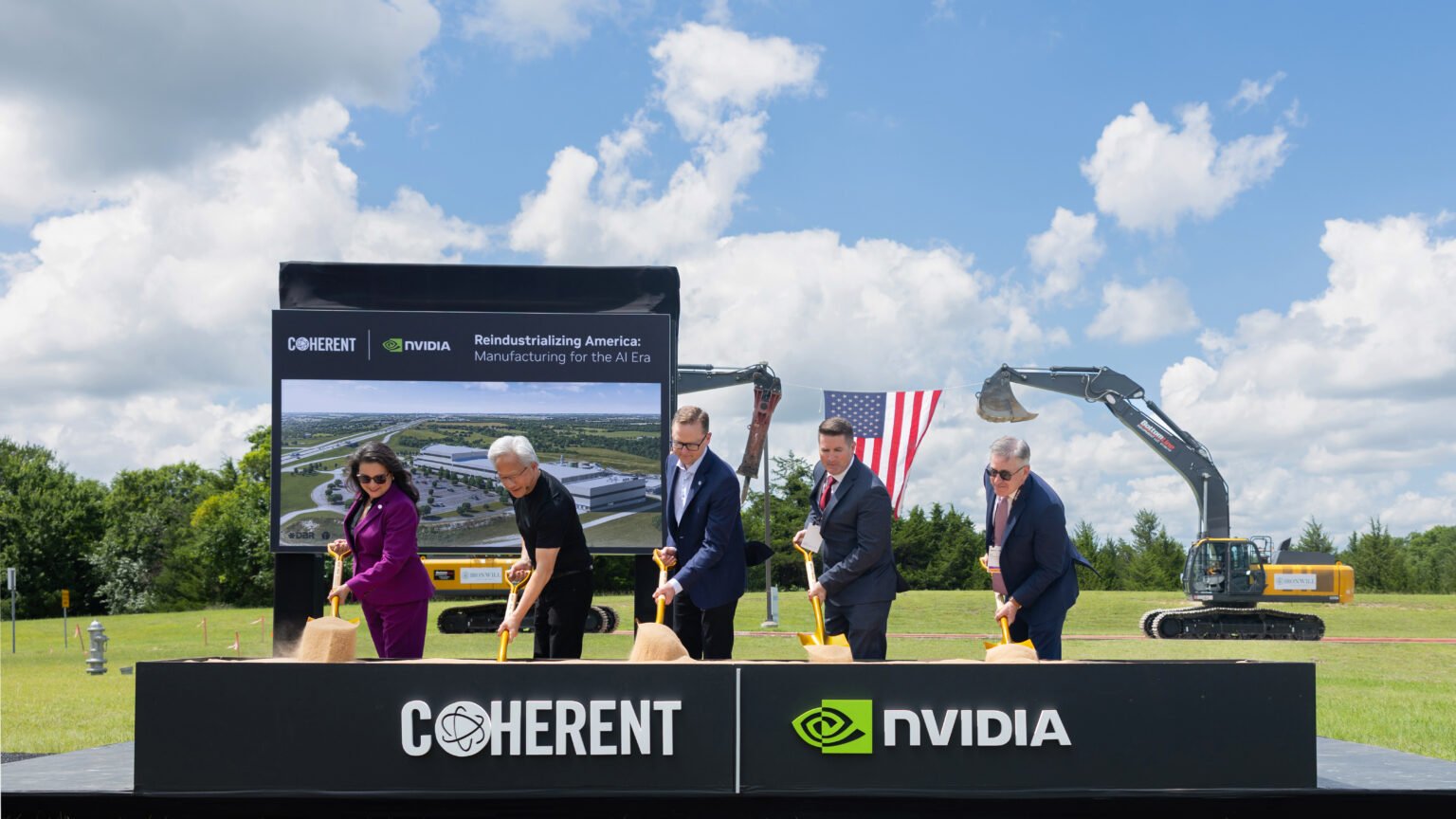
Coherent has broken ground on an expanded manufacturing facility in Sherman, Texas, marking a significant step in strengthening the United States' advanced semiconductor and AI infrastructure supply chain.
The expansion will increase production capacity for indium phosphide (InP) wafers, a critical technology underpinning high-speed optical communications used in artificial intelligence systems, data centres, and networking infrastructure. The project received support through a $50 million grant under the U.S. CHIPS and Science Act, in addition to approximately $17 million in funding from the Texas CHIPS program and the Sherman Economic Development Corporation.
The groundbreaking ceremony was attended by NVIDIA founder and CEO Jensen Huang, Coherent CEO Jim Anderson, Sherman Mayor Shawn Temann, and Adriana Cruz, Executive Director of Texas Economic Development and Tourism.
Coherent operates what it describes as the world's first 6-inch indium phosphide fabrication facility and manufactures lasers, optical components, and compound semiconductors that serve as the backbone of AI networking infrastructure. The expanded facility is expected to play a crucial role in meeting growing demand for optical technologies required to connect increasingly complex AI systems.
"AI is the ultimate general-purpose technology," said Huang during the event. "Because intelligence is fundamental—the ability to process information, to reason and solve problems—it affects every single industry."
As AI workloads continue to scale, optical networking technologies are becoming increasingly essential. Traditional copper-based interconnects face limitations in power consumption and signal transmission over longer distances, particularly in large-scale AI clusters. Silicon photonics and optical interconnects, powered by technologies such as indium phosphide, offer a more efficient solution for moving massive volumes of data between processors, servers, and data centers.
Huang highlighted the importance of optical connectivity in future AI architectures, noting that next-generation systems such as NVIDIA's Vera Rubin Ultra NVL576 platform will require high-speed optical networking to connect hundreds of thousands of processors across large-scale computing environments.
The expansion also reinforces a long-standing partnership between NVIDIA and Coherent. Earlier this year, the two companies announced a multi-year strategic collaboration under which NVIDIA will invest $2 billion in Coherent to support research and development, future manufacturing capacity, and domestic production capabilities. The agreement also includes a multibillion-dollar purchase commitment for advanced laser and optical networking products.
According to Anderson, the Sherman facility will become a major hub for manufacturing the optical technologies that enable AI infrastructure at scale.
"As AI systems grow larger and more powerful, connectivity is just as important as compute," Anderson said. "AI runs on compute, but it scales on connectivity—and Sherman is where that connective tissue gets built."
The facility will manufacture a range of components, including lasers, transceivers, and pluggable optical modules used throughout NVIDIA's networking ecosystem. These technologies are increasingly viewed as critical enablers of next-generation AI infrastructure.
Beyond technological impact, the project is expected to deliver substantial economic benefits to the region. When operating at full capacity, the expanded site is projected to support more than 550 direct jobs and thousands of additional indirect employment opportunities.
The investment underscores growing efforts by both government and industry to expand semiconductor manufacturing in the United States and build resilient domestic supply chains for technologies powering the global AI revolution.