

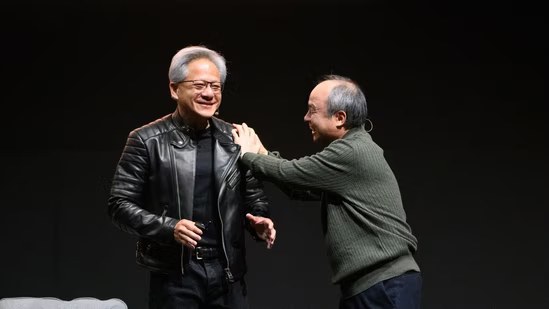
SoftBank Group has cashed out its entire stake in Nvidia for $5.8 billion, banking massive profits as founder Masayoshi Son repositions the company to build its own sphere of influence in artificial intelligence.
The move comes as SoftBank reports a surprise net income of ¥2.5 trillion (roughly ₹1.5 trillion) in its fiscal second quarter, far exceeding analyst expectations of ¥418.2 billion. The Tokyo-based conglomerate also announced a 4-for-1 stock split, taking effect on 1st January.
From Nvidia to OpenAI
SoftBank had raised its Nvidia stake to about $3 billion by the end of March. But Son is now deploying capital differently, building a portfolio that includes some of the world's most sought-after AI names: OpenAI and Oracle.
These strategic stakes have driven real results. SoftBank's share price surged 78% in the three months ending September, its best quarterly performance since December 2005. The company's paper gains and successful exits from various investments have convinced analysts to raise their forecasts.
Citigroup analyst Keiichi Yoneshima set his target price for SoftBank's stock at ¥27,100, linking his calculations with OpenAI's valuation, and assuming a future valuation range of $500 billion to $1 trillion for the ChatGPT operator.
Son's aggressive AI play
The 68-year-old founder is aggressively seeking to capitalise on booming investment in AI and chips, even as he scales back other holdings. His ambitions are staggering in scope:
- A planned $30 billion investment in OpenAI
- Participation in the Stargate data centre rollout
- Courting Taiwan Semiconductor Manufacturing Co. (TSMC) and others about a $1 trillion AI manufacturing hub in Arizona
- Roughly $20 billion earmarked for OpenAI specifically
- $6.5 billion for the planned acquisition of chip designer Ampere Computing
- Even exploring a takeover of US chipmaker Marvell Technology earlier this year
It's a comprehensive strategy to control multiple layers of the AI stack, from chip design to manufacturing to the AI models themselves.
The financing challenge
The big question is how SoftBank will balance the financing behind these enormous new investments. Between the OpenAI stake, the Ampere acquisition, and participation in the Arizona manufacturing hub, Son is committing tens of billions of dollars.
Selling the Nvidia stake provides immediate capital, but concerns persist about the high valuations propping up AI companies and their capital spending. Who will ultimately benefit from the massive data centres and infrastructure under construction remains an open question.
The valuation concern
As one Finimize Research note pointed out ahead of the earnings release: "The simple trade was to buy SoftBank for cheap exposure to Arm shares and a broader AI and tech mix. That idea has more than delivered, the stock's more than doubled, far outpacing the modest rise in NAV," referring to SoftBank's net asset value.
"But now the discount's mostly closed, so SoftBank isn't a 'cheap' way in anymore. So on that basis, it's likely a good time to sell and take your profits."
It's a valid point. SoftBank's stock has surged so dramatically that it's no longer trading at the discount to its underlying assets that once made it attractive. Investors who bought for cheap AI exposure may now be questioning whether valuations have run ahead of fundamentals.
A different kind of bet
What's interesting is Son's strategic pivot. Rather than simply investing in the picks-and-shovels providers like Nvidia. who benefit regardless of which AI applications succeed, he's betting heavily on specific companies and initiatives.
It's a more concentrated, higher-risk approach. If OpenAI maintains its lead and the Arizona manufacturing hub materialises as planned, SoftBank could reap enormous rewards. But if valuations deflate or these ambitious projects stumble, the concentration of bets could hurt.
The India angle
For Indian observers, SoftBank's moves are particularly relevant. The company has been a major investor in India's startup ecosystem for years, though its strategy here has been mixed, spectacular wins with companies like Flipkart alongside painful losses like OYO and WeWork.
Son's current AI focus suggests future Indian investments will likely centre on AI applications, infrastructure, or chip design, areas where India is building capabilities. SoftBank's willingness to deploy tens of billions into AI manufacturing and models also raises questions about whether similar capital might eventually flow toward India's semiconductor ambitions.
The bottom line
SoftBank's $5.8 billion Nvidia sale marks a clear strategic shift. Rather than riding Nvidia's wave as a passive investor, Son is attempting to build his own AI empire spanning chip design, manufacturing, and foundational models.
It's an audacious play that requires enormous capital and flawless execution. The Nvidia profits provide ammunition, but the real test will be whether SoftBank's concentrated bets pay off as handsomely as its Nvidia stake did.
For now, Son is all-in on AI, not as an investor in the infrastructure providers, but as a builder of that infrastructure himself. Whether that proves brilliant or reckless will likely determine SoftBank's trajectory for the next decade.