


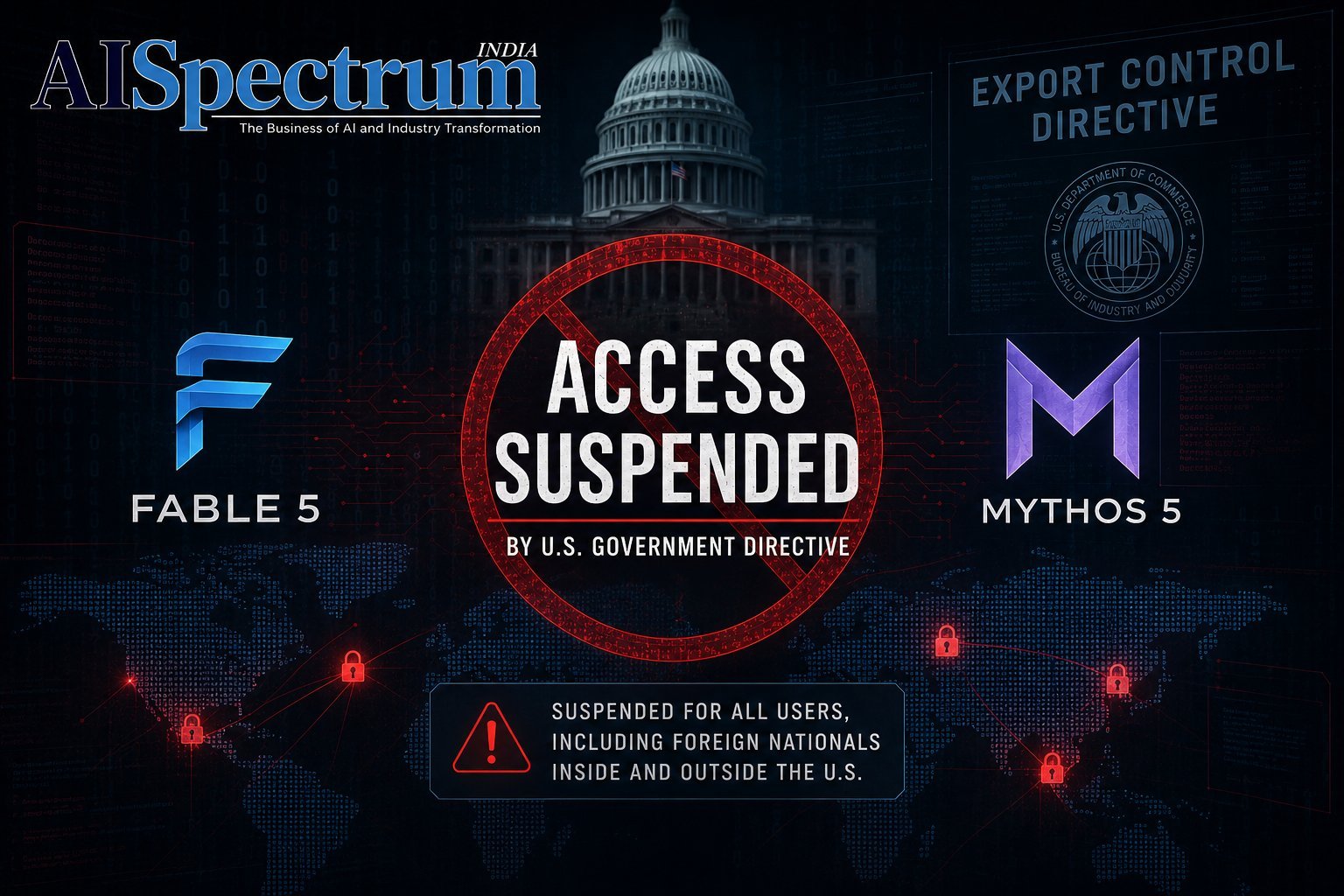
At 5:21pm Eastern on Friday, a letter arrived. By Friday evening, two of the most capable AI models in commercial deployment were dark — not throttled, not patched, not quietly deprecated, but switched off for every customer on Earth. Anthropic's Fable 5 and Mythos 5, launched only days earlier to benchmark-topping fanfare, were gone before most of Asia had woken up.
This is, as far as anyone can tell, the first time a leading AI company has taken a publicly deployed frontier model offline because a government told it to. That sentence deserves to be read twice. We have spent three years debating AI governance in the abstract — voluntary commitments, safety institutes, evaluation regimes, the theoretical question of whether anyone could actually stop a model already in the wild. On Friday the abstract became concrete. The off-switch exists. It was found. It was used.
And almost everyone is now arguing about the wrong thing.
The fight you're being invited to have
The story has already split into two camps, and both are loud. One says this is naked overreach: a government recalling a product used by hundreds of millions over what the vendor itself characterises as a narrow, non-universal vulnerability — one that, by Anthropic's account, other publicly available models can reproduce without any bypass at all. The other camp says national security actors don't move this fast without reason, that there must be more here than the public statement reveals, and that a company with a commercial incentive to keep selling is not a neutral narrator of its own model's danger.
Both camps are arguing about the merits of the jailbreak. Was it real? Was it serious? Did the technical finding justify the response? It is a genuinely interesting question, and it is almost entirely beside the point for anyone reading this from Mumbai, Bengaluru, Singapore or Seoul.
Because the most important facts of this episode are not technical. They are structural — and they were visible the moment the letter's letterhead came into focus.
Read the mechanism, not the model
This was not a recall. There is no AI-safety statute in the United States under which a regulator adjudicated a deployed model and ordered it withdrawn through a transparent, appealable process. This was an export control directive, reportedly issued by the Commerce Department, invoking national security authorities. The operative trigger is not "this model is unsafe." The operative trigger is that the model may not be accessed by any foreign national — inside or outside the United States, including Anthropic's own foreign-national employees.
That distinction is the whole story. Export control is a trade-and-security lever, not a consumer-protection or product-safety one. It is fast, it is blunt, and it carries far fewer of the due-process guardrails that a formal safety adjudication would. It was built to govern who may receive a sensitive technology, and its native unit of analysis is nationality. Applied to a cloud-served AI model that cannot practically distinguish a foreign national from a citizen at the API boundary, the only compliant move available to the vendor was to shut the model off for everyone. A determination aimed at foreign access instantly stranded the entire global user base, including the Americans it was never meant to touch.
So the precedent that matters is not "a jailbreak got a model pulled." It is "a national-security trade authority can dark a frontier model overnight, for the whole planet, on the strength of a determination the public never sees." The letter, by Anthropic's own account, did not specify the security concern. That is not a footnote. That is the regime.
The steelman you should not skip
It would be lazy to file this purely as overreach, and a serious reader should resist the temptation. There may be classified context here that neither Anthropic nor any journalist can see; security agencies routinely act on threat models they cannot disclose, and "we reviewed it and it looked minor" is exactly what you would expect a vendor to say whether or not it is true.
More importantly, the capability at the centre of this — reportedly, asking the model to read a codebase and fix its software flaws — is the cleanest example of dual-use you could construct. The same competence that lets a defender patch a vulnerability lets an attacker find one. A government genuinely worried about the proliferation of offensive cyber capability to foreign actors has a coherent, if entirely contestable, reason to restrict the most capable models from foreign access specifically. The nationality framing is not random. It maps to the worry.
And this did not happen in a vacuum. As CNBC has reported, the relationship between Anthropic and the US administration was already under strain — a defence-side supply-chain-risk designation, with litigation still ongoing. Read against that history, Friday looks less like a bolt from the blue and more like an escalation in a contest that has been building for months. Whatever else it is, it is not an accident.
You can hold all of that and still arrive at the conclusion that matters for your business, which is this: even the most charitable reading makes the situation worse for you, not better. If there are undisclosed reasons, you cannot price them. If the bar for intervention is genuinely as low as the public facts suggest, you cannot predict the next one. Either way, the variable you most need — predictability — just collapsed.
What it actually means if you build outside America
Here is the counter-take, stated plainly. For enterprises headquartered outside the United States, Friday was not a policy story. It was a concentration-risk story, and it belongs on the board agenda, not the engineering Slack.
If your AI stack has a single-model dependency on a US-domiciled frontier lab, you are now holding a geopolitical single point of failure. It can be triggered by a government you did not elect, for reasons you are not shown, on a timeline you cannot anticipate, and the first you will know of it is a status page that says "temporarily unavailable." No SLA covers a sovereign directive. No enterprise contract out-ranks an export control order. The nationality framing of this particular action should focus minds in India especially: the explicit logic of the directive is that the most capable tier of models becomes structurally less available to foreign nationals — not for reasons of price, latency or capacity, but as a matter of another country's policy.
The correct response is not panic and it is not decoupling. It is portfolio design. Multi-model architectures and provider-abstraction layers stop being engineering hygiene and become continuity insurance. Contractual continuity terms — what happens to your workloads if a model is withdrawn, what migration support you are owed — move from boilerplate to negotiated. And the strategic case for sovereign and open-weight capability strengthens, not as nationalist theatre but as a hedge you can actually control: a model whose weights you hold cannot be switched off by someone else's letter.
But keep the scope honest, because overcorrection has its own costs. The vast majority of real enterprise workloads do not run on the bleeding-edge frontier tier that was pulled. The Opus, Sonnet and Haiku class of models remains live; competing providers remain available. The lesson is not "abandon American AI." The lesson is "never let any single model become load-bearing without a tested path off it."
Nobody knows the rule, because the rule was made by action
The tell is in Anthropic's own response. The company warned that if Friday's standard were applied across the industry, it would essentially halt all new frontier deployments. That is not just an argument; it is an admission that no one knows what the standard is. There was no rule written down and adjudicated. There was a determination, and then there was an action, and the rest of us are now reverse-engineering the policy from the wreckage.
That uncertainty is the new operating environment. Every frontier lab now has to price regulatory tail-risk into its release calendar, which will slow public deployment of the most capable systems and may push the real frontier further behind closed doors and government partnerships — exactly where less of it is visible to the market that has to plan around it. And every enterprise that builds on these systems inherits a slice of that same risk whether it has priced it or not.
The firms that win the next eighteen months will not be the ones that bet on the single best model. They will be the ones whose architecture quietly assumes that any single model is revocable — and who built, before they needed it, the muscle to move.
The off-switch was always there. We just got to watch someone pull it.
Note: "This is a developing story and will be updated as new developments emerge."