

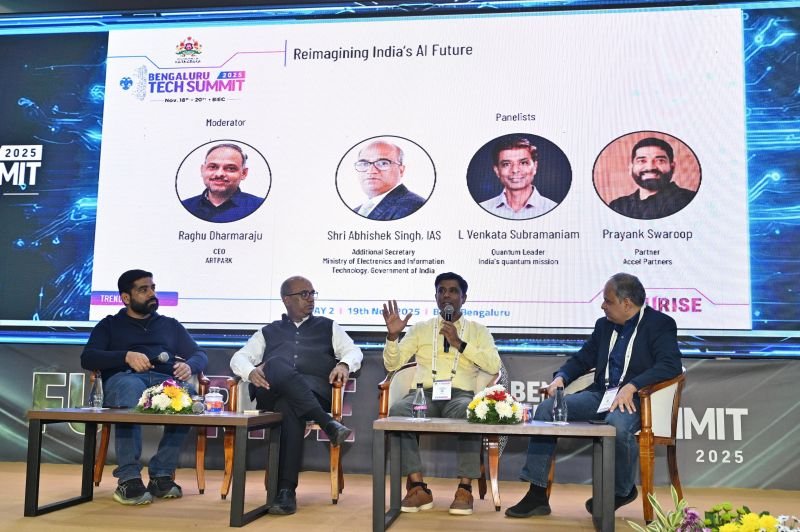
A high-impact panel discussion titled “Reimagining India’s AI Future” took centre stage at the Bengaluru Tech Summit 2025, bringing together senior government leadership, scientific visionaries and technology investors to outline how India is preparing for a decade defined by artificial intelligence and frontier technologies.
The session was moderated by Raghu Dharmaraju, CEO of ARTPARK, who set the tone by noting that India is entering “a decisive inflection point where AI is no longer an experimental add-on but a foundational force shaping how citizens live, businesses operate and innovations emerge.”
The panel featured:
Shri Abhishek Singh, IAS, Additional Secretary, Ministry of Electronics and Information Technology, Government of India
L Venkata Subramaniam, Quantum Leader, India’s Quantum Mission
Prayank Swaroop, Partner, Accel Partners
Policy Momentum and National Digital Infrastructure Lead the Way
Speaking on the country’s recent policy strides, Shri Abhishek Singh, IAS highlighted how India has rapidly built one of the world’s most comprehensive digital public infrastructures. He emphasised that the government’s upcoming AI mission, investment in high-calibre compute, and frameworks for responsible AI deployment will be central to scaling innovation safely and inclusively.
“India’s digital foundations allow us to imagine AI at population scale, not pilot scale. Our aim is to create breakthroughs that reach every citizen, every public service and every enterprise,” he said. He added that new governance models and interoperable datasets are enabling the country to unlock previously unreachable efficiencies across sectors such as health, agriculture, logistics and education.
Quantum Technologies and Compute: The Next Frontier
Providing a deep-tech perspective, L Venkata Subramaniam stressed that India’s leadership ambitions cannot rest on software innovation alone. “The next leap in AI will be powered by indigenous compute, quantum-enabled platforms and advanced hardware capabilities. India must shape this frontier if it wants to remain competitive in the global technology race,” he said.
He highlighted the progress of India’s Quantum Mission, which is nurturing national talent, building research capacity and supporting fundamental science that will underpin the next generation of secure communication, high-precision simulations and AI acceleration.
Startups and Investors Align Around AI-Native Innovation
From an investment vantage point, Prayank Swaroop noted that India’s startup landscape is shifting towards AI-native companies that are embedding intelligence into products from the outset. He pointed out that founders are addressing long-standing inefficiencies in manufacturing, BFSI, supply chains, healthcare and consumer services.
“What we are witnessing is not incremental automation but the redesign of entire workflows and industries. Capital is flowing towards deeptech founders who combine domain expertise with a bold, globally competitive vision,” he added.
AI as a Transformational Force Across Indian Industry
Across the panel, a clear message emerged: AI is no longer a futuristic concept but a national capability reshaping how India builds, scales and serves. The speakers underlined that AI is making research more efficient, business operations smarter and innovation cycles significantly shorter.
The discussion highlighted breakthroughs already visible in healthcare diagnostics, predictive agriculture, intelligent manufacturing and public-service delivery. The panel agreed that India’s mix of talent, infrastructure and policy direction offers a unique opportunity to create AI solutions that are inclusive, trusted and tailored to real-world challenges.
A Vision for an Intelligent, Inclusive and Future-Ready India
Moderator Raghu Dharmaraju closed the conversation by noting that India’s AI journey is ultimately about creating technology that works for everyone. “We have the ingredients — talent, governance, entrepreneurial energy and scientific depth. What matters now is executing with focus and ensuring benefits are shared widely and responsibly,” he said.
The session left delegates with a renewed sense of urgency and optimism: India is not just preparing to adopt AI — it is preparing to lead.