

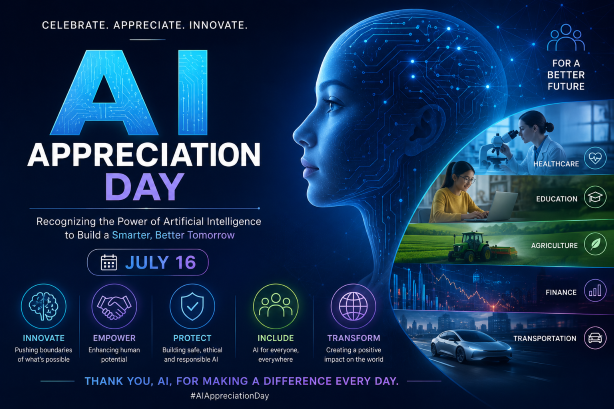
Every year on 16 July, the global technology community marks AI Appreciation Day, an occasion that recognises the transformative role artificial intelligence has come to play across industries and everyday life. More than a celebration of technological progress, the observance has evolved into an opportunity to reflect on how AI is reshaping economies, workplaces, healthcare, education, finance, and public services while reinforcing the need for responsible innovation.
AI Appreciation Day is a community-driven initiative that has steadily gained global recognition since its inception in 2020. As AI adoption accelerates and generative AI becomes increasingly mainstream, this year's observance carries greater significance than ever before, placing equal emphasis on technological advancement, ethical governance, and public trust.
From a Community Initiative to a Global Movement
AI Appreciation Day was established in 2020 by authors and AI educators Tom Taulli and Pete Mack to encourage broader public engagement with artificial intelligence and its growing societal impact. The date 16 July was strategically chosen to coincide with a period of heightened technology activity and industry events in the United States.
With AI now embedded across virtually every economic sector, AI Appreciation Day 2026 reflects not only how far the technology has advanced, but also how essential it has become to modern society.
AI's Growing Impact Across Industries
Artificial intelligence is no longer viewed as a futuristic concept. It has become an integral part of daily life, quietly powering digital services that billions of people rely on every day.
From helping physicians detect diseases earlier and accelerating drug discovery to enabling personalised education platforms, improving agricultural productivity, strengthening cybersecurity, optimising financial services, and delivering round-the-clock customer support, AI is fundamentally changing how organisations operate.
Some of its most significant applications include:
Healthcare: Medical imaging, disease diagnosis, drug discovery, predictive analytics
Education: Adaptive learning platforms, personalised tutoring, automated assessments
Agriculture: Precision farming, crop monitoring, yield prediction
Financial Services: Fraud detection, credit risk assessment, robo-advisory platforms
Transportation: Route optimisation, autonomous mobility, fleet management
Customer Service: AI assistants, multilingual support, intelligent automation
Behind many of these innovations lies a common objective—improving efficiency while augmenting human decision-making rather than replacing it.
Responsible AI Takes Centre Stage
As AI systems become increasingly capable, conversations around governance have become just as important as discussions about innovation.
Industry leaders and policymakers now recognise that building trustworthy AI requires more than powerful algorithms. It demands fairness, transparency, privacy, accountability, and inclusivity throughout the AI lifecycle.
Key principles shaping responsible AI include:
Developing models using representative datasets to minimise bias
Making AI decision-making more transparent and explainable
Protecting personal data through privacy-by-design approaches
Holding organisations accountable for AI-driven outcomes
Ensuring AI technologies remain accessible across languages, cultures, and communities
Regulatory frameworks including India's Digital Personal Data Protection (DPDP) Act and the European Union's AI Act are reinforcing these principles, encouraging organisations to innovate responsibly while safeguarding human rights and democratic values.
AI's Critical Role in Fighting Financial Fraud
For India's fintech industry, AI Appreciation Day also highlights the growing importance of artificial intelligence in defending against increasingly sophisticated financial crime.
According to Hariharashudhan V K, Chief Operating Officer, Neokred Technologies, AI must now be viewed as a critical layer of digital security rather than simply another productivity tool.
"AI Appreciation Day should encourage India's fintech sector to focus on one of its biggest challenges digital financial fraud. Indian consumers and institutions have lost an estimated Rs1.25 lakh crore over the past three years, while fraudsters now operate at machine speed. Defending against these threats requires AI systems that can respond just as quickly."
He noted that AI has become indispensable in identity verification, Know Your Customer (KYC) onboarding, and transaction monitoring, where machine learning models analyse behavioural signals, transaction velocity, device fingerprints, and network anomalies in milliseconds far beyond human capability.
"While generative AI often captures the headlines, equal recognition should be given to AI systems working silently behind the scenes to prevent fraud, safeguard privacy, and maintain compliance. AI that respects user consent, supports data minimisation, and creates transparent audit trails while delivering real-time risk decisions represents some of the industry's most important engineering achievements."
Hariharashudhan added that the fintech ecosystem should recognise the teams developing trusted AI infrastructure that enables regulators, banks, and consumers to transact securely without ever noticing the technology working in the background.
Building Voice AI That People Can Trust
The rapid adoption of conversational AI is also transforming how organisations engage with customers, patients, job seekers, and citizens.
Subhash Kalluri, Founder of FreJun, believes the industry's focus should extend beyond automation to ensuring AI strengthens trust during critical human interactions.
"Voice AI now participates in some of the most sensitive conversations businesses have whether a patient booking a medical appointment, a candidate discussing a career opportunity, or a customer resolving a financial issue. AI is no longer simply automating tasks; it has become part of moments that require trust between individuals and institutions."
Kalluri emphasised that AI systems making recommendations or decisions affecting people's lives must be built on strong governance foundations.
"Responsible AI cannot be treated as an afterthought. Data protection, consent management, call auditing, transparency, and clearly defined escalation mechanisms should be embedded into the infrastructure from the beginning rather than added later."
He explained that FreJun has prioritised compliance and governance as core design principles rather than regulatory obligations.
"Our objective has never been automation for its own sake. AI should eliminate repetitive work while allowing recruiters, sales professionals, and customer support teams to focus on situations requiring empathy, judgement, and meaningful human interaction. A human-first AI future is one where technology earns trust because people's interests remain at the centre of every design decision."
Looking Beyond Innovation
AI Appreciation Day serves as a reminder that the success of artificial intelligence will not be measured solely by increasingly powerful models or rapid technological breakthroughs.
Its long-term impact will depend on whether organisations can deploy AI responsibly, earn public confidence, protect privacy, reduce bias, and ensure the technology remains transparent, inclusive, and accountable.
As AI becomes more deeply integrated into business and society, appreciation must extend beyond the technology itself to the researchers, engineers, policymakers, and organisations working to ensure AI remains safe, ethical, and beneficial for everyone.
On AI Appreciation Day 2026, the message is increasingly clear: the future of artificial intelligence will be defined not only by what AI can do, but by how responsibly humanity chooses to use it.