


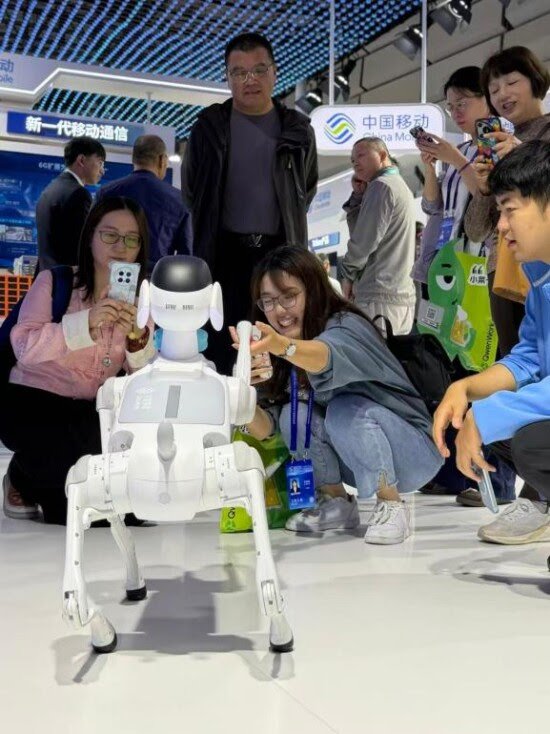
China's robotics industry showcased its progress in developing machines for real-world applications at the World Internet Conference Wuzhen Summit, which concluded in Wuzhen, eastern China. From robots preparing coffee and performing choreographed routines to machines designed for emergency response, the demonstrations highlighted the expanding role of robotics and artificial intelligence (AI) in everyday and industrial settings.
At the summit's ‘Light of Internet’ Expo, companies including Unitree Robotics, AgiBot and UBTECH presented their latest robotic technologies, demonstrating advances in machine capabilities and potential applications beyond exhibition environments.
One of the exhibits that attracted attention was Unitree Robotics' GD01, a robot designed for emergency-response scenarios. American content creator Evan Kail, who visited the expo, said the machine reflected the rapid progress of China's robotics sector. He noted that while Unitree's robots were previously widely recognised for their dance performances at televised gala events, newer developments pointed towards more practical applications, including disaster response and search-and-rescue operations.
"The leaps of technology in China are very impressive," Kail said. "As climate change gets worse and worse, robots like this can make a difference if they are used to save lives."
The demonstrations reflected a broader shift in robotics development, from entertainment-focused displays towards applications in emergency services, industrial environments and public spaces. However, deploying robots reliably in complex real-world settings requires more than advances in hardware.
Connectivity and computing infrastructure will also play an important role in supporting AI-powered robotics. Robots operating in crowded urban environments, disaster zones and industrial facilities need to process large volumes of data, respond to changing conditions and support timely AI-driven decisions. High-speed networks, low-latency communications and computing capabilities closer to the point of operation are therefore becoming important components of the broader robotics ecosystem.
The developments showcased at Wuzhen underline how robotics, AI and advanced connectivity are converging to support more practical applications. As the technology advances, the focus will increasingly be on translating demonstrations into reliable systems capable of performing useful tasks in real-world environments.