

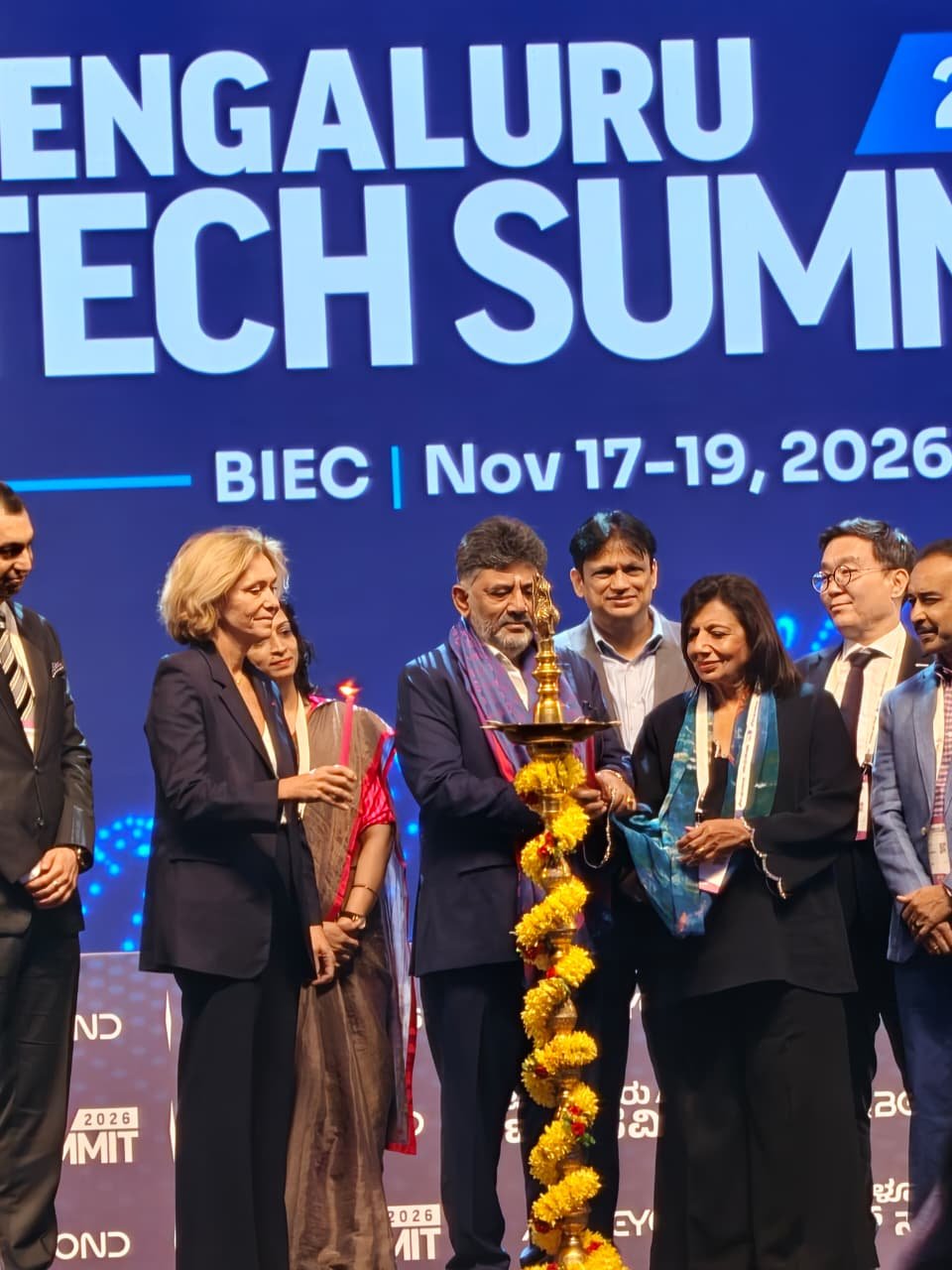
The 29th Bengaluru Tech Summit (BTS) 2026 opened on November 17 with a call for businesses, governments and technology leaders to move beyond artificial intelligence (AI) adoption and focus on delivering measurable real-world impact. Held under the theme ‘AI and Beyond’, the inaugural session highlighted Karnataka’s ambitions in AI and deep-tech, the importance of workforce development and growing international research and innovation partnerships.
Karnataka Chief Minister D.K. Shivakumar invited global technology companies, investors, researchers and entrepreneurs to collaborate with the state in developing emerging technology sectors.
The inaugural programme was also attended by Priyank Kharge, Karnataka Minister for Home, IT and BT; Kiran Mazumdar-Shaw, Founder of Biocon; and Dr Ajay Dharam Singh, Karnataka Minister for Minor Irrigation and Science and Technology.
Karnataka strengthens its AI and deep-tech roadmap
Shivakumar outlined Karnataka’s technology priorities across artificial intelligence, robotics, semiconductors, biotechnology, space technology and the blue economy. He highlighted the state's startup ecosystem and its efforts to help deep-tech companies move beyond early-stage funding through research infrastructure, industry partnerships and access to customers.
He reiterated the state's plans to establish a government-driven AI university and highlighted an AI centre of excellence at IIT Raichur. The initiative is expected to extend AI applications to 13 districts of North Karnataka, with potential applications across agriculture, healthcare, education and small businesses.
He also highlighted the Nipuna Karnataka skilling initiative and collaborations with global technology companies to strengthen workforce readiness.
Emphasising the challenges faced by deep-tech startups, Shivakumar said financial grants alone were insufficient to support commercialisation and scale. Access to laboratories, infrastructure, patient capital and customers willing to adopt emerging technologies would be equally important. The state’s accelerator and startup procurement initiatives are intended to bridge the gap between innovation and commercial deployment.
“My state does not just innovate for India, but it creates for the entire world,” he said.
Microsoft calls for measurable AI outcomes
Puneet Chandok President, Microsoft India & South Asia urged organisations to move beyond experimenting with and adopting AI towards implementing solutions that deliver tangible outcomes.
Drawing parallels with India's space programme, he recalled how ISRO used a bullock cart to test satellite antennas in 1981, highlighting the importance of taking action with available resources rather than waiting for ideal conditions.
“AI adoption is the easy part,” Chandok said. “What lies beyond AI adoption is the hard part, which is impact—which is real impact on the ground.”
He cited Shiksha Copilot, developed by Microsoft researchers in Bengaluru in collaboration with the Shikshana Foundation, as an example of AI being applied to address practical challenges in education. The tool assists teachers in preparing lessons in English and Kannada, incorporating locally relevant contexts and examples.
According to a study involving more than 1,000 teachers in Karnataka, cited by Chandok, the solution helped teachers save two hours every week.
“Adoption is a log-in,” he said, emphasising that the real measure of AI success should be the value it creates for users rather than the number of people accessing a technology.
Chandok also highlighted Microsoft's ambition to train 20 million Indians in AI by 2030. He stressed that developing human capabilities and expanding access to AI skills would be critical to ensuring that India benefits from technological advancements.
“If it works for 1.5 billion people in India across 22 official languages, it will work for the world,” he said.
Karnataka and France strengthen innovation ties
Valérie Pécresse, President of the Regional Council of Île-de-France, highlighted opportunities to deepen collaboration between Karnataka and France's Paris Region across AI, biotechnology, research and entrepreneurship.
She referred to the declaration of intent signed between the two regions in January 2024, which has led to collaborations including an AI agreement with the International Institute of Information Technology Bangalore and the participation of Karnataka startups at VivaTech in Paris.
Pécresse also highlighted a memorandum of understanding scheduled to be signed between Genopole and C-CAMP to strengthen cooperation between their biotechnology ecosystems and accelerate the development of innovations with potential applications in healthcare.
She invited Indian researchers and entrepreneurs to explore opportunities in France, noting that Choose Paris Region could facilitate connections with potential partners and organise tailored visits for research, engineering and industrial projects.
The inaugural session underscored the importance of translating technological innovation into measurable outcomes through investments in infrastructure, talent development, research and cross-border partnerships. As AI adoption accelerates, the discussions highlighted the need for organisations and governments to focus on practical applications that can create value across industries and public services.