


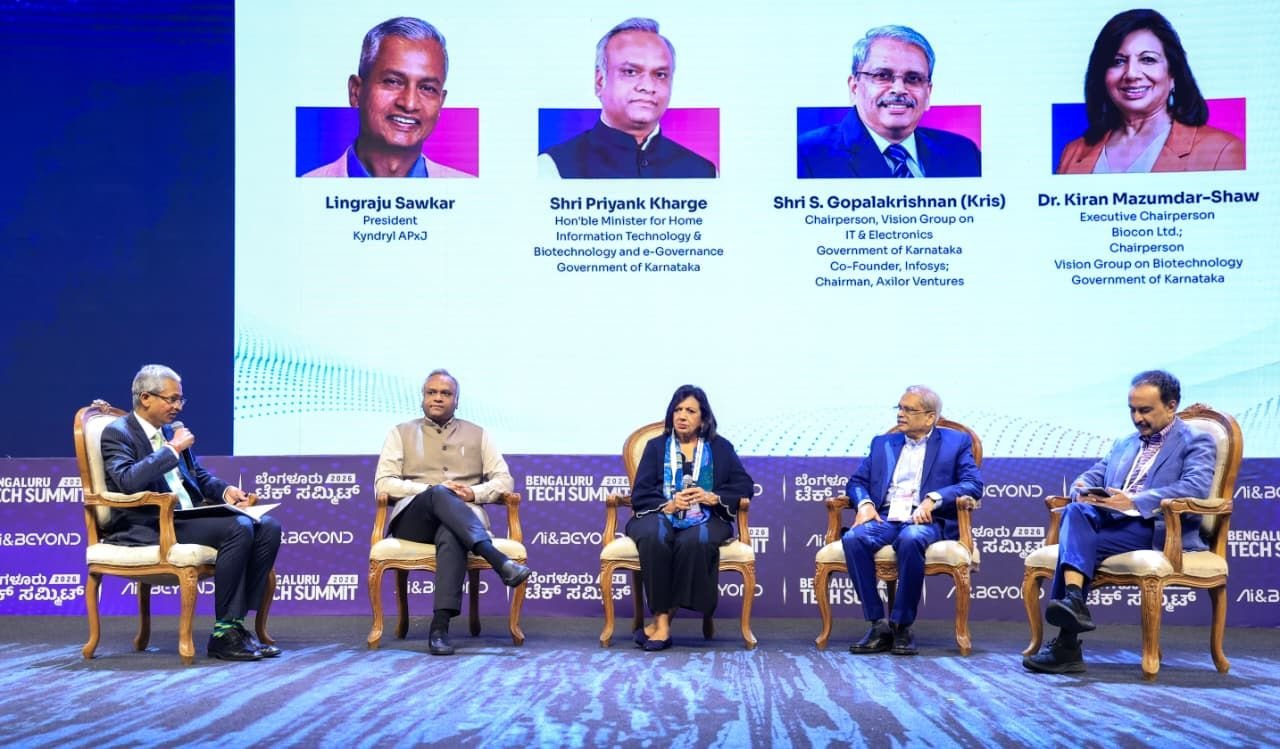
Artificial intelligence (AI) could unlock solutions to some of the world's most complex and long-standing challenges, with its next phase of growth driven by applications that deliver impact at population scale, industry leaders said at the Bengaluru Tech Summit (BTS) 2026. During a panel discussion titled ‘AI & Beyond: Emerging India’, policymakers, technology executives and investors discussed how AI could reshape India's technology ecosystem, public services and key industries.
Moderated by Lingraju Sawkar, President, APxJ, Kyndryl, the discussion featured Priyank Kharge, Karnataka Minister for Home, IT and BT; S Gopalakrishnan, Co-founder of Infosys; Kiran Mazumdar-Shaw, Chairperson of Biocon Group; and Prashanth Prakash, Founding Partner of Accel India.
Karnataka explores AI applications in governance
Kharge highlighted the Karnataka government's efforts to integrate AI across government departments, including cybersecurity and governance. The state is also working with startups to develop technology-led solutions to improve public service delivery.
“We ensure that we have the first mover advantage when it comes to using technology across all our departments,” he said.
He noted that the growing adoption of AI presents an opportunity for governments to understand the technology's potential and develop solutions that can be scaled across wider sections of the population.
However, access to and effective utilisation of data remain significant challenges for AI development in India.
AI reshapes software development and IT services
Gopalakrishnan highlighted the impact of AI on the software and IT services industries, particularly through the automation of coding processes.
He said AI is creating opportunities to develop new products and services while enabling the industry to rethink existing technology architectures. Although IT outsourcing will continue, AI offers an opportunity to reimagine the technology stack and explore new business models.
The technology is also opening up possibilities in areas where problems have remained unresolved, including mathematics and biology.
One emerging change in software engineering is the growing importance of reviewing, debugging and certifying AI-generated code, alongside traditional software development skills.
AI could accelerate drug discovery and healthcare innovation
Mazumdar-Shaw described AI as a means of accelerating intelligence, particularly in complex scientific fields such as biology. She said the technology could simplify biological research and accelerate discoveries in drug development, disease understanding and diagnostics.
“Biology is the most important frontier for AI to be deployed. Because if you know how to deploy AI to unravel the mysteries of biology, you can unravel so many other things,” she said.
She added that AI could help researchers identify connections between biological data and accelerate the development of next-generation medicines.
“The real opportunity from AI is taking molecules faster from lab to clinic to patients,” she said.
Affordability and accessibility define AI's larger opportunity
Prakash emphasised that AI's greatest opportunity lies beyond improving the efficiency of existing products and services. Instead, its transformative potential is in making essential services more affordable and accessible to hundreds of millions of people.
He identified rural India as one of the most significant areas where AI could create value, while acknowledging the challenges of developing solutions suited to diverse local requirements.
Delivering AI-led services to rural communities requires addressing multiple dimensions, including identifying the right technology, understanding local needs and determining how solutions can be implemented and scaled.
The panellists also stressed the importance of reviewing existing processes as AI-driven automation expands. They highlighted the need for appropriate governance frameworks to ensure responsible deployment and effective oversight of the technology.
The discussion underscored that India's AI opportunity extends beyond enterprise productivity and automation. Its larger potential lies in addressing complex challenges across healthcare, agriculture, governance and public services through affordable, accessible and scalable applications.