


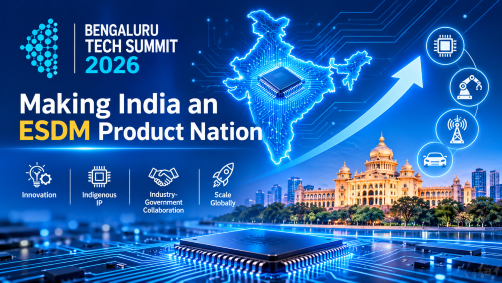
India needs to transition from manufacturing electronic products for global brands to developing and owning its own technology products, according to industry leaders participating in a panel discussion at Bengaluru Tech Summit (BTS) 2026.
The session, titled “Making India an ESDM Product Nation”, brought together investors, technology entrepreneurs and industry executives to discuss the opportunities and challenges in building India's Electronics System Design and Manufacturing (ESDM) ecosystem.
Moderated by Pradeep Vajram, Co-founder and General Partner, Seven Raise Ventures, the panel featured Deepak Shapeti, Co-founder and CEO, Morphing Machines; Arnab Roy, Co-founder, Managing Director and CEO, Tejas Networks; K. Sridhar, CEO, SFAL; and Rajeev Naidu, Head of Enterprise Business, ACT.
Opening the discussion, Vajram highlighted the gap between India's electronics consumption and domestic production. He said India consumes approximately $216 billion worth of electronic products annually, produces around $150 billion and exports approximately $49 billion. Only an estimated $8 billion to $12 billion of the market comes from indigenous Indian brands.
He emphasised that India has engineering talent, domestic demand and supportive government policies, but needs to strengthen its capabilities in product development, IP ownership, customer relationships and independent product roadmaps rather than remain focused on contract design and manufacturing.
Building Complete Technology Products Beyond Semiconductor Design
Deepak Shapeti highlighted the need for stronger system-level product development capabilities in India. He said the country's historical emphasis on services has created a shortage of system builders capable of integrating semiconductor technologies with software to develop complete products.
He also stressed that hardware startups require patient, long-term capital, given their extended development and commercialisation cycles. While commoditised markets face intense price competition, strategic segments such as defence electronics offer opportunities for indigenous technology solutions.
Leveraging India's Domestic Market to Build Global Products
Arnab Roy shared lessons from Tejas Networks' 26-year journey, highlighting the importance of working closely with domestic customers to understand real-world requirements and develop relevant products.
He said India's cost-competitive and demanding telecom market can provide domestic technology companies with the experience needed to compete internationally. Roy also noted that Tejas Networks has started investing in 6G technology alongside its ongoing 4G and 5G deployments.
Local Infrastructure Challenges Create Technology Opportunities
From the perspective of enterprise technology buyers, Rajeev Naidu highlighted the importance of developing products suited to India's cost-sensitive market.
He pointed to opportunities in addressing infrastructure challenges through innovations such as integrated power backup in routers and wireless radio frequency (RF) technologies in locations where fibre connectivity is not economically viable.
Such solutions could also find markets in other developing economies, including countries across Africa. Naidu identified edge security and device authentication as emerging technology opportunities and highlighted the role of incubators such as IISc and IIT Madras Research Park in helping startups accelerate product development and commercialisation.
Bridging the Gap Between Prototypes and Mass Production
- Sridhar highlighted India's strengths in semiconductor design and startup talent, particularly in Karnataka, but pointed out that moving from a working prototype to large-scale manufacturing remains a significant challenge.
He called for dedicated policies and infrastructure support to help system-level product companies scale their innovations into commercially viable products.
The panel also discussed changing investment patterns in the deep-tech ecosystem. Government-backed Research, Development and Innovation (RDI) funds are encouraging traditional software-focused investors to explore hardware and deep-tech opportunities.
Panellists suggested that enabling startups to develop subsystems for global manufacturers and offering more favourable tax treatment for long-term deep-tech investments could further strengthen India's product development ecosystem.
Industry Collaboration Critical to Building Indian Technology Brands
Concluding the discussion, Vajram outlined three priorities for accelerating India's transition into an ESDM product nation: buyers must become early customers for Indian product companies, investors must provide patient capital suited to hardware development timelines, and founders must move beyond service-led business models to build proprietary IP and own their product roadmaps.
The discussion highlighted that India's ambition to become a global electronics product hub will depend not only on expanding manufacturing capacity but also on strengthening indigenous innovation, system-level engineering, commercialisation and long-term investment in technology development.