


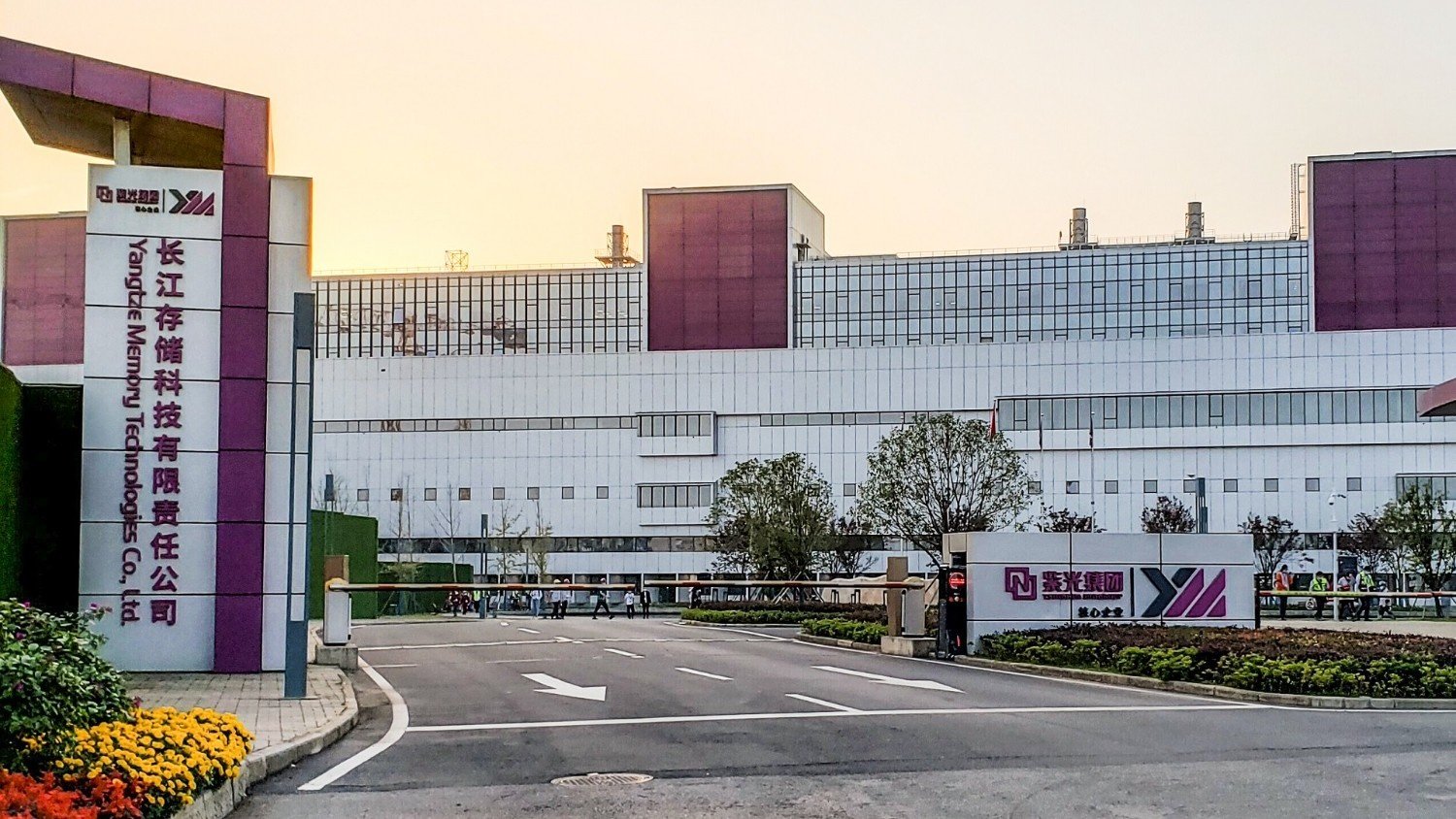
The main NAND flash memory chip producer of China is moving forward with its planned expansion in spite of being blocked from American technology and markets because of security concerns.
According to the sources who are close to the issue and are talking to Nikkei Asia, Yangtze Memory Technologies Corp. (YMTC) has started the construction of its third plant in Wuhan which is going to be operational in 2027. In the meantime, the firm is also increasing the production of its second facility.
Fast Growth in Production Capacity
The development of the company's production facilities is remarkable even with constraints put on it. The Nikkei Asia's industry leaders revealed that if the enlargement continues as planned, the maker might capture more than 10% of the world's production capacity market next year and even surpass Micron to become the fourth largest player in the world within two years.
YMTC is estimated to have around 7% to 8% share of global production capacity in 2025. Nevertheless, it is not the same in terms of revenue where the picture is not very bright – YMTC only accounted for less than 5% of the total global market as of Q2 2025 according to Omdia, a research firm. The disparity is due to the company's concentration on the Chinese local market which is characterized by lower prices and margins compared to the international sales.
The capital expenditure of YMTC has been more aggressive than that of its global competitors in 2025, representing about 20% of the total investment in NAND flash memory for the world. Omdia anticipates that the investment will keep on rising.
The AI aspect
According to two sources speaking to Nikkei Asia, YMTC is also pondering over the idea of venturing into the production of DRAM (dynamic random access memory) chips, which are the building blocks for high-bandwidth memory (HBM) predominantly used in AI data centres.
This action would enable the company to compete with the market's hottest segment of the semiconductor industry. Data centres require both DRAM and NAND flash memory as their essential components.
This strategy would place YMTC in a good position to take on one of the most lucrative market areas of the semiconductor sector. Data centres, computers, smartphones, and other electronic devices all require both DRAM and NAND flash memory as their main materials. The global tech firms are competing very vigorously for the supply of these critical components because of the AI infrastructure supply constraint issue, and YMTC's enlargement may assist in reducing the pressure – at least in China.
Not just the US blacklist issue
Now, let’s get to the rather complicated part of it, YMTC was put on America's Entity List due to security worries in 2022, which greatly impacted its production and technology advancement. The firm was cut off from top-tier US-made equipment provided by companies like Lam Research, as well as foreign technical support.
It was a very painful situation in terms of timing. Apple had completed verification of YMTC’s NAND flash memory products in 2022, which would mean that the Chinese chipmaker could become a global tier-one supplier, but the escalating geopolitical pressure resulted in Apple withdrawing YMTC's products, as first reported by Nikkei.
Bypasses and solutions
For two years, YMTC has been trying to find substitutes for the manufacturing tools and materials that are restricted. The company has achieved some of the most significant technical challenges, especially in the vital etching process, with the help of local semiconductor equipment maker AMEC.
These innovations have allowed YMTC to keep pushing production forward even though it lost access to the best American equipment. It is a sign of China's commitment to becoming self-sufficient in the semiconductor industry, even if the route is longer and more costly than importing the technology from established players.
The broader Chinese memory landscape
In the conflict for memory chip independence, YMTC is not the only company in China. The nation has ChangXin Memory Technologies (CXMT), a DRAM manufacturer who is now the fourth-biggest player in the global memory market after Samsung, SK Hynix, and Micron.
CXMT is providing HBM for domestic AI demand, as such components are subjected to US export controls, according to a Nikkei report. The Chinese firm has concluded the life cycle of the more mature DDR4 grade of DRAMs and is working to lower the barrier to the more advanced DDR5 level that most leading manufacturers are building HBM on.
Along with YMTC, CXMT is the second half of China's plan to be self-sufficient in memory chips: NAND flash and DRAM chips respectively.
What this means globally
NAND production has always been a monopoly of a few suppliers: Samsung Electronics, Kioxia Holdings, SanDisk, SK Hynix, Micron, and Solidigm. YMTC's rise, despite US restrictions, is a factor in reshaping the entire landscape.
Globally, the situation is quite complex with respect to the market as far as the timeline of YMTC's expansion is concerned. One argument is that the new capacity will help in cutting down the supply that has been the main reason for prices to be high and in fact the prices could come down. But then, the issue of security and geopolitical tensions makes Western governments as well as companies very cautious when it comes to Chinese semiconductor suppliers.
The India connection
The path of YMTC is very instructive for Indian companies and policymakers. India is moving towards the establishment of its own semiconductor manufacturing, but that is at very nascent stage compared to China. The case of YMTC stepping around US restrictions – developing domestic alternatives to American equipment, albeit with lower performance – gives a clue about the potential and limitations of the self-sufficiency of technology.
It also emphasizes the strategic significance of memory chips during the AI revolution. India, as it slowly develops its AI infrastructure and abilities, will inevitably require reliable access to NAND and DRAM – through imports, domestic production even partnerships – which will increasingly become the critical factor.
Bottom line
The case of YMTC's expansion, although under the US ban, is sufficient to point out a major shift in the global semiconductor trends. The rules of geopolitics seem to be breaking the global supply chain that had been relatively integrated thus far. China keeps on developing its own capabilities that may not be as advanced as the West but are certainly very fast.
In case the company's intention to venture into DRAM and HBM production turns into reality, then it will be a giant leap towards semiconductor independence for China. However, it is still unclear whether the company can reach the top-notch technical performance without the use of the most advanced American equipment. On the other hand, the company is pushing its way through by investing massively in capital, receiving domestic market support, and improving domestic equipment.
To the rest of the world, the question will no more be about whether China will have an ample supply of memory chips – the answer is yes, it will definitely be the case. The question will be about the implications of the bifurcated supply chain on global technology development, prices, and security in the world that is increasingly dependent on AI.