


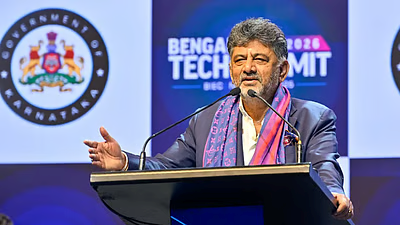
The Karnataka government has unveiled six technology initiatives to strengthen the state's artificial intelligence (AI), robotics, semiconductor, healthcare technology and deep-tech ecosystems. Announced during the inaugural programme of the 29th Bengaluru Tech Summit (BTS) 2026, the initiatives aim to expand research infrastructure, accelerate indigenous technology development, promote industry-academia collaboration and help emerging technologies move towards commercial deployment.
The initiatives cover the Karnataka AI Hub, BRAINZ (Bengaluru Robotics & AI Innovation Zone), 2D Innovation Hub, INFIfab, K-HEAL (Karnataka Health Engineering & Advanced Lifesciences) and Innoverse. Together, they reflect the state's strategy to build capabilities across emerging technology sectors and strengthen its position as a technology and innovation hub.
Karnataka AI Hub to advance AI skilling and research
Established at the International Institute of Information Technology Bangalore (IIIT-Bangalore), the Karnataka AI Hub marks an initial step towards the proposed AI University.
The initiative will focus on AI skilling, research, innovation, entrepreneurship and capacity building. It aims to develop a globally employable workforce while supporting the translation of research and ideas into real-world applications.
BRAINZ to accelerate robotics and AI innovation
The Government of Karnataka, in collaboration with ARTPARK at the Indian Institute of Science (IISc), is developing BRAINZ as a nine-acre innovation hub dedicated to robotics, AI and deep-tech.
The initiative will bring together research institutions, industry players and startups to accelerate indigenous technology development and support real-world applications. It aims to catalyse investments of Rs 1,000 crore over five years.
2D Innovation Hub to support semiconductor R&D
The state government is supporting IISc in developing a proposed national-level 200-mm (eight-inch) semiconductor research and development fabrication and pilot-line facility.
Led by IISc in collaboration with academic and industry partners, the 2D Innovation Hub is envisioned as a shared platform for semiconductor research and development. The proposed infrastructure will include an approximately 100,000 sq. ft. technology building, a 15,000 sq. ft. cleanroom and 80–90 process, metrology and testing tools.
The facility is expected to strengthen India's semiconductor research capabilities and provide infrastructure for developing and validating advanced semiconductor technologies.
INFIfab to strengthen semiconductor manufacturing research
The Karnataka government is supporting the Centre for Nano Science and Engineering (CeNSE) at IISc, Bengaluru, in establishing INFIfab, a national facility focused on semiconductor innovation, advanced manufacturing and technology translation.
The proposed facility will cover approximately 96,284 sq. ft., including a 20,000 sq. ft. cleanroom. It will support research and development across semiconductor fabrication, advanced packaging, micro-electromechanical systems (MEMS), photonics, quantum technologies and neuromorphic computing.
The initiative is expected to strengthen access to specialised research and manufacturing infrastructure while supporting the development of next-generation semiconductor technologies.
K-HEAL to strengthen healthcare technology innovation
K-HEAL (Karnataka Health Engineering & Advanced Lifesciences) is a flagship Centre of Excellence initiative of the Department of Electronics, IT & BT.
The initiative aims to strengthen Karnataka's HealthTech, MedTech and Assistive Technology ecosystems by bringing together clinicians, researchers, industry participants and startups.
Its focus will be on identifying unmet healthcare needs, developing and validating innovative solutions, and supporting their adoption. The programme will prioritise accessible, affordable and globally competitive healthcare innovation.
Innoverse to support deep-tech startups
The Innoverse Foundation ecosystem will support Karnataka-based deep-tech startups with proven technologies as they progress from product-market fit towards global industry leadership.
With a focus on autonomous systems and technologies spanning underwater applications to space, the initiative aims to help startups scale their solutions, strengthen industry connections and improve their global competitiveness.
Through these six initiatives, Karnataka is seeking to strengthen the entire technology innovation pipeline, from fundamental research and infrastructure development to startup growth and commercialisation. The focus on AI, semiconductor research, robotics and healthcare technology also highlights the growing importance of collaboration between government, research institutions, industry and entrepreneurs in developing India's next generation of technology solutions.