

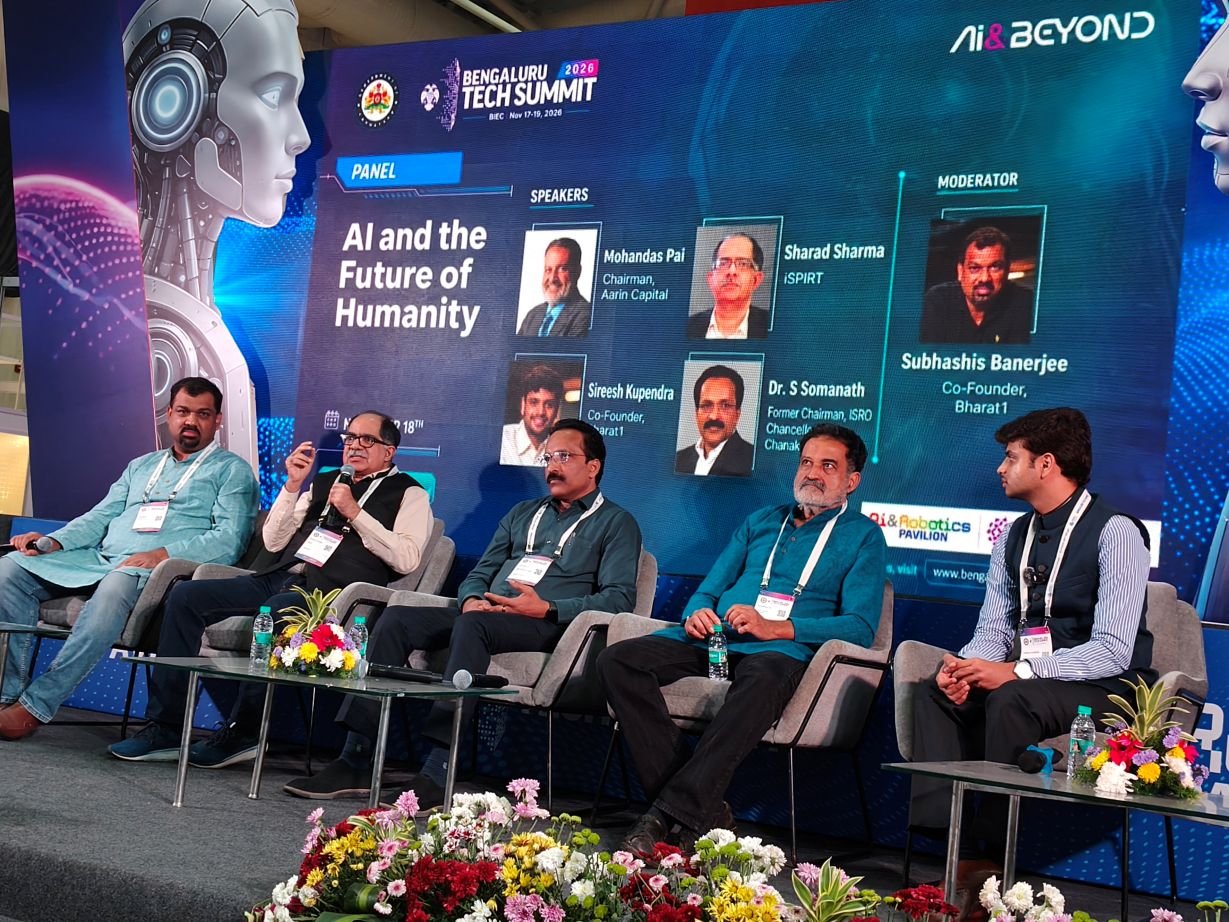
India must prioritise artificial intelligence (AI) that enhances human capabilities rather than simply automating jobs, according to iSPIRT's Sharad Sharma. Speaking during the session at BTS 2026, Sharma and other panellists examined how AI is reshaping employment, professional skills, and access to essential services, while raising concerns about automation's impact on India's workforce.
Mohandas Pai, Chairman of Aarin Capital, cautioned that AI could significantly improve productivity without creating new jobs at the pace at which existing roles are displaced. Routine and rule-based tasks are particularly vulnerable to automation, although the economics of AI adoption will differ across markets.
In India, relatively lower labour costs compared with markets such as the US could make AI-assisted human work more economically viable than complete workforce replacement. Pai also warned that concentrated ownership of AI infrastructure and models could intensify wealth inequality.
AI Could Disrupt Traditional Career Pathways
Bharat 1 co-founder Siresh Rupendra highlighted a less-discussed consequence of workplace automation: the potential disappearance of entry-level responsibilities that traditionally help young professionals develop practical skills.
Junior employees often acquire expertise by undertaking routine assignments under the guidance of experienced colleagues. As AI systems increasingly handle these tasks, organisations will need alternative approaches to provide early-career employees with opportunities to learn and gain experience.
“If it’s a ten-step ladder, the first four are missing,” Rupendra said, highlighting the challenge of building professional capabilities when AI takes over foundational tasks. He also emphasised that the ability to interact effectively with AI systems is increasingly becoming a basic literacy requirement.
Sharma called for an AI development strategy aligned with India's demographic profile and specific socioeconomic requirements. Citing the Unified Payments Interface (UPI) as an example of technology infrastructure developed to address India's needs at scale, he advocated a similar approach to AI adoption in sectors such as healthcare and agriculture.
He emphasised that India should develop solutions suited to its own cost structures and priorities rather than depend entirely on AI systems designed for other markets. He also stressed the importance of incorporating child safety into AI development.
Healthcare, Education and Governance Among Key AI Opportunities
Former ISRO Chairman Dr S. Somanath identified healthcare, education and governance as sectors where AI could deliver significant near-term benefits, particularly in communities with limited access to doctors, teachers and public services.
However, he distinguished between AI's potential in data-intensive applications and its role in complex engineering processes. AI can help analyse large volumes of satellite imagery, but core spacecraft design continues to depend substantially on conventional engineering methods.
He identified computational fluid dynamics, structural analysis and thermal modelling as areas where AI could help accelerate simulation and design cycles, potentially improving engineering efficiency.
Balancing Automation with Human Capability Development
The discussion underscored the need for a more inclusive approach to AI adoption, one that considers not only productivity gains but also the long-term development of human skills.
For India, the challenge is to harness AI to expand access to essential services, improve industrial and institutional productivity, and strengthen workforce capabilities without eliminating the entry-level opportunities through which future professionals gain experience.
As AI becomes increasingly integrated into business operations and public services, the ability to balance automation with human development could become a defining factor in India's technology-led growth.