


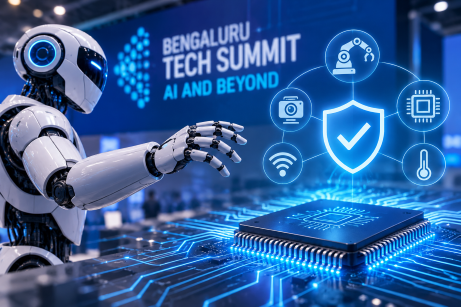
Semiconductors will play a central role in the transition from pre-programmed automation to intelligent robots capable of responding to dynamic environments, said Allan Fredericksen. As physical AI moves from software-based decision-making to real-world applications, the challenge is not merely enabling AI models to determine a robot's next action, but ensuring that the machine can execute those decisions safely.
Unlike generative AI systems that operate primarily in digital environments, physical AI systems must perceive their surroundings, process information, make decisions and translate them into physical movements. This transition has implications for a broad range of machines, including industrial robotic arms, mobile robots and humanoids.
Although these robots differ in mechanical design and application, they share common electronic requirements, including sensors, computing hardware, communication networks and safety controls.
Independent Safety Systems Critical for Physical AI
Fredericksen highlighted the importance of integrating independent safety mechanisms into robotic systems. Cameras, depth sensors and joint sensors provide information about a robot's surroundings and movements, while graphics processing units (GPUs) process this data to support planning and decision-making.
However, AI-generated commands must undergo additional safety checks before execution. Fredericksen described the role of a separate, automotive-grade safety microcontroller that can independently assess commands and prevent potentially unsafe movements. This approach allows robots to maintain a safety layer that does not depend entirely on the AI system generating the instructions.
He also highlighted Ethernet-based networking as an important component of physical AI infrastructure, enabling the transfer of increasing volumes of data between sensors, processors and controllers.
Power consumption and thermal management are additional considerations, particularly for battery-powered robots that must continuously process sensor inputs while maintaining operational efficiency.
India's Opportunity in the Physical AI Ecosystem
Fredericksen also highlighted India's potential to move beyond semiconductor consumption towards developing technologies and solutions for the global semiconductor ecosystem.
The growing adoption of physical AI creates opportunities across multiple layers of the semiconductor value chain. These extend beyond processors powering AI models to include sensors, microcontrollers, connectivity technologies and safety components that enable robots to interact reliably with the physical world.
As robotics advances towards more autonomous and adaptive operations, semiconductor innovation will be critical to ensuring that intelligent machines can not only make decisions but also execute them safely and efficiently.