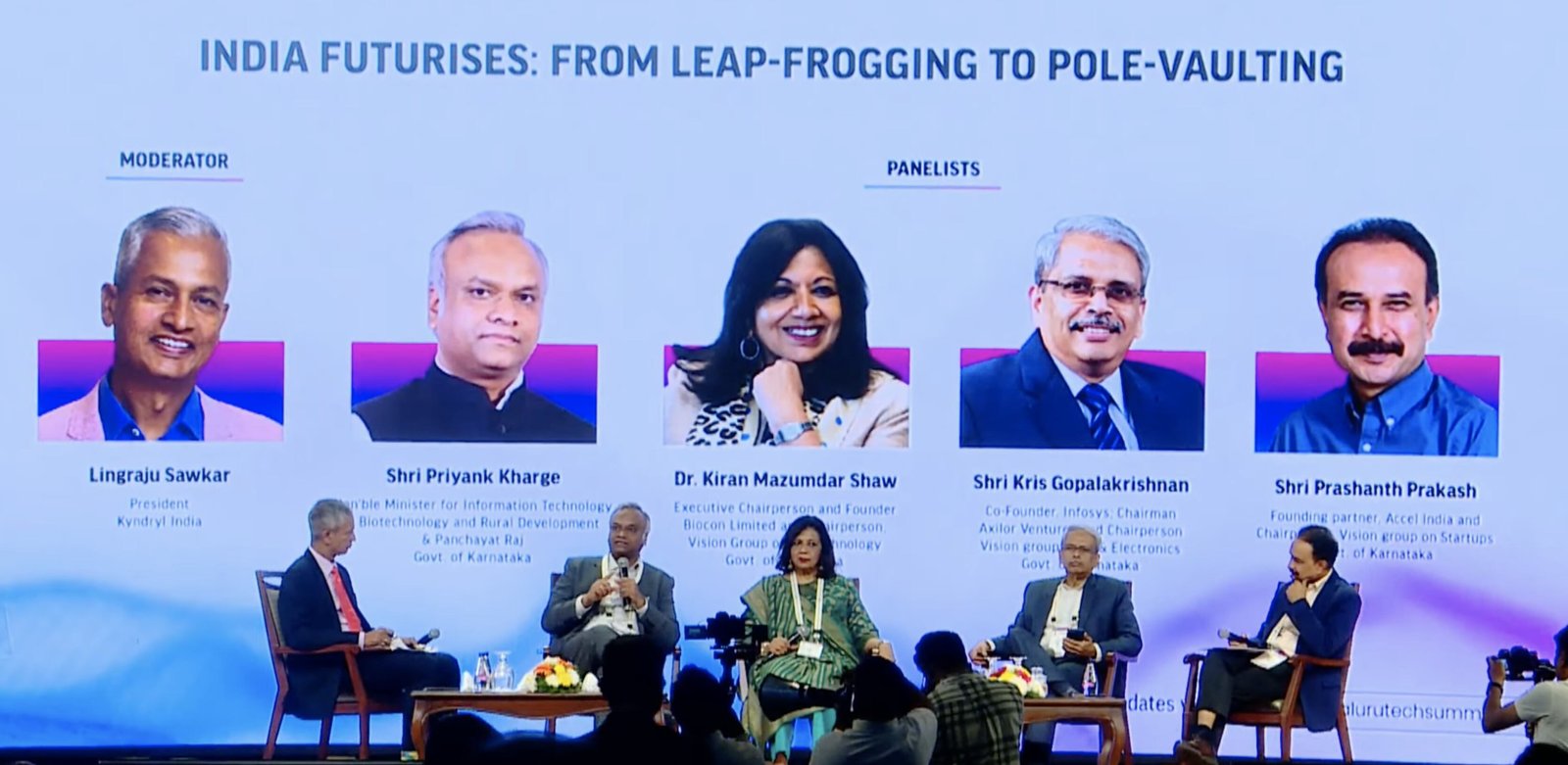
The opening plenary, India Futurises, set an assertive tone for Bengaluru Tech Summit 2025 by positioning India at the cusp of a decisive transition — from incremental catch-up to transformational pole-vaulting. The discussion moved well beyond celebratory rhetoric, instead presenting a clear and coordinated narrative of where India must compete, how it must scale and what structural shifts are needed to lead global innovation cycles.
At the heart of the conversation was a shared conviction: India’s technology ambition will be realised only through depth, not breadth. This means deeper talent pools, deeper scientific innovation, deeper capital, and deeper collaboration across disciplines that historically operated in silos.
Key perspectives from the panel included:
Priyank Kharge emphasised that Karnataka is no longer content with being seen merely as the country’s leading technology destination, but is deliberately shaping itself into a global innovation state. He described how the government’s forward looking policy architecture, combined with sustained investments in large scale R and D, specialised skilling programmes, and sector specific innovation missions, is strengthening the state’s long term competitiveness. Kharge also highlighted Karnataka’s expansive digital public infrastructure — from data exchanges and open innovation platforms to advanced e governance layers — which together create an ecosystem that global companies increasingly view as reliable, collaborative and ready for high value partnership.
Kris Gopalakrishnan brought the discussion decisively into the DeepTech arena, stressing that India’s next phase of exponential growth will depend on building robust indigenous platforms across AI, semiconductors, quantum technologies and advanced computing. He noted that while India has achieved scale in digital adoption, the country must now shift its focus to creating foundational technologies rather than merely deploying them. Gopalakrishnan emphasised that long term, defensible leadership in frontier domains will require sustained investment in core research, the creation of globally competitive intellectual property and the development of deep scientific talent pipelines capable of driving breakthroughs, not just incremental improvements.
Kiran Mazumdar Shaw highlighted convergence as India’s most powerful opportunity, emphasising the transformative potential unlocked when biotechnology, digital health, sustainability and data driven precision science begin to operate in tandem rather than in isolation. She explained that the future of innovation will be shaped at these intersections, where biological insights meet computational power, where environmental imperatives align with advanced materials, and where clinical decision making is strengthened by real time data intelligence. Mazumdar Shaw noted that such cross disciplinary fusion will not only accelerate breakthrough solutions in healthcare and life sciences, but will also give rise to entirely new industries and business models that do not yet exist today — positioning India to lead global scientific and economic shifts.
Prashanth Prakash turned the spotlight onto the startup ecosystem, noting that India has moved beyond early stage vibrancy and is now entering a phase where scale up capability will determine its global standing. He emphasised that the country can no longer rely solely on the volume of startups to signal progress; instead, it must cultivate the depth, resilience and ambition required to build world class companies. Prakash stressed the need for patient capital that supports long term innovation cycles, greater access to global markets and customers, and stronger founder support systems — from mentorship and governance frameworks to talent networks and advanced accelerator pathways. These elements, he argued, are essential for transforming promising ventures into globally competitive enterprises capable of shaping the next decade of India’s innovation narrative.
The session resonated with clarity and urgency, encapsulated by Kiran Mazumdar Shaw’s remark:
“Innovation is no longer optional. It is the currency of differentiation.”